Showing posts with label Flea Market. Show all posts

Tuesday, August 21, 2018

A Gentle Wind blew me to the Annual Furin Market in Sojiji Temple, Tokyo


Some people welcome the rains because raindrops on the roof make for a pleasant sound to fall asleep to.
I'm lucky that I need not wait for the rains to fall asleep to soothing, mellifluous tones -- 
I have a neem tree in the front yard laden with wind chimes that melodiously ring through the night. 
All my wind chimes are made of metal -- they are souvenirs of my travels to Japan where wind chimes are much loved summertime symbols -- in the sweltering heat, their light tinkling heralds the
appearance of a much needed cooling breeze. 


I can only surmise that it was a good wind that blew me, one sunny summer day in Tokyo, to the Sojiji Temple in Nishiarai.  Unbeknownst to me, the temple was holding its annual furin or wind chime market.   Someone at the temple told me that this furin market is one of the most popular in Japan.  What a serendipitous moment for me to visit!  


Japanese wind chimes are made of different materials -- from metal to ceramic to glass.  
Sojiji's furin market had hundreds of all of these types on display,  their different tones and tunes jangled merrily and somewhat chaotically each time a breeze blew by.  
These chimes had come from all over Japan, from many different regions and prefectures. 
I stood transfixed under the metal chimes -- these are the ones that I buy and collect.  
There were so many new designs that I had never seen before.  Metal chimes may not look as attractive or colourful as glass or ceramic chimes but I like their durability and the clear and round tones that they make. 
As I stood there enjoying the music they made, I was in a near state of panic -- I couldn't quite choose from among the hundreds just which ones I wanted to buy. 


The hand blown glass chimes gave off sweet, dulcet tones.   They looked like colourful and fragile bubbles swaying in the wind. Glass chimes are usually called Edo chimes since they date back to 
the Edo period when the  Dutch brought advanced techniques of glassmaking to Nagasaki. 
The Japanese quickly embraced the art of glassmaking and soon applied it to their wind chimes. 


Ceramic wind chimes come from areas well known for their pottery traditions.  This very 
kawaii ceramic chime of Kumamon could only have come from Kumamoto where their pottery tradition goes all the way back to the 17th century.  
Kumamon is my favorite Japanese mascot but sadly, I was afraid that this little ceramic bear would 
not survive the trip back home. 


All the chimes at the market were for sale.  Each one on display is tagged with a number and a price.  All I had to do was jot down the numbers of the chimes I had chosen and the ladies at the selling booth retrieved them from the available stocks, boxed, wrapped and ready to go.  
If I had a bigger suitcase I would have bought more but I was more than happy with my small haul -- quite a heavy haul as all the wind chimes were made of metal. 
Before I left, I breathed a silent thank you to the good wind that blew me here to Sojiji Temple to enjoy the symphony of sounds and colours at their once-a-year Furin Market. 


Tuesday, November 28, 2017

A Summer afternoon at Kyoto's Kitano Tenmangu Flea Market


The flea market at the Kitano Tenmangu shrine in Kyoto is held every 25th of the month, spring thru winter, rain or shine.  It's one of my favourite places to shop and I usually try to schedule my trips to include a visit to the market. 


On this trip, we opted to go after lunch avoiding the normally thick morning crowd.  
While the early shoppers would have snagged good buys, there are so many vendors and a variety 
of merchandise that you will not run out of unique and interesting finds.  And of course, as it gets nearer to closing time, most of the vendors are willing to give bigger discounts.


The huge stone lanterns lining the path are almost obscured by the many stalls.  At the very end, you can see the second torii that stands just before the impressive romon, the wooden two storey gate built in the 16th century.


You will never go hungry at the flea market.  There are numerous stalls selling all kinds of food and snacks.  Like these giant sweet potato fries that look so crisp and inviting.


The tantalising smells of this yakisoba stall waft through the market practically seizing you by the nose and inviting you to dig in. 


Want to eat as you walk?  While munching while walking is not really done in Japan, you could probably be forgiven if you could not resist this roasted sweet corn on the cob.  


'
These farmers were selling their homegrown yuzu and were even giving passers by free sips of fresh squeezed juice.  


I made a beeline for my favourite stall at the market. Since I can't read Japanese, I like to call him Bacon Man.   This guy sells rice wrapped in bacon, roasted with a teriyaki style sauce then slathered with your choice of topping.  It's chock full of umami deliciousness not to mention, fat and some cholesterol too. 


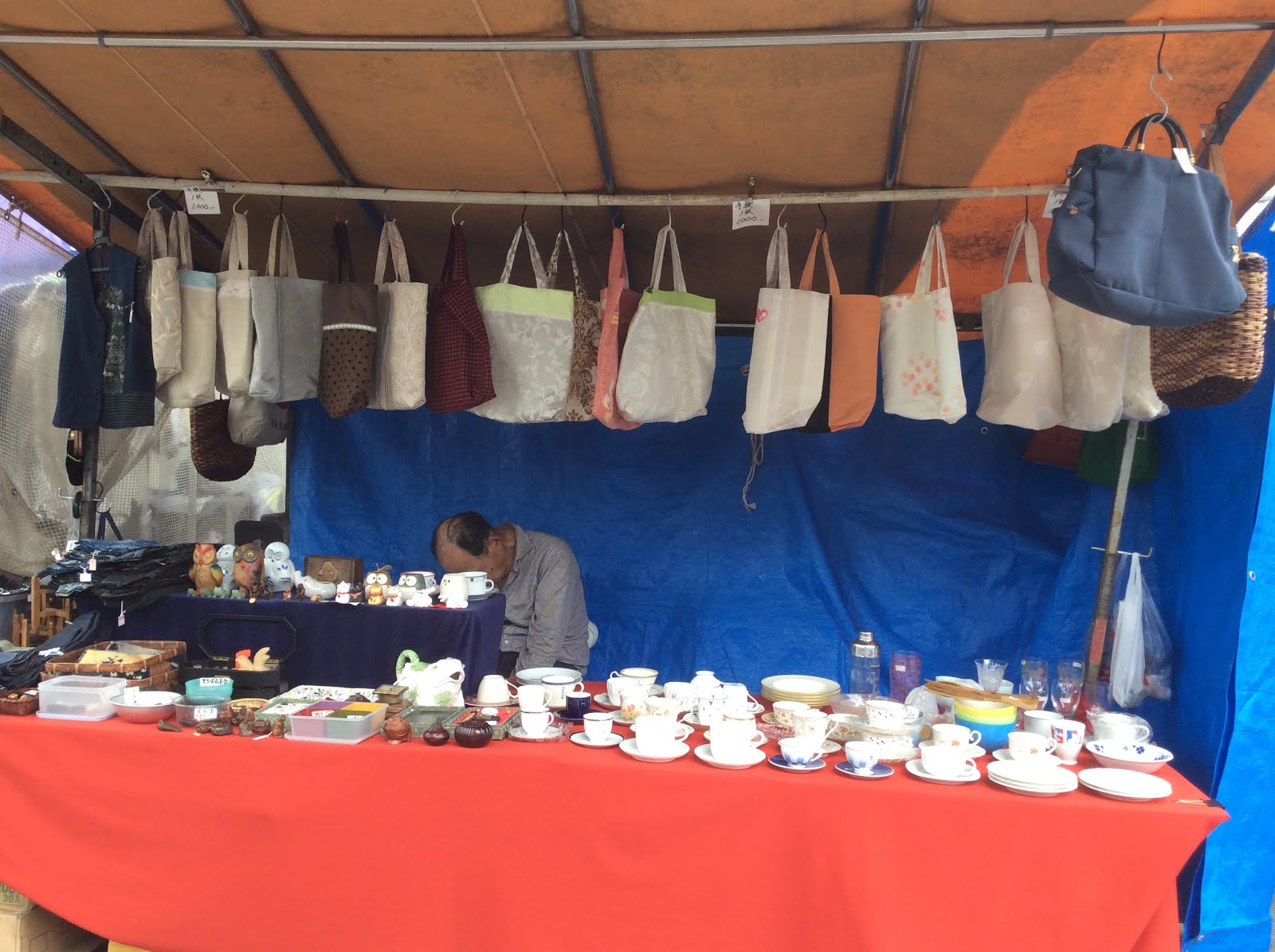
There are an assortment of stuff -- one man's junk could be your treasure.  Those hand sewn bags made of old obi are good buys.  Or how about some english style tea cups?  


I much prefer the Japanese style ceramics.  There are many sellers that have both brand new and previously used wares.  I find that the vintage used bowls and cups are more to my liking.


I am always happy to see these pre-loved obi and coats.   Some can be had for as low as 500 yen.  The more elaborate and luxurious ones can sell for so much more.  But Jay reminds me that I have bins full of these at home so I have to regretfully walk away.


This is the intricately carved, beautiful wooden gate, the romon.  The Kitano Tenmangu is popular with students who visit to pray for success in their exams and studies so it's not surprising to see young people in their school uniforms at the shrine. 


The flea market is so big, with hundreds of vendors, that the stalls spill out on the side streets surrounding the shrine.  Don't forget to explore and walk around or you might miss that one thing you were meant to buy.


I thought these wooden black boxes were so interesting, particularly the lacquer one in the foreground.  


There are more pre-loved yukatas or casual kimonos which are perfect for summer wear.  
Can you believe that these sell for just 500 yen each?


If you thought that 500 yen was a good deal, this stall offers everything you can pack in a big plastic bag for 3,000 yen (or in a small bag for 1,500 yen).  And yes, shoppers were stuffing their bags to overflowing.  It was an amazing bargain but Jay was making strangling noises behind me so I had to tear myself away.  


How about some antique cameras?  I am sure they don't work but would make nice souvenirs for a photography buff. 


Every time I go to a flea market, there is always an item or two that I like to call "the one/s that got away".  This time it was these old wooden lamps, on the top right of this photo.    
They were so unique and obviously handmade but so big and quite heavy.  They would never have fit in my suitcase or in my carry-on.


It was late afternoon and  most of the vendors had started to put their wares  away -- to be kept and stored until the next month.  
If you're planning a trip to Kyoto ....  try to be here on the 25th so you can delight in the many pleasures and treasures of the Kitano Tenmangu flea market. 


P.S


Jay and I didn't walk out empty handed.  Our favourite purchases were these light woven hats ... just perfect for walking around sunny, summery Kyoto!

SaveSaveSaveSave

Tuesday, February 14, 2017

Our Fukuoka Christmas 10 - Foraging (and feeding!) at the Hakozaki Nomi-no-Ichi


One of the few places where you can find something irresistible, quirky, unique, priceless and yet affordable is a local flea market.
In France, these are called marche aux puces (literally, market of fleas), in Madrid, the biggest is called el rastro  and in Japan, the old-timers fondly call them nomi-no-ichi.
By whatever name they are called, flea markets sing out their siren call to me and I can never resist.
I did my research before our trip to Fukuoka and found out one would be held on December 23 -- just in time for our visit. 


Flea markets open and close early so the early birds get the proverbial "worms".  
The Hakozaki -gu Flea Market opens at 7:00 so we set off right after breakfast. 


The bus ride to  Hakozaki-gu took a little over 30 minutes.  I had been here last June but Jay and Gani had not,  so a visit to this third most important Hachiman shrine in Japan was the first priority.   There were more pigeons than shrine goers this early in the morning.


Hakozaki-gu's entrance is guarded by a huge stone torii.  Beyond it is the Hakozaki  Nomi-no-Ichi.  
Some major temples and shrines in Japan hold regular flea markets as the grounds are usually extensive and can accommodate many stalls and shoppers.  
In Kyoto, there are monthly flea markets at To-ji and Kitano Tenman-gu that are extremely popular with both locals and visitors alike.


There are over 200 stalls at the market -- it is probably Kyushu's largest and certainly one of the biggest in Japan.


This shopper has already snagged a prize -- a fabric covered footstool plus some more items in her shopping bag.  Perhaps she's on her way home. 


Like any flea market,  there are all sorts of items for sale, some of it new but most are "pre-owned"
or "pre-loved".
Vendors have set up their stalls from behind their parked vehicles with merchandise carefully arrayed on folding tables.  
This reminds me of Paris week-ends spent at my favourite Marche aux Puces de la Porte de Vanves where cars and even light trucks are squeezed side by side with items for sale spilling out onto the sidewalk.
Of course this being Japan -- things are a lot more neat and orderly.


Jay and I had been looking for a cast iron tea pot and we saw several "good as new" examples at the market.  They were well below department store prices so we were happy to have finally bought
one.


The comical slightly ribald tanuki (a fairytale racoon like creature) is a common sight outside izakayas. Carrying its little sake flask,  it invites you to drop by and have a drink.  We bought a
small tanuki statue from this friendly vendor who gave us a discount -- even before we had asked
for one.
By the way,  as in all flea markets,  good natured and fair haggling is allowed! And in Japan, a
polite  greeting and smile will certainly go a long way.


At every flea market I go to, there is always a stand-out item that I really want but know that I
cannot bring home.  I recall, with some regret --  antique light sconces, ceramic topped apothecary jars, vintage steamer trunks (!),  a large beautiful green leather suitcase ---  and other one-of-a-kind finds that were too fragile or too heavy to lug back home.
Today's most wanted item was this vintage bamboo and rattan rocking chair that stopped me dead in my tracks.  It was definitely a find but would never have fit in my luggage.


Antiques were out in full force.  I wonder how old this child's pedal car is?  Made of tin and wood,
it may not have been in  mint condition but it is still something that a collector would definitely snap up!


I am not sure if this vintage metal wash basin set is actually functional or merely a decorative piece.


Some vendors have added home grown produce to their usual merchandise. 


One of the items I look for in Japanese flea markets are old obis -- those broad sashes that are tied around kimonos.  They are usually made of gorgeous, rich silk brocade.   I have quite a few stashed away so for today,  I was just "looking".


A small scoop of these wooden beads costs 500 yen each.  I have no idea what I will use them for ... 
a Buddha bracelet maybe?  I buy two scoops. They hardly weigh anything and are so pretty that I could not resist. 


Poor, forlorn Teddy -- looking spiffy and clean as he sits with his valise, waiting for some child
to take him home.


These tote bags were re-purposed from old obis and kimonos.  The designs are traditionally Japanese and would make unusual omiyage or pasalubong.  The lady that you see in the photo told me that she makes them herself.  They were a steal at just 500 yen each.  


I am always attracted to traditional Japanese clothing --  at the market, there are haori coats
(loose, worn over a kimono) and happi coats (for informal wear) in different colours and designs
for the different seasons.  
Over the many years of combing through various nomi-no-ichi, I have bought quite a few of these 
coats at unbelievable prices... would you believe 500 yen for a lovely embroidered purple coat?! 
I have recycled and worn them on formal occasions  -- giving a new and fresh look to standard evening dress. 


There are plenty of lacquer ware and beautiful stone and ceramic plates, bowls and cups but these 
are now also available in local Japanese surplus shops.  


Audiophiles and bibliophiles would be happy rooting through boxes and crates of books and vinyl LPs  at the market.


Fancy some vintage toys -- monsters, robots, action figures even some Buddhas or Gods of Fortune?
E.T and Harry Potter are also in attendance.


While flea markets do have food stalls,  I was a bit surprised to see this yakitori stall.   I associate yakitori with boozy evenings in smoky izakayas.  To see one in the middle of a bright morning
was a bit disconcerting.  But there it (happily) was.
The smells of grilled meat over a charcoal fire wafted through the cold air -- reeling us right in.  


No english signs available -- just point to each skewer and ask if it is tori (chicken),  buta (pork) or gyu (beef). 


On the rightmost are tsukune or chicken meatballs.  These are dipped in tare,  a sweetish spicy sauce.   Beside it are skewers of kawa -- the deadly but delicious chicken skin. On the leftmost plate are skewers of horumon or beef and pork offal.


As you order, the grill master finishes cooking up a half-cooked skewer, brushing it several times with his special tare or  sauce. The yakitori in this stall are all tare,  there is no yakitori shio (salt)  which is what I normally order. 


There are tables and plastic chairs so we can enjoy our barbecue at leisure.
While there are no plates we are given paper cups to hold our yakitori sticks. 
Water and other drinks are available from the vending machines nearby.  I would have gotten
a cold beer but it seemed much too early in the day for that.


The yakitori was hot and delicious.  Aside from the tsukune, we also had pork skewers, momo or chicken thigh and mune or lean (and healthier)  chicken breast. I wish I had bought that beer after all.


Despite our limited language skills, we were able to chat with the friendly chef, who was kind enough to allow us to take photos.  
This unplanned and tasty stop was  the perfect way to end a most productive morning foraging through the finds at the Hakozaki-gu Nomi-no-Ichi. 


NB Thanks to Jay and Gani for some of the photos used in this post!