Showing posts with label Kyoto. Show all posts

Monday, December 31, 2018

Discovering the treasures of Kennin-ji


"Discover" is the appropriate word for our visit to Kennin-ji, Kyoto's oldest Zen temple.
We had passed by this place many times ... while walking around Gion, ... walking to and from Kiyomizu-dera ... but it was only until good friend, Chieko san incredulously said -- "You have
never been to Kennin-ji?  No?! You must go"  -- that we finally did. 


Kennin-ji is one of those places that is "hidden in plain sight".  Shijo is the main street where everyone walks down on the way to Gion.  At the end of Shijo is Yasaka-jinja, on the leftmost part
of this photo.   Before you get there, make a turn at Hanamikoji street to get to the temple.


Popular for the row of machiya or teahouses and the many quaint stores, Hanamikoji is also where you might catch a glimpse of a maiko, on her way to work.  At the southernmost end is the entrance to Kennin-ji.


I guess one reason we had walked past Kennin-ji so many times is that the entrance is tucked away at the end of the street.  We must have missed the five lines on the wall signifying this as a most important temple -- that should have been a giveaway to us and reason enough to venture in.


Belonging to the Rinzai branch of Zen Buddhism, Kennin-ji is one of the five major Zen temples in Kyoto.    The grounds are expansive and make for a pleasant walk but one should really enter the main buildings to truly appreciate what Kennin-ji has to offer.  While entrance to the compound is free, there is a 500 yen fee to enter the temple buildings. 


Unlike other popular temples in Kyoto which open very early, Kennin-ji does not allow entry to the temple buildings till 10 a.m.  We arrived just past  9 and used our time to enjoy the peace and quiet
of an early morning stroll. This is the Sanmon gate and beyond it you can see the Hatto or the Dharma Hall. 


Facing away from the Sanmon, you will see the Chokushi-mon, the oldest structure in Kennin-ji, dating back to the 13th century.  
Kennin-ji was established in 1202  and its first abbott was the famous monk Eisai who also
brought  Zen Buddhism to Japan.  In addition,  Eisai  introduced tea and tea drinking to the Japanese.    I remember him from my visit to the mountain temple  Kozan-ji where he started the
first tea plantation in the country. 


Like most of the major temples in Kyoto, many of the original structures in Kennin-ji have been destroyed due to natural calamities and wars.  The main building, the Hatto or the Dharma Hall, was rebuilt in the 18th century. 


The Hatto is immense and quite bare.  The main altar enshrines Kennin-ji's principal deity,
Shaka Nyorai.  However, the minute you enter the building,  your eyes will be drawn to the ceiling.
I am sure the Buddha will not hold this against you because right above the main altar, covering most of the entire ceiling is an amazing,  aaah-inducing painting of two gigantic dragons.  
You might be surprised to learn that this painting is relatively new, having been donated to the temple in 2002, to mark Kennin-ji's 800th anniversary. 


The painting is the size of 108 tatami mats or  about 175 square meters.  Created by the artist 
Koizumi Junsaku,  the dragons were painted on Japanese paper spread out on the floor of a gymnasium in Hokkaido.  It was then transported and assembled in Kyoto when Koizumi san finished it, in just two years.  I did not mind the sore neck muscles from staring up at it for so long --- the dragons were so  "life-like" -- they looked as if they were running after each other, all around the ceiling.  


Aside from the twin dragons,  Kennin-ji has other precious artworks that are designated as 
National Treasures and Important Cultural Properties.  
The most famous one and the symbol of the temple is this scroll of Fujin and Raijin -- 
the gods of Wind and Thunder.  The scroll dates back to the 17th century and was painted by the noted artist Tawaraya Sotatsu. 
A dynamic and vibrant painting,  the gods seem almost human because of the expressions on their faces -- they actually seem to be laughing and having a good time together.  
This is such a popular painting that the images are used in many souvenir items. 
This scroll exhibited in the temple is merely a very good copy as the original is in the National Museum of Kyoto. 


While most of the priceless artworks of Kennin-ji are housed in the National Museum, you can still enjoy the skilful reproductions that grace the fusuma or the wide panels that serve as dividers between the rooms.  The one above is part of the painting called "Seven Sages in the Bamboo Grove".


Meditation cushions carefully placed on tatami mats are surrounded by the painting of " The Four Elegant Pastimes", another Important Cultural Property. 


These dragons seem to swoop through the air in this painting called "Dragons and Clouds". This and the two other paintings were done by Kaiho Yusho and are believed to be from the 16th century. 


This  austere, large wooden building from the late 1500s is the Hojo or the Abbott's Quarters.
The structure itself is an Important Cultural Property.   All of the buildings in Kennin-ji are 
strictly no-shoes areas -- after all, you cannot just scuff the patina of these ancient wood floors. 
Slippers though are thoughtfully provided for walking between the different buildings. 


A beautiful karesansui or dry landscape garden is right between the Hojo and the Hatto.  This is the
Daio-en or Grand Garden and the painstakingly raked sand is said to depict a sea of clouds.
Contemplating the garden is inevitable.  One just has to stop and breathe and take it all in. 


As you sit and contemplate, the garden can look like anything and mean anything to you.
As I gazed on it, I was reminded of waves, driven by the wind, moving towards the horizon. 


Aside from the the Daio-en,  there are other pocket gardens within the grounds but two are 
specially popular.  If you do not pay attention, you may just miss this Marusankakushikaku-no-niwa, 
depicted as ⚪△⬚.
In Zen philosophy, this garden shows the only true shapes in space -- a circle, a triangle and a square.  If you look at the photo long enough, I am sure you will see them too. 


The △◯⬚ garden does not really invite one to sit and meditate since it is in a busy, well trodden area between the Hojo and the Honbo.  However, a little further away, just a few steps really, is this lovely moss and rock garden.  
This is Chouontei,  the Garden of Sound and Tide.  The three large stones in the middle called the San-zon-zeki are said to represent Buddha with two Zen monks.  
Zazen stones are placed around for meditation purposes and many visitors enjoy the garden from the viewing decks situated all around.   Maple trees surround the rocks and during autumn, this garden is  a favourite koyo viewing spot. 
P.S.


Wooden decks and covered wooden walkways surround the Chouontei.   I found a solitary bench away from the crowds where I sat and thought of nothing at all.  In a zen state, at last. 


Wednesday, November 29, 2017

A solo saunter through Shosei-en Garden, Kyoto


A warm sunny day may not be the best time to visit a traditional Japanese garden -- it's certainly not going to be a shady walk through the woods.  On this trip,  I found myself in the Kyoto station area with about an hour to spare before lunch so I decided to visit the Shosei-en Garden.


The garden is about a fifteen minute walk from the station.  With Kyoto Tower looming behind me, 
I turned off into one of the side streets that would take me to Shosei-en.


The entrance to  Shosei-en is through the Nishi-mon or the western gate.  The garden is open from 
9 in the morning till 4 in the afternoon.  While entrance is free, you are subtly invited to make a "donation"  -- 500 yen will give you a  glossy full colour magazine with photos and articles about Shosei-en.  It is definitely worth more than 500 yen!

Shosei-en was built in the 17th century for  the Abbot of Higashi Hongan-ji, a major Buddhist temple.  Designed by Ishikawa Jozan, it was intended not just as a residence but as a stroll garden as well.  It isn't a very big garden, as shown by the map above but it has many of the elements of the traditional Japanese garden.


Since I had barely an hour to spare, I thought I would breeze in and out of the garden.  
Take a few photos and leave.   But as I was walking in I was stopped dead in my tracks by this small green turtle crossing my path.  If I hadn't looked down at the right moment,  he would have been crushed underfoot.
I took it as a sign and decided that perhaps he was sent to tell me to relax,  slow down and enjoy 
the beauty of Shosei-en.


My first glimpse inside the garden was this serene pond, filled with koi and bordered by two wooden viewing pavilions called Rinchi-tei and Tekisui-ken.   The still shallow waters are a vivid green, reflecting all the shrubbery and trees around the pond. 
Can you see the stone lantern partially covered by the trees? There is a waterfall beside it that just completes this lovely scene.  I can imagine just how peaceful it must have been to sit on these decks and contemplate all this beauty.


A short walk away is this unusual two story building.  There are two wooden staircases on each side, leading up to the second floor.   This is the Boka-kaku which was built as a ceremonial gate.  
Cherry trees surround it making it a popular sakura viewing spot during spring.
Boka-kaku and the other buildings in Shosei-en were painstakingly reconstructed in the late 19th century as the original structures were destroyed by fire and wars.  


The biggest and perhaps the major feature of the garden is this large pond. 
Called Ingetsu-chi,  it covers more than 20% of the grounds.  The booklet given at the entrance states that this is an ideal spot to view the full moon, which on a clear cloudless night is reflected perfectly on the water.  
Unfortunately, a couple of tall buildings, electric wires and even a tall crane mar the daytime view.  


Because it is summer, lotus pads have proliferated on the pond's surface.  At the very end is Sochinkyo,  where tea ceremonies were held during the Abbot's day.  


As I lingered by the pond's edge, I saw this exquisite lotus flower.  Kobo Daishi's teaching 
came quickly to mind -- even in the mud, beauty can bloom. 


Taking the cue from my friend, the turtle, I walked quietly and slowly through Shosei-en, seeking out shaded cool paths that offered some relief from the bright noonday sun. I crossed  a  small stone bridge that connects two areas of the garden -- the west and north side.


In this lush sylvan setting, I forget that I am in the middle of Kyoto.  There was no one else around, no busloads of tourists -- I have Shosei-en all to myself on this splendid summer day.


On the north side of the garden is Kaitoro, a covered wooden bridge that spans part of Ingetsu-chi pond. 


I trod gingerly and carefully on the bridge's wooden boards.  At the very end are stone steps leading to Shukuen-tei, another small tea ceremony house.  I sat for quite some time here in Kaitoro, thinking of nothing but just being completely present in this moment. 


The sun was high above the sky as I headed back to the exit -- back to the bustle and crowds of Kyoto.  I felt almost reluctant to take the next steps that would lead me out of the garden.


I looked for my friend the turtle and found him cooling off in the shade.   I just knew he would be waiting for me.  I whispered a quick thank you for his priceless gift of a tranquil solitary hour,
all by myself in Shosei-en. 

N.B Details about Shosei-en were taken from the booklet that you are given when you make a 500 yen donation.
SaveSave

Tuesday, November 28, 2017

A Summer afternoon at Kyoto's Kitano Tenmangu Flea Market


The flea market at the Kitano Tenmangu shrine in Kyoto is held every 25th of the month, spring thru winter, rain or shine.  It's one of my favourite places to shop and I usually try to schedule my trips to include a visit to the market. 


On this trip, we opted to go after lunch avoiding the normally thick morning crowd.  
While the early shoppers would have snagged good buys, there are so many vendors and a variety 
of merchandise that you will not run out of unique and interesting finds.  And of course, as it gets nearer to closing time, most of the vendors are willing to give bigger discounts.


The huge stone lanterns lining the path are almost obscured by the many stalls.  At the very end, you can see the second torii that stands just before the impressive romon, the wooden two storey gate built in the 16th century.


You will never go hungry at the flea market.  There are numerous stalls selling all kinds of food and snacks.  Like these giant sweet potato fries that look so crisp and inviting.


The tantalising smells of this yakisoba stall waft through the market practically seizing you by the nose and inviting you to dig in. 


Want to eat as you walk?  While munching while walking is not really done in Japan, you could probably be forgiven if you could not resist this roasted sweet corn on the cob.  


'
These farmers were selling their homegrown yuzu and were even giving passers by free sips of fresh squeezed juice.  


I made a beeline for my favourite stall at the market. Since I can't read Japanese, I like to call him Bacon Man.   This guy sells rice wrapped in bacon, roasted with a teriyaki style sauce then slathered with your choice of topping.  It's chock full of umami deliciousness not to mention, fat and some cholesterol too. 


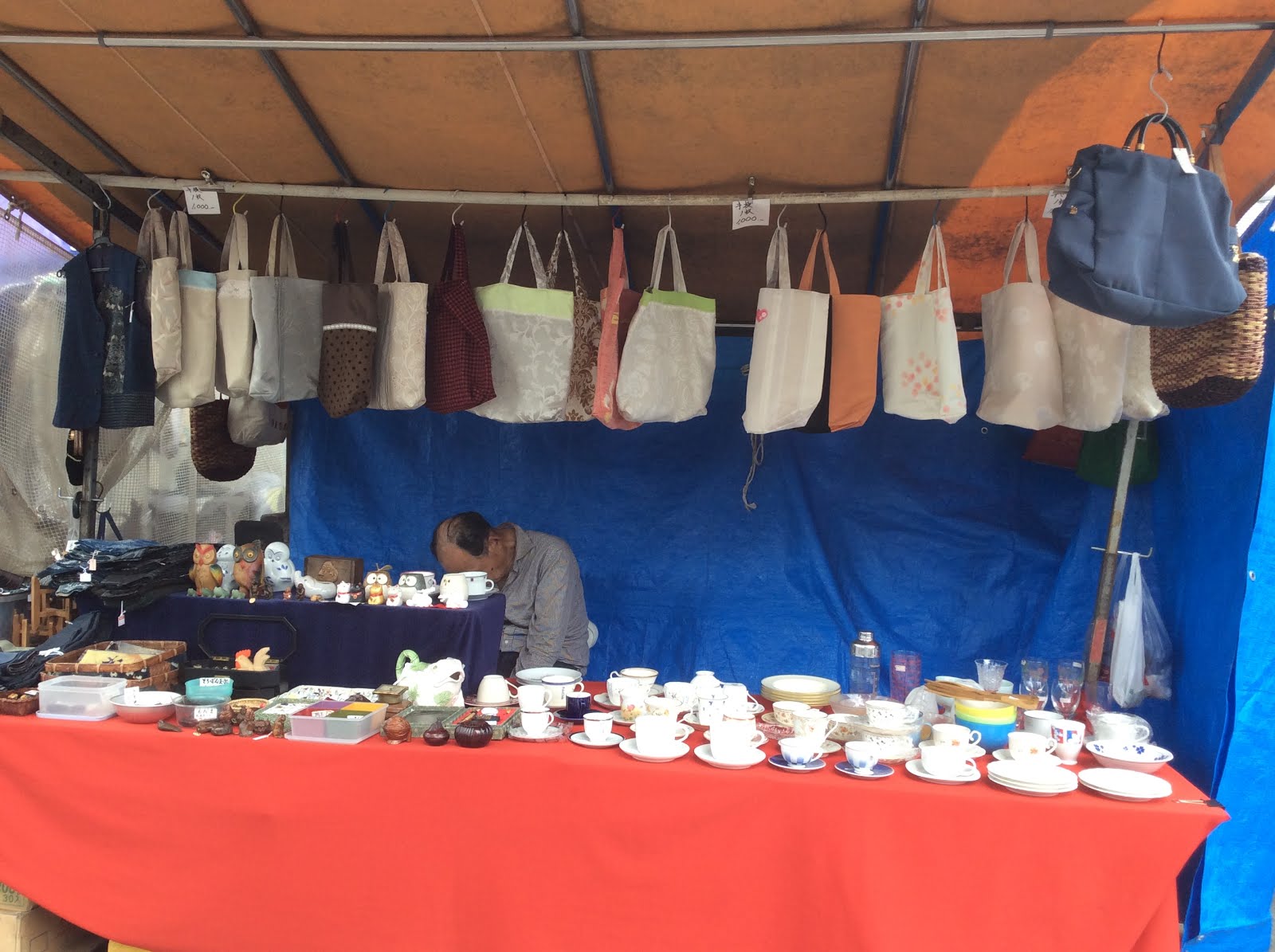
There are an assortment of stuff -- one man's junk could be your treasure.  Those hand sewn bags made of old obi are good buys.  Or how about some english style tea cups?  


I much prefer the Japanese style ceramics.  There are many sellers that have both brand new and previously used wares.  I find that the vintage used bowls and cups are more to my liking.


I am always happy to see these pre-loved obi and coats.   Some can be had for as low as 500 yen.  The more elaborate and luxurious ones can sell for so much more.  But Jay reminds me that I have bins full of these at home so I have to regretfully walk away.


This is the intricately carved, beautiful wooden gate, the romon.  The Kitano Tenmangu is popular with students who visit to pray for success in their exams and studies so it's not surprising to see young people in their school uniforms at the shrine. 


The flea market is so big, with hundreds of vendors, that the stalls spill out on the side streets surrounding the shrine.  Don't forget to explore and walk around or you might miss that one thing you were meant to buy.


I thought these wooden black boxes were so interesting, particularly the lacquer one in the foreground.  


There are more pre-loved yukatas or casual kimonos which are perfect for summer wear.  
Can you believe that these sell for just 500 yen each?


If you thought that 500 yen was a good deal, this stall offers everything you can pack in a big plastic bag for 3,000 yen (or in a small bag for 1,500 yen).  And yes, shoppers were stuffing their bags to overflowing.  It was an amazing bargain but Jay was making strangling noises behind me so I had to tear myself away.  


How about some antique cameras?  I am sure they don't work but would make nice souvenirs for a photography buff. 


Every time I go to a flea market, there is always an item or two that I like to call "the one/s that got away".  This time it was these old wooden lamps, on the top right of this photo.    
They were so unique and obviously handmade but so big and quite heavy.  They would never have fit in my suitcase or in my carry-on.


It was late afternoon and  most of the vendors had started to put their wares  away -- to be kept and stored until the next month.  
If you're planning a trip to Kyoto ....  try to be here on the 25th so you can delight in the many pleasures and treasures of the Kitano Tenmangu flea market. 


P.S


Jay and I didn't walk out empty handed.  Our favourite purchases were these light woven hats ... just perfect for walking around sunny, summery Kyoto!

SaveSaveSaveSave