Showing posts with label Ilonggo food. Show all posts

Monday, September 8, 2014

Comfort me with food -- Remembering Bambi over dinner at 27th Bascon, Bacolod City


Sometimes, food is the only thing that can make you feel a little better.  A few weeks ago, I lost a dear and wonderful friend -- too quickly and too suddenly.  No one had the chance to say good bye.
Bambi Borromeo, friend for over 35 years, was a true blue "Bacolodian" and in a serendipitous turn of events, suddenly found himself immersed in a second career after retirement -- as indefatigable and much sought after tour guide in his beloved hometown. 


These past years I had been to Bacolod to visit Bambi and had taken his tours a number of times -- he put a lot of effort and work in planning the perfect itineraries for me -- and yes, it always ended with a fantastic, sumptuous Ilonggo meal.


I discovered Emma Lacson's most scrumptious pili tarts through Bambi, who whisked us up to the owner's kitchen to see, to taste and yes to buy.


Thanks to Bambi, my friends and I were able to gain access to places that no ordinary tour guide could have arranged for --  such as the esteemed Rev. Monsignor Gaston's ancestral home, Hacienda Rosalia.  Because Bambi was a good friend of the Monsignor's, we were treated to a feast of the family's favourite recipes, not the least was the Monsignor's very own french onion soup.


From a Spanish era hacienda to a seaside kubo (native hut) on stilts over the mudflats of Balaring Bay ... every meal with Bambi was a discovery of the richness and expansiveness of Ilonggo cuisine.


And throughout each meal, Bambi gamely discoursed on the origins and back story of what we were eating or who owned the restaurant and what its history was -- always told with the perfect blend of information and entertainment.   


Here's a photo of Bambi and me at Pendy's in Bacolod -- probably waiting for our batchoy to be served.  I am grateful for all the inasal, piaya, mango tarts, laswa, tinola, etc etc that we shared together. 
Not to mention the bottles of wine and beer from our "salad days" as Will Shakespeare would have said (and Bambi would have agreed, being the erudite Atenista and English Lit major that he was). 
So I am sure, as I write this with a heavy heart,  that Bambi approves of my having found comfort and solace in a good meal during my short trip to Bacolod to attend his wake.  
He would have understood the fact I made the time to have a good dinner, in a place that he definitely would have endorsed.  
Forgive me ... this is a hybrid tribute and food post but it's hard to separate Bambi from my Ilonggo food memories as he gave me so much to taste and treasure.


It made perfect sense to have a pre-wake dinner at 27th Bascon, which was right across the funeral parlour.  It may seem gruesome but as Bambi would have said in his own inimitable fashion ...
"Hala Mamoosh,  go!"


The menu is of a blend of both  Ilonggo and spanish-influenced dishes.  We had their version of a black paella which interestingly had the black rice and the squid set off on opposite sides of the sizzling plate.  The squid was marinated in a slightly sweetish spicy sauce which made me think of chinese food.  It may have been a slightly confused dish but no matter -- it tasted good.


We  ordered the Ilonggo standard -- KBL or kadyos (a black bean), baboy (pork) and langka (green jackfruit).  The soup was pleasantly sour and the pork was very tender.  I loved the langka but I wished there were more of the kadyos.


This was my dinner mate and another of Bambi's dearest friends.  Abe Florendo is one of the country's foremost  feature writers  and has been a lifestyle editor in many major publications.
We had hoped to toast Bambi's life and friendship with a good bottle of wine and some cheese but 27th Bascon only had beer.
I guess our wine and cheese party in his honour will have to wait.


As we were in the sugar capital of the Philippines, it would have been remiss and thoughtless
(and Bambi would have been aghast) if we did not end our meal with dessert.
In addition to the restaurant, 27th Bascon has a cafe right next door specialising in sugar laden cakes, pies and desserts.
Abe and I shared a mango pavlova -- plus strong black coffee to fortify ourselves through the rest of the night.


I spent just about 12 hours in Bacolod.  I was up at dawn to catch the first flight back to Manila.
A short but much needed trip -- comforting to have paid my last respects to an unforgettable friend and comforting too to have enjoyed a good meal in his honour.


Bambi Borromeo 1950 - 2014
Till we meet (and eat) again


Wednesday, August 13, 2014

"It was a dark and stormy night" at Ted's La Paz Batchoy, SM Bicutan

On our way home a few rainy weeks ago, we decided to get in out of the storm and have dinner at SM Bicutan.  There are not too many options aside from fast food outlets in this mall but there is one unpretentious spot in the basement that serves reliably good comfort food.


It's a strange but revealing name -- Ted's Oldtimer Lapaz Batchoy tells it like it is.  Yes, it's quite old, yes it's from Lapaz in Iloilo and yes, the specialty is that very simple, traditional Ilonggo noodle soup, batchoy.  Just the perfect comfort food for a "dark and stormy night".


I prefer my batchoy with yellow egg noodles although Ted's also has thin, rice noodles or bihon.  
We ordered the "special", which is a good sized serving.
Their batchoy broth is clear but the flavour runs deep.  I presume like home made batchoy broth, 
it is made of pork and or chicken bones, slow cooked over a low fire and seasoned with that very Visayan ingredient -- guinamos.  
Guinamos is made with either anchovies,  herring or other small fish that has been  brined, aged and fermented.  Authentic Ilonggo batchoy includes  guinamos -- which adds a complex saltiness to the soup.  It reminds me of the use of bonito flakes in dashi -- that quintessential ingredient in good Japanese soups.
What makes Ted's batchoy even more hearty is the generous addition of chopped chicharon  or pork crackling and slices of pork meat and pork liver.  
If all these ingredients are a bit much, order some puto or pandesal to help cut through the richness.


If you need a bit more sustenance than a bowl of fragrant steaming hot batchoy, Ted's has value meals that pair a mini bowl with viands like daing na bangus, grilled pork chop, even sisig and chicken, inasal or fried.


We enjoyed our unsophisticated, no frills dinner at Ted's.  It was a straightforward, honest to goodness taste of Ilonggo cooking.

Monday, October 3, 2011

A Silay Treasure -- Emma Lacson's Pili Squares

I discovered a Silaynon treasure that I think will keep me going back to this wonderful city time and again. For the simple reason that this treasure can be found only in one place, in one house in Silay.

I speak of those tidbits of ambrosial goodness -- Emma Lacson's Pili Squares.
This small, elegantly designed maroon box hides a confectionary triumph.
The pili squares are mildly nutty, moist, chewy, buttery yet not cloying or oily. A box contains pre-cut 2 inch long bars that have a flaky, thin crust on the bottom.
Surprisingly, the bars are also not too sweet -- something that I cannot say for most of Negros' candies and pastries -- which definitely adds to their delectable taste.
I have had pili mazapan and pili pastries in Bicol -- where it is acclaimed as the regional delicacy but nothing I have tasted in Bicol compares to this Silaynon treat.

You can buy these delicacies from the old Lacson heritage house in Silay City, right along the main road, across a BPI bank branch. Just knock on the green gate and someone will let you in.

We were led up right to the kitchen on the second floor. I saw the tin pans and the ovens that are used in making the pili squares. This huge steel topped table is where the bars are cooled and sliced before they are wrapped in foil and boxed.

This old heavy duty mixer is still in use and has probably churned out millions of pili squares since this delicacy has been around since 1925.
Emma Lacson passed away last year but her daughter continues to make the pili squares from her mother's secret recipe.

The Lacson kitchen is comforting in its homespun simplicity. While we wait for orders, something good is cooking and the smells waft across the room.

Laden with boxes of pili squares (which somehow are never quite enough once you get home and start eating them), we make the long trek down the steep stairs outside the house.
The stairs are quite high and we have to make sure not to trip or slip -- not so much for our safety we joke, but for the safekeeping of the precious bundles of Emma Lacson's Pili Squares.

Sunday, October 2, 2011

Going back in time -- Hacienda Rosalia in Manapla

One of the very special experiences I enjoyed this past trip to Bacolod was to have visited the old Gaston mansion, centerpiece of Hacienda Rosalia in Manapla, an hour's drive away from Bacolod City.
The Gaston Mansion, a cultural heritage house in Negros, sometimes opens its doors to private groups. It can be arranged that lunch will be served by the household staff as part of the tour.
We were fortunate that our tour guide, the aforementioned Bambi Borromeo, was a good friend of the current resident and owner of the Gaston Mansion -- no less than the esteemed retired prelate, Monsignor Guillermo Gaston.
Perhaps Bambi said, he might be home and we would meet him during lunch.


The Gaston Mansion may look familiar to you, if you have seen Peque Gallaga's 1982 masterpiece, Oro Plata Mata.
This stately and elegant house hidden within the heart of Hacienda Rosalia is set amidst lush, verdant grounds.
The gorgeous garden is a study in disheveled orderliness. Flowers, shrubs, trees, potted palms, herbs -- a riot of color and greenery!


We were amazed upon entering the second floor dining room.
The long, 24 seater antique wooden table was formally set for five.
Crystal stemware, antique silverware, fine china and linen napkins brought back visions of a bygone age when people still saw mealtimes as formal occasions.
It was going to be a very special lunch.


And special it was indeed! Monsignor Gaston was at home and very kindly stayed with us over lunch, regaling us with stories of the Hacienda, the mansion, his studies, travels and experiences.
The conversation was stimulating and scintillating -- I closed my eyes and imagined that I was taking part in a tertulia, the setting was just so right!


Monsignor Gaston has found culinary acclaim among his friends for his French Onion soup. His many years in France during his younger days helped him master this classic french recipe.


The table just outside the dining room, on the breezy azotea overlooking the garden, was laid out with a buffet of the house specialties. While it was Monsignor who cooked our soup, his staff have been trained to prepare the traditional recipes handed down from generations of Gastons.


Each dish was identified by a handwritten place card.
The rice was elegantly presented, molded into a perfect round and sprinkled with finely chopped herbs, taken from the garden.


We were served tender pork chops, cooked in olive oil and with tomatoes and a lively, piquant mustard sauce.


Another traditional Gaston heirloom dish was the Adobo Milyonario.
The everyday chicken and pork adobo had been simmered and stewed till falling off the bone tender. Lightly sauced with drippings, garlic, soy sauce and olive oil -- it was transformed into a dish fit for the most discerning palate!
While I no longer eat meat, I enjoyed this vicariously through my friends who, unmindful of the genteel and small appetites that characterized ladies of a bygone era, went back for seconds and thirds of this dish!


Thankfully, Monsignor Gaston also served Garlicky Prawns -- there they were, fat and fresh, redolent with garlic and butter. The sauce was heavy with shrimp aligue. I could not resist.
Yes, I spooned the sauce over my rice.
Que barbaridad!


We started the meal with a classic French soup, we ended it with a classic French dessert.
Crepes aux creme de marrons. Thin, melt in your mouth crepes with a sweet chestnut filling and with whole candied marrons on top.


After lunch, we left Monsignor Gaston who had to leave to say mass in another town.
We walked through the back of the house, taking a shortcut to the hacienda's very own private chapel.
Called the Chapel of the Cart Wheels, it was designed and built by Monsignor Gaston to serve as the center for worship for the family and all the people who lived in the hacienda.


The chapel stands across the fields behind the house. Shaped like a tall, outsized and stylized native salakot, the structure is made of items that are indigenous to Hacienda Rosalia and its daily endeavours.


Serving as base of the wooden, cone shaped roof are dozens of old, used cart wheels, taken from the carts that used to haul sugar cane from the hacienda's fields to the sugar mill.
When he designed this chapel, the monsignor wanted a place that would celebrate the people of Hacienda Rosalia. A place that would give glory to God through the work of their hands.
Ora et labora. Prayer and work.


The old cart wheels form the walls of the chapel, giving it a cool and airy atmosphere.


The portion behind the altar is made of native stone which adds to the coolness of the interiors. The rest of the round structure is fully made up of the cart wheels, they function as windows and walls, even as a stylized frame for the Christ above the stone altar.
This chapel is consecrated and Monsignor says mass here every Sunday and during holy days of obligation. Weddings and baptisms are regularly held here.
It is the hacienda's parish church.

For me, The Chapel of the Cart Wheels is a unique and extremely personal expression of faith.
The faith of Monsignor Gaston and of his flock in Hacienda Rosalia.


Wednesday, September 7, 2011

Virgie's - the House that Mango Tarts Built!

The first time I visited Bacolod in the early 90s, I was told to forget the piaya but to make sure I tried the mango tarts from a lady named Virgie. I managed to find the house from which she sold her mango tarts and was instantly hooked!
Made with gooey mango jam encased and baked in pie pastry, each tart or mini empanada was an invitation to have another one.
I would order from Ilonggo friends and hoard my stash in the refrigerator.
Of course as the years wore on, Virgie would bring her products to Manila through the Negros Trade Fair and much later on, she even had carts and kiosks in some malls in the city.


The mango tarts now come in very attractive boxes, good for gifts and pasalubong when going abroad. The tarts keep for a few weeks, as long as you keep them refrigerated.
I like bringing them back to room temperature when I'm ready to eat them.
Or, you can put them in the toaster oven for a couple of minutes.


On this trip to Bacolod, I was really glad to see that all her success from mango tarts and a host of other baked goodies has taken Virgie's store out of her modest home to this spanking new building! You can find all her delicacies here, all branded Virgie's, in attractive and colorful packaging -- it is a showcase of what hard work and a great product can do!


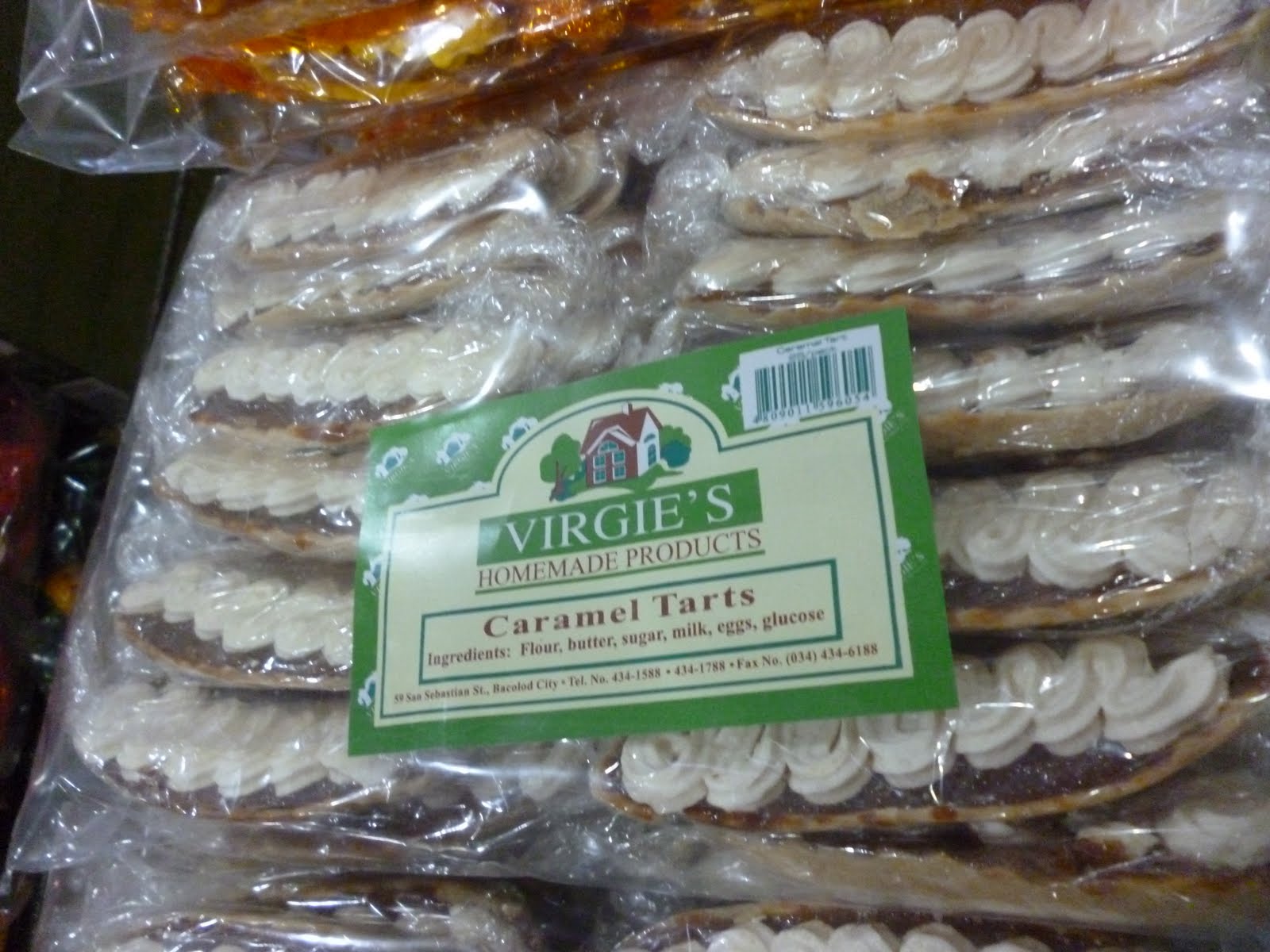
Here is my other favorite -- Virgie's Caramel tarts! These bring back memories of tarts that I used to eat when I was very young. Virgie's caramel tarts feature dark bittersweet caramel with that slight burnt sugar taste.
Each tart has a very retro looking squiggle of meringue piped on top.
A word of warning though -- if you have sugar issues, stay away.
While they are not too sweet, they are definitely habit forming!

Top ten favorite ... sisig at Kubo sa Lawn!

People think that sisig is best where it was first invented -- beside the tracks along Angeles City, Pampanga at Aling Lucing's. Be that as it may, but that was a long time ago and sisig has since been done and redone by nearly every restaurant, bar, carinderia in every part of the country.
On this trip to Bacolod, my friends and I discovered that sisig has been perfected in a casual and breezy outdoor drinking place called Kubo sa Lawn. KSL, as the locals call it, has received rave reviews from various newspapers and food magazines -- ranking its sisig as one of the top ten in the Philippines!


Just because I've stopped eating meat doesn't mean the rest of the party have to suffer. We ordered KSL's famous pork sisig which came sizzling on a hot plate -- naturally we let it cook a bit more until we could see the edges turn a toasty, crusty brown.
As it cooked further, I found myself slowly being enveloped in sisig-y fumes. The wonderful onion and pork aroma brought back memories of sisigs past. Everyone who tried it said it was indeed delicious -- and possibly one of the best they had ever tasted.


Thankfully, KSL had squid sisig on the menu so of course I ordered that. Done with lots more chopped white onions, the squid was tender and tasted fresh. It was perfectly done and went well with my ice cold beer.

Kubo sa Lawn is right along well traveled Libertad Ext. Hard to miss, specially at night when the brightly lit sign beckons.


You'll find a cluster of open air native huts -- perfect for wafting away those food smells from all the sizzling plates of sisig! You can choose to dine semi indoors where most families and office workers sit.


Drinking and eating buddies prefer the more outdoorsy feel and stay in the tented gazebo that is softly lit with hanging lamps and framed by a lot of shrubbery and trees.
The mild Bacolod night breeze perks up the appetite and enhances one's enjoyment of the evening!

Friday, September 2, 2011

Namit ang Luto ni "Sir"! A food find in Silay.

The plane from Manila landed in Bacolod just before 10 am -- too early for lunch but just right for a quick bite before embarking on our "C" Bacolod tour. The last time I was there, I saw this restaurant called "Sir" in Silay -- I had asked Bambi Borromeo, our indefatigable and excellent tour guide if it would be a good place for a late breakfast so that became our first stop of the day.


The signboard "Sir" apparently also includes "Maam", a fact I missed the first time, since the font was decidedly smaller. We presumed that "Maam" must have taken umbrage at being left out of the billing since she probably also calls the shots in the kitchen.


"Sir" Restaurant is right along the highway from Bacolod to Silay and is across the very popular Sta. Teresita school. It looks like a converted family home and has a wide and welcoming expanse of lawn, a tiled walkway and lots of greenery.


It isn't air conditioned but it's fan cooled and because there are wide windows that open up to the outdoors, where there are lots of large shady trees, it's cool and comfortable inside.
There are simple monobloc chairs and tables for 6 and 8 -- which further attests that this is a place where large groups usually dine.


Dishes are laid out, turo turo style. You lift up the caldero covers and choose from what's available for that day.


Since we were in Negros after all, we had to have lumpiang ubod. Their version came unwrapped or hubad. It was very good, the ubod or heart of the coconut tree, was fresh and sweet. Lightly sauteed with small shrimps, it was one of the best I had ever had -- and I didn't miss the lumpia wrapper at all!


Bambi recommended that we try the pata with beans or a home cooked version of what has made Hunts quite famous -- pork and beans. Since I no longer eat meat, I was not able to enjoy the pata but my friends said it was delicious -- falling off the bone tender! The beans were soft but not mushy and the sauce had the right balance of sweet and sour tomato goodness.


They were selling packs of Manapla puto by the counter. This version was called puto margarine and it was margarine'y indeed! It was the perfect thing to sop up the sauce of the pata with beans with -- savory salty meets sourish sweet!
"Sir" in Silay was definitely a good opening salvo to the rest of what would be a very culinary week-end in Negros!