Showing posts with label Buddhist temple. Show all posts

Monday, December 31, 2018

Discovering the treasures of Kennin-ji


"Discover" is the appropriate word for our visit to Kennin-ji, Kyoto's oldest Zen temple.
We had passed by this place many times ... while walking around Gion, ... walking to and from Kiyomizu-dera ... but it was only until good friend, Chieko san incredulously said -- "You have
never been to Kennin-ji?  No?! You must go"  -- that we finally did. 


Kennin-ji is one of those places that is "hidden in plain sight".  Shijo is the main street where everyone walks down on the way to Gion.  At the end of Shijo is Yasaka-jinja, on the leftmost part
of this photo.   Before you get there, make a turn at Hanamikoji street to get to the temple.


Popular for the row of machiya or teahouses and the many quaint stores, Hanamikoji is also where you might catch a glimpse of a maiko, on her way to work.  At the southernmost end is the entrance to Kennin-ji.


I guess one reason we had walked past Kennin-ji so many times is that the entrance is tucked away at the end of the street.  We must have missed the five lines on the wall signifying this as a most important temple -- that should have been a giveaway to us and reason enough to venture in.


Belonging to the Rinzai branch of Zen Buddhism, Kennin-ji is one of the five major Zen temples in Kyoto.    The grounds are expansive and make for a pleasant walk but one should really enter the main buildings to truly appreciate what Kennin-ji has to offer.  While entrance to the compound is free, there is a 500 yen fee to enter the temple buildings. 


Unlike other popular temples in Kyoto which open very early, Kennin-ji does not allow entry to the temple buildings till 10 a.m.  We arrived just past  9 and used our time to enjoy the peace and quiet
of an early morning stroll. This is the Sanmon gate and beyond it you can see the Hatto or the Dharma Hall. 


Facing away from the Sanmon, you will see the Chokushi-mon, the oldest structure in Kennin-ji, dating back to the 13th century.  
Kennin-ji was established in 1202  and its first abbott was the famous monk Eisai who also
brought  Zen Buddhism to Japan.  In addition,  Eisai  introduced tea and tea drinking to the Japanese.    I remember him from my visit to the mountain temple  Kozan-ji where he started the
first tea plantation in the country. 


Like most of the major temples in Kyoto, many of the original structures in Kennin-ji have been destroyed due to natural calamities and wars.  The main building, the Hatto or the Dharma Hall, was rebuilt in the 18th century. 


The Hatto is immense and quite bare.  The main altar enshrines Kennin-ji's principal deity,
Shaka Nyorai.  However, the minute you enter the building,  your eyes will be drawn to the ceiling.
I am sure the Buddha will not hold this against you because right above the main altar, covering most of the entire ceiling is an amazing,  aaah-inducing painting of two gigantic dragons.  
You might be surprised to learn that this painting is relatively new, having been donated to the temple in 2002, to mark Kennin-ji's 800th anniversary. 


The painting is the size of 108 tatami mats or  about 175 square meters.  Created by the artist 
Koizumi Junsaku,  the dragons were painted on Japanese paper spread out on the floor of a gymnasium in Hokkaido.  It was then transported and assembled in Kyoto when Koizumi san finished it, in just two years.  I did not mind the sore neck muscles from staring up at it for so long --- the dragons were so  "life-like" -- they looked as if they were running after each other, all around the ceiling.  


Aside from the twin dragons,  Kennin-ji has other precious artworks that are designated as 
National Treasures and Important Cultural Properties.  
The most famous one and the symbol of the temple is this scroll of Fujin and Raijin -- 
the gods of Wind and Thunder.  The scroll dates back to the 17th century and was painted by the noted artist Tawaraya Sotatsu. 
A dynamic and vibrant painting,  the gods seem almost human because of the expressions on their faces -- they actually seem to be laughing and having a good time together.  
This is such a popular painting that the images are used in many souvenir items. 
This scroll exhibited in the temple is merely a very good copy as the original is in the National Museum of Kyoto. 


While most of the priceless artworks of Kennin-ji are housed in the National Museum, you can still enjoy the skilful reproductions that grace the fusuma or the wide panels that serve as dividers between the rooms.  The one above is part of the painting called "Seven Sages in the Bamboo Grove".


Meditation cushions carefully placed on tatami mats are surrounded by the painting of " The Four Elegant Pastimes", another Important Cultural Property. 


These dragons seem to swoop through the air in this painting called "Dragons and Clouds". This and the two other paintings were done by Kaiho Yusho and are believed to be from the 16th century. 


This  austere, large wooden building from the late 1500s is the Hojo or the Abbott's Quarters.
The structure itself is an Important Cultural Property.   All of the buildings in Kennin-ji are 
strictly no-shoes areas -- after all, you cannot just scuff the patina of these ancient wood floors. 
Slippers though are thoughtfully provided for walking between the different buildings. 


A beautiful karesansui or dry landscape garden is right between the Hojo and the Hatto.  This is the
Daio-en or Grand Garden and the painstakingly raked sand is said to depict a sea of clouds.
Contemplating the garden is inevitable.  One just has to stop and breathe and take it all in. 


As you sit and contemplate, the garden can look like anything and mean anything to you.
As I gazed on it, I was reminded of waves, driven by the wind, moving towards the horizon. 


Aside from the the Daio-en,  there are other pocket gardens within the grounds but two are 
specially popular.  If you do not pay attention, you may just miss this Marusankakushikaku-no-niwa, 
depicted as ⚪△⬚.
In Zen philosophy, this garden shows the only true shapes in space -- a circle, a triangle and a square.  If you look at the photo long enough, I am sure you will see them too. 


The △◯⬚ garden does not really invite one to sit and meditate since it is in a busy, well trodden area between the Hojo and the Honbo.  However, a little further away, just a few steps really, is this lovely moss and rock garden.  
This is Chouontei,  the Garden of Sound and Tide.  The three large stones in the middle called the San-zon-zeki are said to represent Buddha with two Zen monks.  
Zazen stones are placed around for meditation purposes and many visitors enjoy the garden from the viewing decks situated all around.   Maple trees surround the rocks and during autumn, this garden is  a favourite koyo viewing spot. 
P.S.


Wooden decks and covered wooden walkways surround the Chouontei.   I found a solitary bench away from the crowds where I sat and thought of nothing at all.  In a zen state, at last. 


Friday, November 23, 2018

An almost vegetarian lunch at Haduki on Mt Shosha


Buddhists believe in doing no harm to any living creature  that's why most of them do not eat any  meat, poultry or fish.   In Japan,   Buddhist monks prepare vegetarian cuisine or shojin ryori --
it's served in temple restaurants or in temple lodgings.


Engyo-ji has both temple lodging or shukubo and a restaurant.  The Engyo-ji Kai-kan, just past 
the Nio-mon is a shukubo where  guests and visitors to the temple can also enjoy a shojin ryori meal.  
For day visitors, reservations for lunch are sometimes necessary, particularly during the temple's 
busy season.  
However, there was no one in the reception area of Kai-kan when we walked in so regretfully we were not able to try the shojin ryori lunch. 


 Meiko san promised a more casual and just as delicious meal just a little further on.  Across the Maniden is this cafe cum souvenir shop called Haduki.  According to Meiko san, the cafe served simple vegetarian meals but its specialty was oden.  That perked me right up!


Haduki looks like a Japanese home converted into a restaurant.  There were just seven items on the menu -- mostly hot udon or soba with either mushrooms, vegetables or yuba (tofu skin). 
Except for the oden, which came with chikuwa or  fish sausage and one of the noodles that used a
fish broth,  all the other dishes were vegetarian. 


Souvenir items such as amulets, charms and specialty foods are sold at Haduki.  If you want something else to drink aside from the free green tea,  there is a cooler stocked with bottled water, 
juices and surprise, surprise --  cold beer.  Does this mean that Buddhists are not alcohol averse?  


Jay opted to go full vegetarian with his bowl of udon noodles with seaweed and yuba. 
The heart cut-out was a kawaii touch.


Meiko san and I split an order of plain onigiri (rice balls).  One was sprinkled with sesame seeds
and the other was topped with dried shredded akajiso or Japanese red shiso leaves. 


Naturally we had to have the oden and yes,  Meiko san was right -- it was superb. 
Every ingredient in that oden was made right in Haduki's kitchen.  The chikuwa  and
the egg were the only non-vegetable elements on this plate. 
Beer is made with barley, hops and yeast so it definitely counts as vegetarian fare!


P.S.


Right outside Haduki is a small pond stocked with vari-colored koi.  For 50 yen, you can buy a 
small tray of fish food and treat them to lunch.  
Gomen nasai, I whispered.  I'm sorry for eating the chikuwa in my oden.

Thursday, November 22, 2018

A Thousand Years Away at Engyo-ji in Himeji


Many tourists who visit Kansai seldom go outside Osaka or Kyoto.  Nara will sometimes make
it to their list if only to mingle with the passive-aggressive deer in the park.
But not too far away from Kyoto is Himeji City in Hyogo prefecture - home to two amazing, must-visit sites .... one of Japan's most impressive, original castles and a  stunning Buddhist temple located on top of a mountain. 


I must admit that I was one of those who had not ventured out to Himeji -- at least until this trip.  Even my very good friend Meiko san, who lives in Kyoto was surprised that I had not been to
Himeji at all.  You must go, she insisted.  She knew my penchant for Buddhist temples and clinched the deal with a promise that Engyo-ji  would be one of the most beautiful temples I would see.
So one sunny morning a couple of months ago, we took the JR Rapid Express from Kyoto Station to Himeji City -- 98 minutes away.


Our first stop was to buy the combined bus and ropeway ticket that would get us from the station to Mt Shosha, where the temple is situated.


There is a convenient ropeway service  from the bottom to midway up the mountain.  The view 
from the cable car shows a city much larger that what I had originally perceived  it to be. 
The landscape is dotted with hills and you can see the Harimanada Sea in the distance. 


As we exited the ropeway station,  we saw this post which Meiko san said was one of her 
very favourite Buddhist sayings.  Loosely translated, she read it as  "Light up your corner".  
What an uplifting reminder!  All of us need to  shine a light in our corner and we'll make a 
difference in this world.


The ropeway will take you halfway up Mt Shosha.  There is a 500 yen entrance fee to the mountain.  For those who do not want to hike the remaining one kilometre up,  mini buses will take you to the top and back down again.  A round trip ticket is also 500 yen.  Almost everyone we rode with in the cable car hopped into the bus but we decided the hike up would be a much better option. 


When you visit a Buddhist temple, you are supposed to ring the bell to announce your presence. 
This huge bell at the entrance is Jihi no Kane, the Bell of Compassion.  It reverberated with a loud clang that seemed to echo throughout Mt Shosha.  Jay said he did not mean to hit it so hard and that he actually thought he had cracked the bell!  


The walk up Mt Shosha is a gentle ascent on a smooth earth-packed path.  
The bus goes up via a different route so our walk was uninterrupted and absent of unnatural sounds.  We only heard our own soft conversation and  the sound of birdsong and crows cawing.  
Engyo-ji is number 27 on the Saigoku 33 Kannon Pilgrimage.  On the way up at regular intervals,  you will see all 33 statues of the different temples on each side of the path.  


A break in the trees gave us another sweeping view of Himeji City down below.


It is just a  kilometre to the top and before I realised it, we were almost halfway there.   
I was really happy that we did not take the bus -- the  hike reminded me of some of the mountain paths we trekked  through when we did the Kumano Kodo.   Particularly the wider and easier ones.


The entrance to Engyo-ji  is marked by a large wooden Niomon gate.  This dates back to the 17th century and is guarded on each side by Nio-zo, the traditional guardians of Buddhism.  


Once past the gates, the visitor is officially inside the mountain's sacred grounds. It was a lovely 
day for a visit as there was hardly anyone walking up the mountain.  Those who took the bus missed seeing the different important buildings and sub-temples that we saw along the way. 


These steep stone steps lead up to a side entrance of Juryo-in, an important sub-temple in Engyo-ji.  The temple building which dates back to the 11th century was dismantled for repair and restoration in the 1960s.  Unfortunately, this building which is also a National Important Cultural Property is closed to visitors. 


Behind these high walls stands Jumyo-in, another National Important Cultural Property. Like 
Juryo-in, it is closed to the public and opened only during special occasions.


Just as in other mountain temples,  Engyo-ji  exudes an atmosphere of tranquility.  I was very much aware of my surroundings and mindful of each minute that I was on the mountain.  Mountain meditation is a wonderful way to find stillness and inner peace amidst your surroundings.  
Engyo-ji is an ideal place for that.  


I envied the beatific smile on this jizo.  How many centuries had he been in meditation, here in 
the peaceful environs of Mt Shosha.


The path descended to this small wooden bridge, the Yuya-bashi rebuilt in the early 17th century by the lord of  Himeji,  Honda Tadamasa.  It leads to the Maniden, just across the bridge.


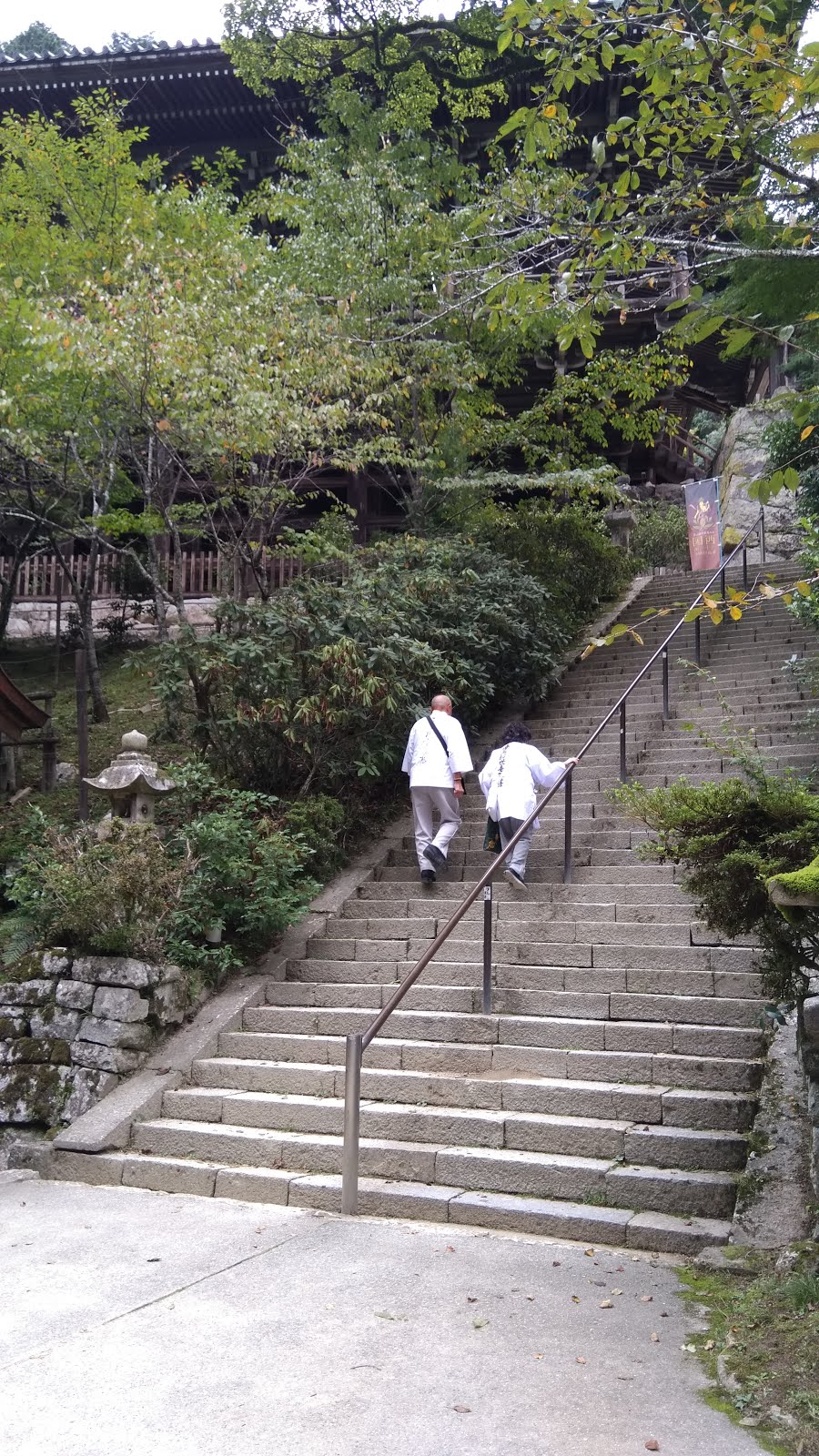
Surrounded by the forest of Mt Shosha, this is the Maniden, which can be reached by a tall stone staircase. 


A couple wearing the traditional hakui  slowly  goes up the stairs.  
Because of how they are dressed, I  can only presume that they are henro or pilgrims
doing the Saigoku 33 Temple Pilgrimage. 


The Maniden's architectural style,  its wooden deck and  its support beams remind me very 
much of Kiyomizu-dera in Kyoto which is also one of the 33 temples of this pilgrimage.


This temizuya with a dragon stands in front of the Maniden.  I saw a very similar one in Okubo-ji, temple 88 of the Shikoku 88 Temple Pilgrimage. 


Engyo-ji is rich with buildings designated as National Important Cultural Properties.  
The Maniden, with its intricate carvings was one of the earliest structures, built in the 10th century.  
Miraculously, it stood for over a thousand years until fire destroyed most of it in 1920.


Using the surviving structures and details from the original structure, the Maniden  was rebuilt with precise accuracy and finished in 1933.  I can imagine the meticulous craftsmanship that went into its reconstruction but more than that, I believe Kannon in her mercy, blessed and guided the hands 
that restored the Maniden so faithfully.


The Maniden is dedicated to one of Kannon's incarnations,  Roppi-Nyoirin-Kanzeon-Bosatsu.  
The image is hidden and is shown only once a year on January 18 which marks an important event in the Buddhist calendar.


Standing at the wooden deck that wraps around the building, I was again reminded of Kiyomizudera in Kyoto.   Looking out at the lush green forest,  I thought that this is how the view from Kiyomizudera must have looked like too, a thousand years ago. 


From behind the Maniden,  we continued on the trail as it climbed,   steeper and narrower this time.  


This cluster of buildings is the Honda Family Mausoleum. Honda Tadamasa was the first daimyo 
of the powerful Honda clan to rule over Himeji Castle and he and his family extended their protection and support to Engyo-ji.  


Across the Mausoleum is a wide open space bordered by three magnificent wooden structures .  
On the leftmost is Jogyo-do which was the training hall for monks.   In the middle is the Jiki-do, 
the dormitory where the monks lived and worked.  And on the right most is the Daiko-do, the Main Hall of Engyo-ji.  If these buildings look familiar, it is because this is where many of the scenes of the movie The Last Samurai starring Tom Cruise were shot.  


While Jogyo-do and the Daiko-do are closed to visitors, you can enter  the Jiki-do and see where the monks lived and worked, a thousand years ago.  Visitors may copy sutras on the first floor and view some architectural pieces like actual centuries-old wooden posts and the fish shaped ornaments that adorn both the top of the temple buildings and that of Himeji Castle. 


The Jiki-do was constructed in the 12th century and dismantled for repair and restoration in 1959. 
It's amazing that the building lasted so long with just minimal repairs.  The Jiki-do is forty meters long, with a second floor wooden deck that runs the whole length of the building.


The second floor houses some of the treasures of Engyo-ji such as these wooden statues and other valuable Buddhist artefacts. 


At the back of  Jogyo-do you can find a window that looks into the inner room of the building. A figure seemed to shine in the darkness so I climbed the steps to look inside.


The room was dimly lit but the image of  Joroku-Amida-Nyorai-zazo can be seen, the soft and compassionate features visible through the darkness. The original statue was carved in 1005, 
more than a thousand years ago by Anchin, who also carved the statue that is enshrined in the Maniden.   This statue however is a replica and the original has been transferred to the Daiko-do.


Behind the Jiki-do and Daiko-do is a of cluster of wooden structures that make up the Okunoin, the cemetery and inner sanctuary of Engyo-ji.   To the leftmost is the Goho-do Haiden, the worship hall.  
Partially hidden in the middle is the Kaizan-do, built in 1007 as a memorial to the priest 
Shoku Shonin, founder of Engyo-ji.  His bones are kept inside the temple.  
The Kaizan-do burned down but was reconstructed --what you see today dates back to the 17th century.  The two small buildings on the right are shrines called the Goho-do, dedicated to the deities who are protectors of Shoku Shonin.  
The Goho-do were built in the 16th century and these are still the original structures.
It is awe inspiring to view all these beautiful wooden temples that make up the totality of Engyo-ji. Most of the temples have been restored from their original structures.  What we walk through and marvel at today is almost the same as how visitors saw them, a thousand years ago.
'


As we looked at the intricate roof and eaves of the Kaizan-do, Meiko san pointed out a small figure, tucked in one corner.  Can you your sharp eyes spot him?   She said that the sculptor cum carpenter who built the Kaizan-do also carved four small figures of sumo wrestlers,  one on each corner of the building to help hold up the roof.


It was mid afternoon when we ended our visit to Engyo-ji.  The way down was sometimes 
steep and sometimes slippery.  I wondered how many had walked this same path through the 
past thousand years.  I was just thankful to be tracing their footsteps.

P.S. 


And here we are, back into the present, waiting for the bus that would take us back.  I cannot say thank you enough to our dear friend Meiko san who gave us this gift of a visit to Engyo-ji. 

Ki ni shite kurete arigatou!