Showing posts with label Hotel review. Show all posts

Tuesday, May 8, 2018

Tokyo Tales Part 3 - A Haiku in the Park (Hotel)


According to an industry survey, Tokyo has about 100,000 hotel rooms. Thirty of the most interesting and unique ones are at The Park Hotel Tokyo, located in the quiet yet accessible business district of Shiodome.  It is also my favourite hotel -- a refuge in this huge, hectic mega-city.


What makes these rooms at the Park Hotel so special? They are called Artist Rooms,
each one designed and done by noted contemporary Japanese artists.  
The Artists Rooms used to be spread out in different floors but they are now all clustered on the
31st floor.
The project is not new and has been ongoing for several years now. It is a way for the hotel to bring art and hospitality together, creating unique and lovely spaces for its guests. 
On this last visit to Tokyo, I stayed at the Haiku Room by Rieko Fujinami. 


Each room is done in the featured artist's distinctive style and each artist chooses a theme to "play" with.  The theme of my room was "Haiku" with a poem by noted Japanese poet Basho written on a scroll on the wall.  In english, the haiku goes "The moon a sign / this way sir,  to enter / a traveller's inn".  Such an appropriate and elegant way to welcome the guest into the hotel. 


I had stayed in an Artist Room before (see previous post https://porkintheroad.blogspot.com/2015/04/sleeping-under-sakura-tree-park-hotels.html)  but on 
this trip had opted for my regular room with a view of Tokyo Tower.  Perhaps because I am a 
member of the hotel's loyalty programme and perhaps because I have stayed so many times in the past,  I was upgraded to this single room.  
While it was a bit on the smallish side and I hardly had a view but I could sleep surrounded by art --  on the walls and the even on the ceiling.  


To add texture to her work, the artist Fujinami san had attached irregular shaped discs which symbolised the Milky Way.  It shimmered throughout the length of the black painted ceiling.  
I lay in bed and let my thoughts meander among the stars. 


Lotus pads and the occasional blossom encircled the room, painted on the walls around the bed and cascading down to the floor.   On the large blank wall koi in different colours floated lazily in the lotus pond, not in still life but swimming serenely, brought to life via the wonders of a video shown on an LCD projector.    I did not have to hie myself off to a Japanese garden,  the lotus pond had been brought right into my room.  


The koi swam languidly.  Subtle sounds of water and soft music followed their gentle movements. 


I tried to capture the experience of almost being immersed in the lotus pond via this video.  A part of me wished that I could just stay in my room enjoying the solitude but I had places to go and people to see.  At some point, I had to turn off the projector and step out of the room.  But I knew this tranquility would be waiting for me ... later tonight.   
I would make sure that I would hurry back. 


P.S

I hope you indulge me (and a thousand apologies to the great Basho san for even daring to try)  
but I was encouraged to create my own haiku inspired by Fujinami san's lovely Artist Room at the 
Park Hotel. . . 

My mind drifts, wanders
Through koi noiselessly gliding
Weaving through my dreams. 


SaveSave

Thursday, February 8, 2018

Nagoya in 24 Hours Part 1 - A night at the (Meitetsu) Inn


Full disclaimer ... the next few posts are much delayed from July of 2017 -- my accident in September absolutely put a stop to my blogging so I am hoping to catch up now.  
I did a quick trip to Tokyo last summer, flying in not to Narita or Haneda but to Nagoya, a city 
over an hour away by bullet train from Tokyo.  


I had never been to Nagoya and with a 24 hour layover before I zoomed off to Tokyo, I hoped to scratch a tiny bit of the surface ... enjoy a local specialty or two, see a temple or a shrine, buy a few souvenirs.   The clock started to count down the hours,  the minute I set foot in the city.
The pressure was on!


For convenience , I decided to stay around Nagoya Station.  Like any major train station in Japan,
it is a massive block of restaurants, office buildings, department stores and all kinds of shops.  


I had booked a room at the Meitetsu Inn Nagoyaeki Shinkansenguchi.  Meitetsu is the private 
railway company of Nagoya and they have hotels all around the city and even a couple in Tokyo.
There are three Meitetsu hotels in the perimeter of Nagoya Station and the one I chose was a
5 minute walk to the shinkansen terminal. 
The hotel is quite impressive,  strikingly modern with a sleek and stylish facade. 


The spare and uncluttered entrance hallway has a few benches for guests and visitors. 


The lobby design is contemporary and minimalist.  Touches of blue break the overall beige and
cream interiors.


I was given a room on the 7th floor.  The streamlined look is carried all throughout the hotel.


Meitetsu Inn is a business hotel and as these go in Japan, the standard rooms are comfortable but definitely compact. The absence of a closet saves space and clothes are hung on the bar in the hallway.


The room may be small but the welcoming touches are all there -- including a comfortable pair of room slippers.


The three sided folding mirror above the small desk is a practical touch.


A small drawer holds the coffee maker, plain white ceramic mugs and the complimentary tea and coffee bags.


For guests traveling without their devices,  Meitetsu Inn has an in-room tablet that you can use 
to access the hotel's free wifi.  Again, such a functional and convenient room amenity. 


I almost did not see the tiny refrigerator as it was cleverly disguised as a drawer.   It can hold  
a few bottles of soda or water (and yes, a candy bar or two!).


My room is called a "small double".  The bed is bigger than a twin bed but slightly smaller than a double bed --  two people would be a tight fit.  The flat screen t.v mounted on the wall makes for 
comfortable horizontal viewing. 
But what I really liked about this room was the floor to ceiling window located right at the foot of the bed.


This is the view from my bed.   Nagoya is the third largest city in Japan and the cityscape is quite dense with buildings as far as my eye could see.


The view was much better at night when all the lights turned on and Nagoya transformed into a brilliant city scene.  As I lay in bed,  it seemed that the entire city was literally at my feet!


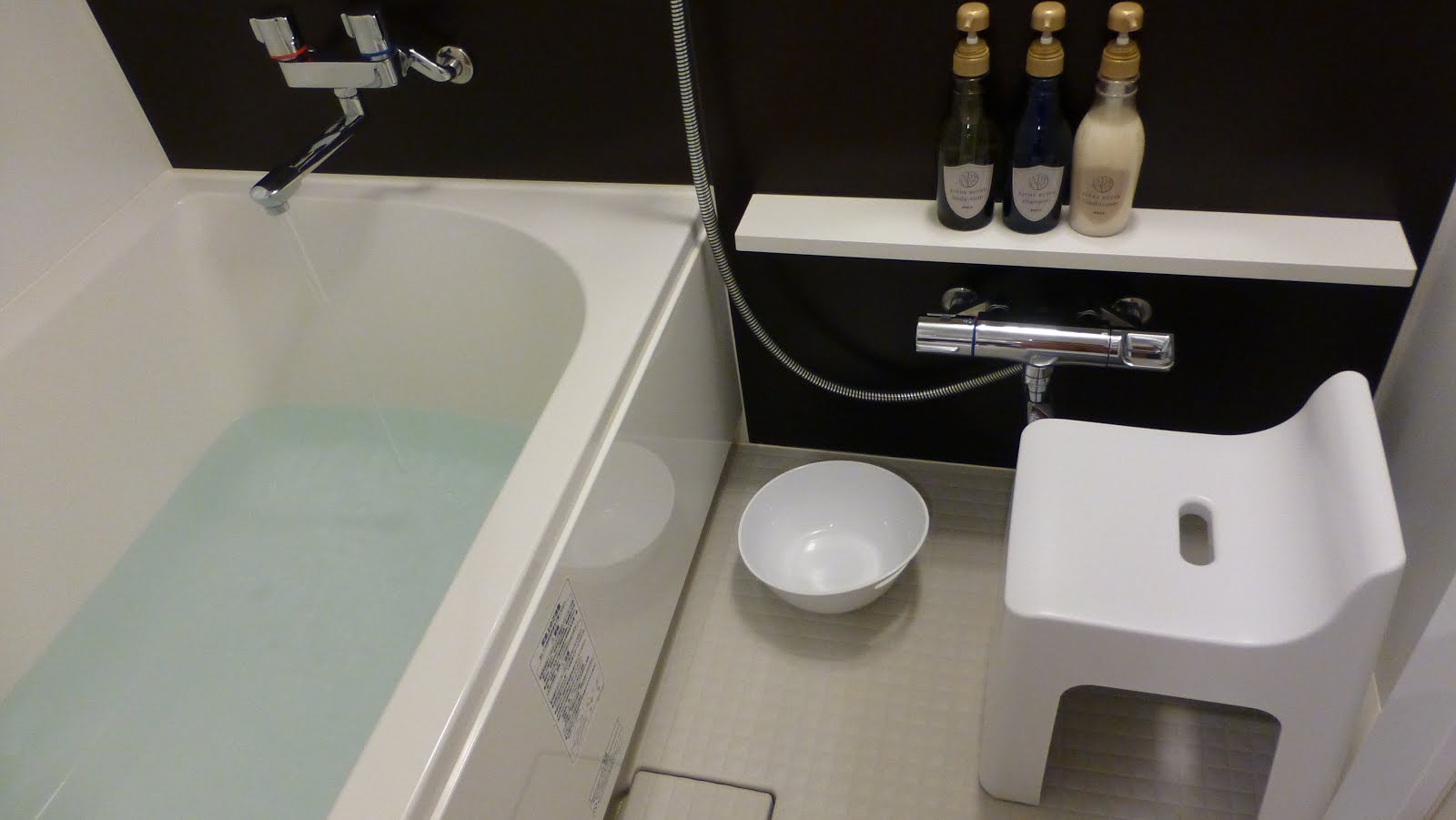
I love Japanese bathrooms -- small in scale but everything fits and everything you need is in place.  


It was a pleasant surprise to see this traditional style bath normally found in Japanese homes.   
You sit on the stool and clean yourself thoroughly before enjoying a long relaxing soak in the hot bathwater.   I was impressed as the bath amenities were premium, high end Japanese brands.


The next morning,  I set my alarm for 6:00 a.m. (the better to get an early start on sightseeing).  
After a cup of refreshing matcha,  I was ready to head out and see Nagoya.


There was no one in the elevator so time to indulge in a selfie!


The hotel does not have a dining area but guests can have breakfast and meals throughout the day 
at Tonkatsu Matsuya which is right at the ground floor. 


You can choose from the menu and buy a ticket at the vending machine.  Hand your ticket at the counter and take a seat -- someone will bring your food to your table.


There were not too many people at 6:30 in the morning, my fellow diners were all hotel guests too. 
The door at the leftmost is the connecting door to the hotel lobby. 


I chose the western breakfast set -- good strong coffee, buttered toast, scrambled eggs, 
a sausage, the usual cabbage slaw plus  a small scoop of potato salad.  All this for just 500 yen!  
Enough to keep me going till the next meal.  


Thank you Meitetsu Inn for the hospitality and the warm introduction to Nagoya.   I will be back!


SaveSave

Wednesday, June 14, 2017

Kumano Kodo Day 2 : Minshuku Nakano -- small town Japanese hospitality at its best

When travelling through Japan-off-the-beaten-tourist-track,  away from the bright lights and the big cities -- don't look for a Hilton or a Holiday Inn because there won't be any.  Not even a Best Western.
At best,  you'll probably find a small  business hotel,  part of a Japanese chain.
In the remote towns and hamlets, your best bet would be to stay in a minshuku -- Japan's version of the home stay.   It's couch surfing Japanese style, long before couch surfing became popular. 


After that muscle-straining, sometimes fingernail-biting 9.7 kilometre hike over the mountain
passes, we finally reached Chikatsuyu. 
It was comforting to see these two large figures of the tanuki, that mythical beast modelled on
the Japanese racoon.  It meant a warm welcome was waiting inside as these creatures are found in front of restaurants, bars and in this case, in front of Minshuku Nakano, our rest stop for the night.


Minshukus, for those who have yet to stay in one, is a family run operation  -- these homes accept  travellers and offer rooms with or without meals.  As a guest, you stay with the family, eat at their table, use the shared bath and experience authentic Japanese culture up close and personal.
Some minshukus may be very old houses and some may have just a few rooms.  They are modest and affordable and more often than not, your window into how the Japanese truly live. 
Minshuku Nakano was a relatively modern residence with five rooms -- maybe the owners' 
children had grown up and moved away and something needed to be done with all that space.


An older, one story structure is attached to the minshuku -- perhaps this was the original family home and where I suspect, the owners continue to stay. 


When you enter a Japanese home, it is imperative to remove your shoes. You do this right past the door, at the small entryway called the genkan.  Mind that you don't put your shoes on the wooden floor, only slippers are allowed on this area.


Minshuku Nakano has 3 tatami style guest rooms on the ground floor.  Since we were the late stragglers, we had to climb these steep wooden steps up to the second floor where there were
two more rooms. Our entire group of 10 occupied the whole house for this night.


Here's our tatami style bedroom -- spare but cosy, with a small t.v.  Later after dinner we would lay out our futons which were kept in the closet. 


Nakano san had asked us what time would we want our dinner to be served.   7 p.m seemed reasonable as the couple would still have to wash and clean up after us.  Minshukus are normally run by the family themselves, without any outside help.  
We came down promptly at 7 to this appetising spread laid out on the tables in the living room.


It was  a home cooked meal done by Mrs. Nakano herself.  Each place setting was meticulously arranged -- the Japanese are perfectionists when it comes to food presentation.   Each one of us had sashimi, a grilled fish, a pot of pork and mushroom nabe or hot pot and side dishes of tomatoes, eggplant and beans. 
Itadakimasu!


Ayu or sweetfish is common in the area and I asked Mr. Nakano if the small grilled fish was an ayu.  He said that this red spotted fish is called an amago, a type of salmon.  Since he is an avid fisherman, he caught this fish himself.  
When we arrived, Mr.  Nakano was grilling the amago in the irori -- a traditional indoor sunken pit 
that is used for both heating and cooking.  The irori is no longer such a common sight in most homes and  I was happy to see an actual one in use.  


This nasu or eggplant with miso sauce was easily my favourite of the evening. The lightly broiled eggplant was sweet and instead of the usual miso glaze, Mrs. Nakano's version had a salty-spicy 
miso based paste.  Umai desu yo!


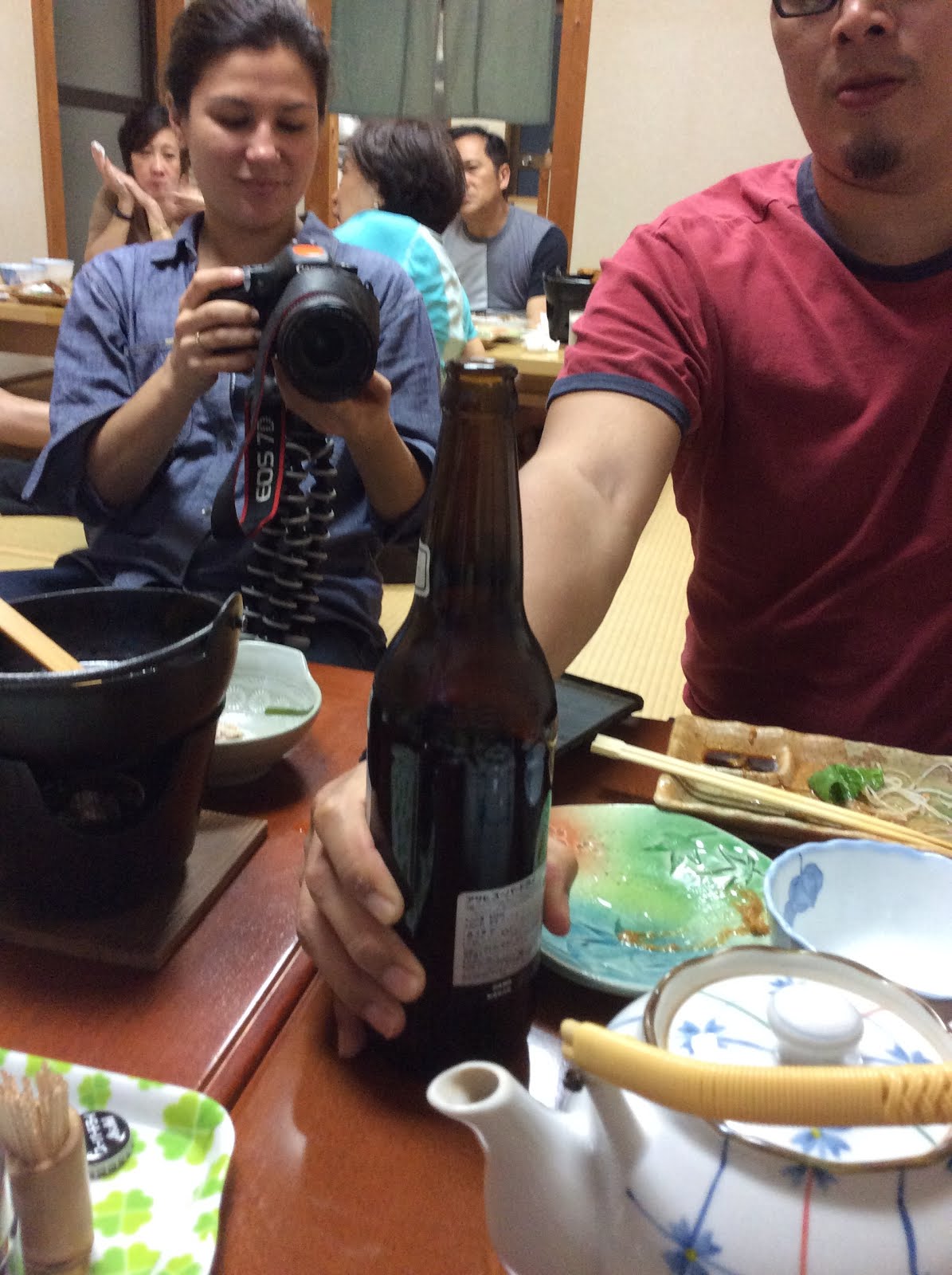
Good food and good friends deserve a bottle of beer -- thankfully, the minshuku has a stock of beer and you can order a bottle (or two)  to go with the meal. 


After the very satisfying dinner, time to head to the bath.  The minshuku has separate facilities for men and women -- one toilet and one bath for each.  Right outside the bath area is a lavatory where you can brush your teeth while someone else is using the bath.  Very efficient and saves time for everyone.


The typical Japanese  ofuro or bath has a shower area where you should very thoroughly soap and wash your entire body before you sink into the hot tub.  
The bathtub is covered to keep the bathwater warm.  Of course it would be ideal if you could be the first one in the bath but in case you find it a bit odd to soak in pre-used bathwater, you will just have to contend yourself with taking a shower.


The futons were clean and smelled so fresh -- Jay was asleep once his head hit the pillow.
O yasumi nasai!


I woke up very early to see this view from outside our bedroom window.  Perhaps these are the very same mountains that I trudged through yesterday.   


This part of Chikatsuyu is quiet and the houses are spaced well apart.  I love that the mountains are so near -- surrounding the village and keeping it "hidden" and seemingly far away from it all.


I took a quick walk around the village -- some of the homes had plots of vegetables with leeks and onions growing by the roadside.


This very hard working lady was cutting the grass growing by her small rice paddy -- she said a friendly "Ohayo!" as I passed by before getting back to her task.  


By the time I returned to the minshuku, breakfast was ready.  A slice of grilled salmon was augmented by egg and slices of sausages -- it was a western/japanese blended breakfast!  


We were ready and out of the door by 8 a.m. to start our third day of walking.  Like the gracious and hospitable hosts that they were,  the Nakanos stood patiently by the front yard to properly see us off.  They were still standing there, waving when I turned the corner and walked down the road.

Lessons learned : Minshuku Etiquette 101
1. Always change to the house slippers when you enter the doorway.
2. Leave the slippers outside your room, do not use them on the tatami mats.
3. When using the toilet, leave the slippers outside the door.   There will be slippers inside, specifically for use in the toilet. 
4. If you plan to use the ofuro or common bath, clean yourself very well with soap and water before soaking in the tub. 
5. It's early lights out in the minshuku and guests are normally expected to check out after breakfast.