Friday, October 22, 2010

Deco's La Paz Batchoy -- this tabatchoy's favorite!


I love batchoy! Which is why I am a tabatchoy! I don't much care for cakes, cookies, chocolates or candy -- none of that sweet stuff gets me swooning.
No, I get fat on the salty, savory stuff. Which is why La Paz batchoy is a favorite of mine. Yummy flavorful broth, chewy egg noodles, bits of pork and liver, crunchy chicharon sprinkled on top -- what more can you ask for?
Unfortunately, I find that most of the batchoy versions served in food courts and chicken inasal places don't quite match up to the original that you can get right in Iloilo. I'm talking Ted's Batchoy and Deco's.
But now, Deco's is in Manila! Established in Iloilo in 1938, Deco's has been bought by the owner of Mang Inasal and has opened its first Manila outlet at Alphaland Mall at the corner of Pasong Tamo ext. and EDSA. Right now, I think it is the best batchoy you can find in the Metropolis.
Deco's at Alphaland is on the ground floor, right beside the Mang Inasal outlet. You can order from both -- have your inasal with a bowl of steaming batchoy on the side.
What makes Deco's so good is the quality of the broth -- not insipid or too salty, you can tell it's freshly made broth, made from scratch and not from bouillon cubes or mixes. The noodles are fresh and springy and the julienned pork and liver slices are tender and flavorful. They don't skimp on the chicharon bits and each bowl has a generous serving on top. You can ask for egg (hard boiled or fresh) to go with your batchoy and extra soup is free too.
The biggest order of batchoy is called "Extra" and costs only P77. Batchoy goes well with pandesal and Deco's has a serving of 6 pieces. They come warm and crusty, and taste just like the pandesal you used to eat when you were a kid.

Thursday, October 7, 2010

Ryuma Ramen -- Great Place in Sta. Rosa!


The road to Tagaytay is paved with temptation most specifically, as you pass through the Paseo area in Sta. Rosa where there's plenty of shopping and eating to be had.
On the second floor of the building that houses the M&S, Debenhams, Timberland and Aerosoles outlet stores is Ryuma Ramen, a Japanese restaurant that is one part of an entire complex that includes a karaoke/fine dining restaurant, a tatami seating style grill, a bar, a japanese grocery, a children's clothing store -- all owned by the same person/s.
I think of it as RYUMA-LAND.
We stumbled upon it one late afternoon on the way down from Tagaytay. Ryuma's waitresses were aggressively pitching their menu to passersby so we decided to give it a try.
We opted to eat in the ramen restaurant as we thought it would be a bit more inexpensive but we learned the same menu is available wherever you decide to sit.
For me, the test of a good ramen restaurant is chashu ramen and Ryuma passed with flying colors! Their chashu slices were not too thin nor too thick, they were soft and melted in your mouth and had the right fat to meat ratio. The pork was just so flavorful -- fresh and juicy and had no pork-y taste (which you sometimes find in other chashu ramen bowls around Makati).
The ramen noodles were very good, cooked just right to retain that chewy bite. And no wonder their noodles are good -- a large noodle maker in one glassed in corner of the restaurant shows that they make their noodles fresh on the premises.
Aside from the chashu ramen, my friends ordered katsudon and katsu curry which they gave two thumbs up to. Both were good-sized portions and like the chashu ramen, very reasonably priced.
Ryuma Ramen's waitstaff are strangely enough dressed in chinese inspired uniforms, considering it is a Japanese restaurant. But they are all very pleasant, efficient and eager to serve.
The evening we were there, the Japanese manager was trying out a traditional pancake maker -- fish shaped and with a sweet bean filling -- and handing out samples to diners. i hope that he decided to buy it and look forward to having it again on my next visit!
Don't mind the kitschy, campy ambience and decor -- white leather covered chairs, table legs made of stainless steel, all sorts of Japanese doodads on the walls (samurai swords, armor, japanese dolls!) but try it for the authentic Japanese food at very un-Japanese prices.
Most of the regulars are Japanese expats from the nearby manufacturing companies and that should be your best indicator of how good this place is.

Saturday, October 2, 2010

BLT Burger Hong Kong : What an $80 burger tastes like.


Well, it's really 80 Hong Kong dollars and not US dollars. But still, I had to know ... what does an $80 burger taste like?
BLT Burger is part of acclaimed chef Laurent Tourondel's bistro empire (BLT -- Bistro Laurent Tourondel, get it?) and he has one in Las Vegas, New York and now, they had just opened the first one in Asia, along a busy, crowded corridor in Ocean Terminal.
I was overdosed from char siew pork and dumpling noodles and came upon BLT Burger one late week-end afternoon. Since it wasn't too full, I was able to snag a small table by the window, overlooking the view of Hong Kong Harbor.
The exterior view was much better than the interiors. I thought BLT a little too cozy -- the tables were small and edged up against each other. The lighting was dim and looked like your regular sports bar with un-sports bar prices.
I ordered the classic 7oz. Certified Black Angus burger which was $78. It was the cheapest burger on the menu (the BLT burger with bacon and cheese was $98, the Wagyu burger without cheese, $118). If I wanted cheese, I would have to shell out $8 more for a choice of blue, American, cheddar, Swiss or Monterey Jack. I held off on the cheese and the fries ($38). And held off the waiter pushing me towards the "combo" which would have cost me $128 -- for the classic burger, fries and a glass of soda.
Instead, I opted to spend $30 for a can of Tsing Tao Beer (when in China ...)
A beer is much better than fries. Or a soda. Or a milkshake, another specialty of the house ($58 for chocolate, strawberry or vanilla, $68 for fancier concoctions like Mocha Mudslide and Rocky Road).
My burger arrived and I was disappointed to see how ordinary it looked. There was a mound of shredded cabbage and raw onion rings on top, perhaps to lift the bun and give the sandwich more height. A small wooden stick with the word "medium" was stuck on the bun. Aside from this little piece of decor, it came with a small portion of coleslaw and a pickle slice (not even a whole pickle!!! For $80!!!).
For a moment, I almost wished I had spent more money on the combo and not the beer!
Taste-wise, the burger was juicy (a perfectly cooked medium) but I thought it had been fried and not grilled -- it was a little greasy. It was a bit bland but perked up a bit after I put some salt on it. Juice (grease?) ran down my fingers after a few bites.
However, the Tsing Tao beer was very cold and very good. The $80 burger was just so- so. BLT notwithstanding.

Sunday, September 26, 2010

Made in China -- Beijing's Best Peking Duck


Well of course, you might think -- but in this case Made in China is not a description but the name of a restaurant in the Grand Hyatt Hotel in Beijing.
We once spent (a very very cold) New Year in Beijing where the temperature was at a steady -3C but the duck dinner we had in Made in China warmed the very cockles of our hearts (not to mention, clogged our aortas and ventricles too).
I was looking for a special restaurant to celebrate the holidays in while in Beijing and came upon a lot of good reviews for Made in China in various blogs and travel sites.
I checked out the hotel website and learned that Made in China featured Beijing and northern Chinese cuisine and the specialties were Peking Duck and Beggar's Chicken. Since we would be visiting during the very busy holiday season, I sent off an e-mail for reservations a good month in advance. Response was swift and very polite -- they even offered to pre-order our duck so it would be waiting when we arrived.
When we finally got to Beijing, we were all looking forward to our Peking duck dinner(s) -- we had scheduled a few, along with Made in China at the Hyatt, we also made sure we would have duck in other, less high-end places.
The day of duck reckoning arrived. We were coming from a full day of sightseeing so we were famished. The windy and cold walk along Wangfujing to the Grand Hyatt was little discomfort to bear for the feasting we were anticipating.
And indeed what an experience it was! While Made in China is a very popular and busy restaurant in the hotel, both with locals, hotel guests and tourists, we were quickly led to our reserved table -- in a very prime spot overlooking the open kitchens where we could see the chefs slicing, cooking, roasting, wok-ing.
Since it was the holiday season, the restaurant was full but still very comfortable. Waitstaff were efficient and not once did we notice any delay in the service. The ambience was modern and minimalist and very contemporary.
The waiter recommended a light appetizer of vegetables with miso and steamed dumplings to go with the duck. Our Peking duck dinner would be served two ways -- sliced with pancakes and hoisin sauce and the bones would go into duck soup which would be served at the end of the meal.
Our duck was brought out within minutes after we finished our appetizers. Reddish brown, gleaming and glistening -- it was offered up for our admiration before the waiter started to very deftly slice it up.
What a duck it was -- crisp skin, not too much fat but just enough for a juicy mouthful. The duck was cooked perfectly and each slice practically melted in a pool of umami-goodness in your mouth.
The pancakes were freshly made, very light and soft. After the duck had been completely decimated, they brought it back to the kitchen and it came out reincarnated as piping hot soup in bamboo "mugs".
It was the perfect ending to a wonderful meal -- and the soup definitely kept us a little warmer in -7C weather as we walked back to our hotel.

Monday, September 13, 2010

NASI LEMAK ... Binalot by way of Singapore


I try to keep from eating too much rice but when traveling to Singapore, it's practically impossible.
All the yummy food involves rice ... hainanese chicken RICE, claypot RICE, NASI (indonesian for RICE) goreng and my personal rice meal favorite ... NASI LEMAK. Binalot ala Singapore!
Nasi lemak is rice that's been soaked in coconut cream before it's cooked. To add to the aroma, pandan is oftentimes used.
A scoop of this very flavorful rice is then put in the middle of a section of banana leaf -- it's topped with a sprinkling of dried ikan bilis or dilis along with some roasted peanuts. A small fried fish looking suspiciously like sapsap is also sometimes included.
A dollop of sambal sauce smeared on the banana leaf completes the equation. Everything is then wrapped up in a neat triangle, ready to be sold and eaten.
You'll find nasi lemak on most food kiosk counters in the morning, in coffee / kopi shops, in small eateries where busy Singaporeans drop before heading to the office.
Breakfast counters typically offer the banana leaf wrapped nasi lemak, trays of fried noodles (think pancit bihon), fried hotdogs or vienna sausage, fried eggs, luncheon meat and sometimes, crispy chicken wings.
For nasi lemak, my go-to side dish is otah, a brown paste made of fish meat, coconut milk and other spices. Otah is also wrapped in a thin sliver of banana leaf before it is roasted.
Otah is savory and the soft paste is a good counterpoint to the crunch of the peanuts and the ikan bilis. The sambal sauce is thoughtfully smeared on a small portion of the banana leaf so you can mix as much or as little of it with the rice, controlling the heat and spiciness of each mouthful.
Nasi lemak is a yummy and filling meal -- one that is perfect to eat while relaxing with a hot cup of kopi C and the day's edition of the Strait Times. I make sure I have my nasi lemak on the last day of a business trip so that its memory is something that I can take home.

Sunday, September 5, 2010

Swooning over Mooncakes


I love the Mid Autumn Festival in Singapore because I love mooncakes. This year, the Mooncake Festival is on September 22 but mooncakes have been on sale since late August.
I am always lucky enough to be in town at the right time. Singapore has the traditional baked mooncake but a few years back, they introduced the heavenly snowskin mooncake.
Made of glutinous rice flour that is molded around the filling, snowskin mooncakes are chilled and not baked. Baked mooncake fillings are the usual red bean or white lotus paste with eggs and nuts. But snowskin mooncakes are filled with all sorts of decadently delicious stuff -- how about durian, mango, Bailey's, cappucino, Irish whiskey, passion fruit, dark chocolate, hazelnut -- you name your particular fancy and chances are, you'll find it inside the snowskin mooncake.
Bakeshops, hotels, restaurants in Singapore have both varieties available -- baked mooncakes for the traditionalists and snowskin mooncakes for those who want something different.
The basement hall of Takashimaya in Orchard Road was running its annual Mooncake Festival Sale this week-end. I walked through row upon row of stalls selling both mooncake versions. You could easily tell which stalls had the durian variety!
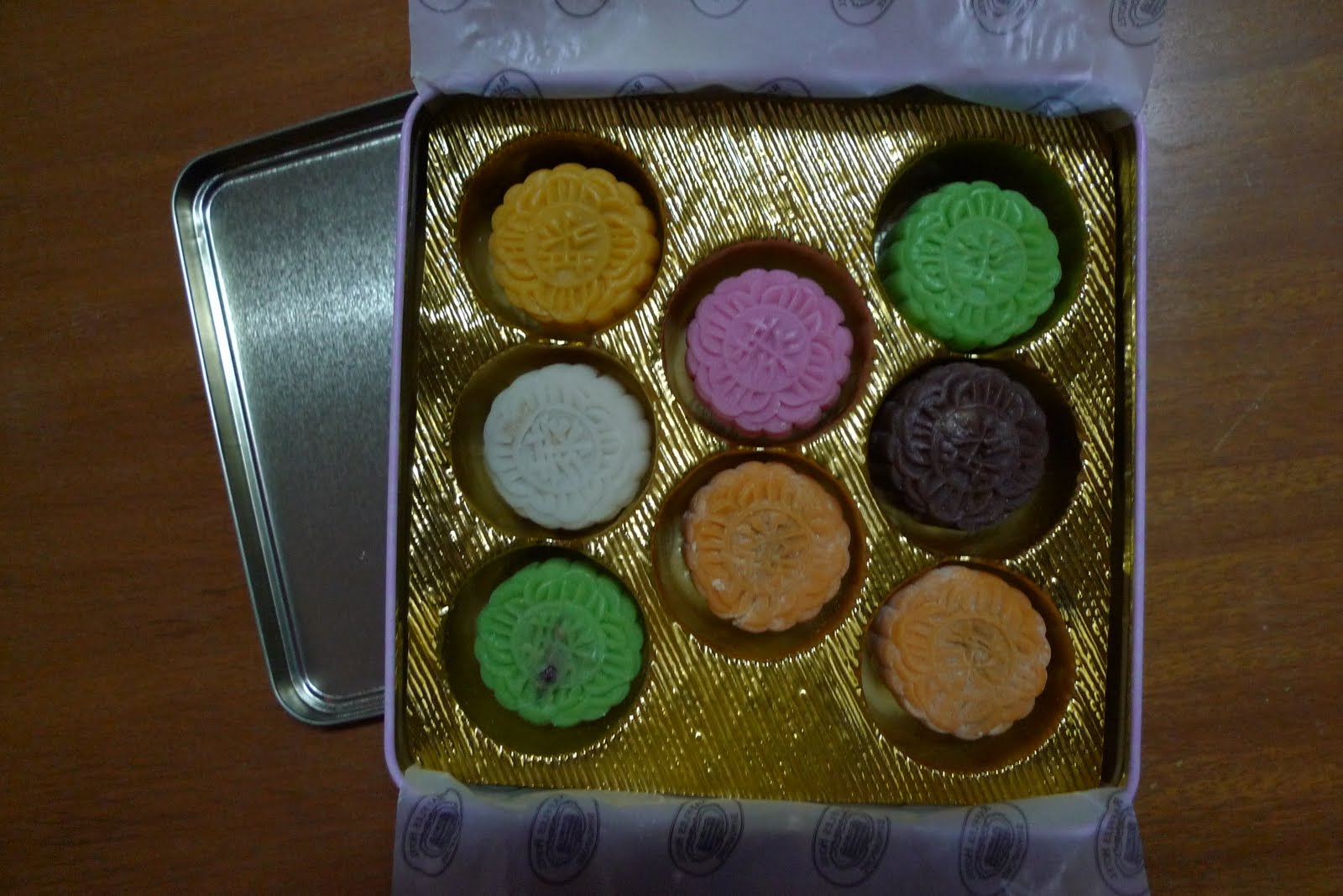
However, my personal favorite is the snowskin mooncake from the Raffles Hotel. It's not just the really pretty tin it comes in -- I can't resist the out of this world flavor varieties that they have.
The best seller is the Snowskin Mooncake with Champagne Truffle and Ganache. This year, they also featured the Hazel Choco mooncake, Cognac Truffle, Dark Chocolate Crunchy Pearl, Apricot with Popping Candy and the Tiger Lily Mooncake.
I always get a combination of flavors in a tin -- it comes out a bit more expensive but I get to try all the flavors. A tin of 8 of the same flavor is S$50 -- not much to pay for a taste trip to the moon and back!
Happy Mid Autumn Festival to all!

Wednesday, August 4, 2010

Rosy's Pancit Malabon - The Gold Standard


Pancit Malabon is one of the few things that I could eat everyday and one of the things I have a regular craving for. I grew up in Malabon when it was still called Malabon, Rizal and my eating habits and food preferences are rooted in that place.
Malabon City as it is known today is a far cry from what it was in the 60's and 70's but food wise, it has remained quite unchanged.
So, I can still get sapin sapin from Dolor's, que kiam and broas from Betsy's, Rufina patis, tinapang bangus ... most of the things I enjoyed while growing up.
But my utmost favorite is pancit Malabon and when it comes to this dish, there is only one place that brings back that sense of place and that is Rosy's Pancit Malabon.
Owned and still run by the Pacheco sisters, Rosy's in the 60s was already a Malabon landmark. It started as a small simple eatery in Cuatro Cantos and famous people flocked to it for take-out bilaos of pancit. Rosy's fans included then First Lady Imelda Marcos, Susan Roces and FPJ, writer Julie Yap Daza and other celebrity name-droppeables.
We would go to Rosy's for a mid afternoon snack and find a queue of "out-of-towners". We knew they were not from Malabon because they came in cars and not on foot or by "stainless" jeep.
What made Rosy's so special and so different from the rest, when you could find pancit malabon in practically every corner? I specially liked Rosy's because the sauce to noodle ratio was just right -- each noodle strand coated with the sauce but never cloying or soggy. It was perfectly seasoned, didn't need any patis or calamansi.
As early as then, Rosy's knew the importance of food styling. Each bowl of pancit malabon would come perfectly arranged and topped with the plumpest, pinkest shrimp, bright green crunchy pechay baguio, fat oysters, flecks of roasted garlic, tender julienned pork. It looked just as good as it tasted.
In the 80s, Rosy's decided to import the pancit malabon to the big city and they opened a branch at Philtrade along Roxas Boulevard.
Philtrade then was spanking new, with lots of restaurants, exhibit and trade halls. More than twenty years later, it has gone to seed. The restaurants and exhibit and training centers are gone and in their place is a flea market of dubious "antiques" -- wooden retablos, santos, china cabinets, odds and ends.
Rosy's still exists though -- at the end of Philtrade there is a rather rundown un-airconditioned hall where the best pancit malabon this side of the world is still cooked and sold every day.
Lunchtime finds Rosy's busy with regulars who obviously love the food. I've had pancit malabon sitting next to senators, mayors, generals, politicians ...
Like its main store in Malabon, it's a very simple and humble place -- the Pacheco sisters still rule over the kitchen. Now, they have some of their next generation relatives helping out.
Aside from just pancit malabon, they have "escaparates" of home cooked viands -- ginataang labong, dinuguan, bopis, sinigang, paksiw and tochong bangus, misua with bola bola, okoy -- all the things you used to eat at home but are now too busy to cook yourself. But all these of course pale in comparison to the real star ... that bowl of yellow golden yumminess called pancit malabon.
I make the trek to Rosy's as often as I can -- when the craving for a taste of Malabon and childhood is just too much to bear. Who says you can't go home again?