Friday, September 12, 2014

How to get from Osaka to Ise-jingu on the Kintetsu Ltd Express


Travelling solo on a train in a land where I hardly speak the language -- that's exactly the kind of travel that I love.
On this last business trip to Osaka, I stayed an extra day so I could do just that,  meander off on my own, on a short day trip, out of the comfort zone of the city.
Thanks to Hyperdia, that fount of information on the Japanese train system, I was armed with all the details on trains, stations and timetables that I needed for this day trip to Ise-jingu, the most important Shinto shrine in Japan and just a two hour train ride away from Osaka.


My journey started very early.  I wasn't sure how easy it would be to navigate my way around Namba station -- a vast underground maze where it would be so easy to get lost in.
I took a cab from the hotel and asked the driver to take me to the Kintetsu Station in Namba and was  surprised that he dropped me off in this building, a block away from the main station.


But it was a pleasant surprise!  The Kintetsu and Hanshin train lines share this easy to get to entrance.  No need to enter busy Namba station at all!


Because Ise-jingu is a major destination for tourists, directions and instructions were well marked, in both Japanese and English.


There are quite a number of ways from Osaka to Ise-jingu but the fastest way is via the Kintetsu Limited Express which will zip you to Ise City in just under two hours.
Because it is a Limited Express train,  it is reserved seating all throughout and costs 3,120 yen for a one way ticket.
In my excitement, I got to the station way too early for my planned 7:05 a.m train and thus, ended up making it in time for the first trip at 6:05.


The platform is just below the ticket station.  I had barely gotten down when the train pulled in, making me miss out on one of my favourite train rituals in Japan -- buying the eki-ben or the special bento box sold chiefly in train stations.  I would have no breakfast on the train.
Zannen desu ne!


From my window seat,  I looked out on bucolic and tranquil scenes of rural Japan -- a far cry from skyscrapers and concrete roads.  This is why I always try to squeeze in an out-of-town day trip every time I am in Osaka or Tokyo.  And thanks to the fast and efficient Japanese train system, I am able to see some of the beautiful countryside whenever I can.


 Before long, the train had stopped and dislodged us at Iseshi, the station closest to Geku, the outer shrine of Ise-jingu.  This grand Shinto shrine is composed of two shrines -- Geku is the Outer Shrine and the more important shrine is Naiku, or the Inner Shrine.


From the station platform, signs point travellers in the direction of the exit towards Ise-jingu or Geku.


The Kintetsu Limited Express stops at the platform designated for Kintetsu trains but the exit for Geku is closest to the JR trains exit.


It was not even 8:00 a.m. when I exited Iseshi Station.  Again, I was glad to note that there were prominent signs pointing to Ise-jingu.  Dear reader ... trust me.  It is impossible to get lost  if you travel by train to Ise-jingu.


The outer shrine or Geku is a mere 500 meters from Iseshi Station. This huge signboard is hard to miss.


There is also a large map of Ise City, showing where you are in relation to Geku, Naiku and other places of interest.


A large unpainted torii marks the exit to the station and leads you to the street that will take you to Geku.  The torii is made of cedar and I actually got a whiff of the fragrant wood as I passed by.
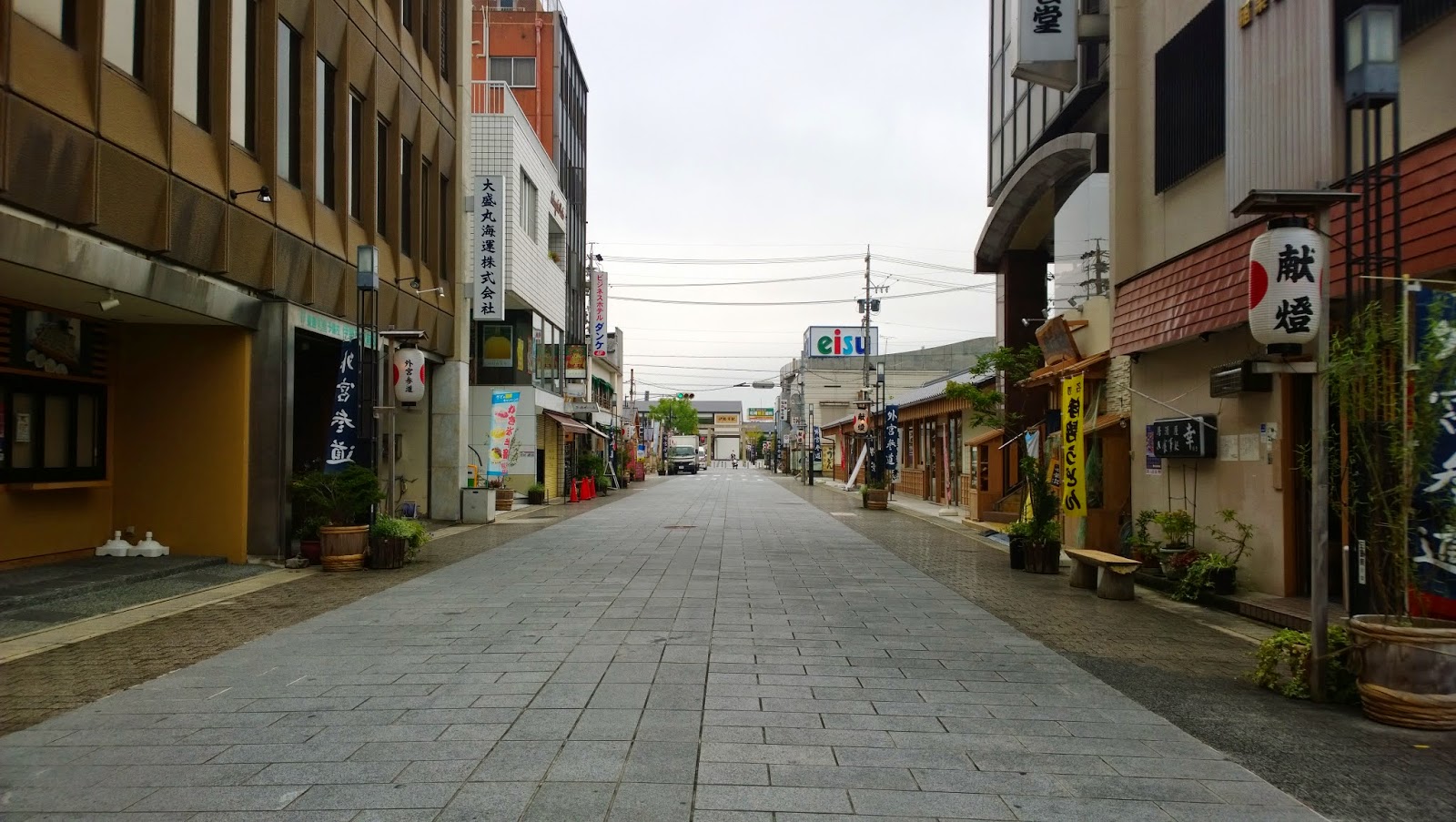

Since it was early, the souvenir shops, restaurants, cafes on the street leading to Ise-jingu were still closed.


It was a short walk to get to this wide avenue -- the crosswalk led me to the entrance of Geku, the Outer Shrine of Ise-jingu.


There were just a few of us at this hour at the shrine.  The small bridge you see on the left side marks the entrance to Geku.  There is no payment or entrance fee to the shrine.   I even got a free map in english when I stopped at the small guardhouse.


After my visit to Geku, it was time to head to Naiku.  The Inner Shrine is 3.5 kilometres away and there is a  bus that you can take from right across Geku.  Again, the destination is clearly marked. There were quite a few people waiting in line for the bus.


 To Naiku, the fare is 420 yen.  Pay as you exit by dropping the exact number of coins in the little box beside the driver's seat.


After a 20 minute ride through Ise City, the bus made its final stop at Naiku, right across the entrance to the shrine.  Since this was much later in the morning, more tourists and pilgrims had arrived.  The temperature had also shifted from an early morning cool to a blistering and humid mid-day heat.


After my visit to Naiku and lunch (more about that in a later post), it was time to head back to Iseshi station where I planned to catch the 12:52 train back to Osaka.  To take the bus back to the station, I bought my tickets first from the shop directly across the bus stop.


 Buses going around Ise City come around every 15 or 20 minutes so I didn't have to wait long before my bus bound for the train station arrived.


I took my seat right by the exit and  dropped my ticket in the payment slot.


I got back to Iseshi Station with plenty of time to spare.  However, instead of being able to buy a straight ticket to Osaka Namba station where I had gotten on earlier this day, I had to make a transfer at Osaka Uehommachi and take the regular Kintetsu tram to Namba.


From Osaka Uehommachi, it was one level down to the platform for the Kintetsu Nara Line which dropped me off at Namba.  I was back in my hotel before 3 p.m.
Thanks to the efficient train system and the many directional signs in English along the way ...
going solo to Ise-jingu was easy and worry free!

Tuesday, September 9, 2014

Taking a Turn on the Hep 5 Ferris Wheel in Osaka

Roller coasters have never been my thing. Why pay and wait in a long line for a few seconds of gut wrenching misery?  I am a ferris wheel kind of girl ... the slow, steady ascent to an eye popping view.  
I cannot pass by a ferris wheel without stopping for a ride.


I had always wanted to take a spin on the bright red wheel atop the Hep 5 Mall in the environs of Osaka Station.  I had caught glimpses of it from past trips and wondered when I would be able to get on board.  This last business trip to Osaka -- before the business part actually commenced, I found myself right outside the entrance of Hep 5.  There looming above me was the ferris wheel, framed against the darkening Osaka sky.  Of course I walked right in.


Don't be surprised to  find a huge red whale once you walk into Hep 5.  A colossal cetacean dangling from the ceiling probably lures shoppers in.


 An elevator took me  to the 7th floor where I boarded the ferris wheel.  I was afraid there would be a queue and was happy to see that on this Wednesday night, business was relatively slow.


What a thrill to see the city scene from my air-conditioned gondola.  I got to appreciate the architecture of Osaka Station, seen from this vantage point.


Far off in the distance, squeezed between those two buildings is the Osaka Tower.  Much closer and right smack in the centre of the photo above is  H&M -- where I had just been window shopping.  I'll take a slow ferris wheel ride over shopping any day!


 I tried to capture a panoramic shot of my view, catching even part of the giant red wheel in the frame.


It was a beautifully clear night -- perfect for a ferris wheel ride.  After a while, I stopped  taking photos and just sat and enjoyed the view.


All too soon, it was time to get off.  My sweet and slow ride took just 15 minutes.  But it gave me the time to exhale,  release all the tiredness from work and put me in the right frame of mind for the business meetings to come.

Monday, September 8, 2014

Comfort me with food -- Remembering Bambi over dinner at 27th Bascon, Bacolod City


Sometimes, food is the only thing that can make you feel a little better.  A few weeks ago, I lost a dear and wonderful friend -- too quickly and too suddenly.  No one had the chance to say good bye.
Bambi Borromeo, friend for over 35 years, was a true blue "Bacolodian" and in a serendipitous turn of events, suddenly found himself immersed in a second career after retirement -- as indefatigable and much sought after tour guide in his beloved hometown. 


These past years I had been to Bacolod to visit Bambi and had taken his tours a number of times -- he put a lot of effort and work in planning the perfect itineraries for me -- and yes, it always ended with a fantastic, sumptuous Ilonggo meal.


I discovered Emma Lacson's most scrumptious pili tarts through Bambi, who whisked us up to the owner's kitchen to see, to taste and yes to buy.


Thanks to Bambi, my friends and I were able to gain access to places that no ordinary tour guide could have arranged for --  such as the esteemed Rev. Monsignor Gaston's ancestral home, Hacienda Rosalia.  Because Bambi was a good friend of the Monsignor's, we were treated to a feast of the family's favourite recipes, not the least was the Monsignor's very own french onion soup.


From a Spanish era hacienda to a seaside kubo (native hut) on stilts over the mudflats of Balaring Bay ... every meal with Bambi was a discovery of the richness and expansiveness of Ilonggo cuisine.


And throughout each meal, Bambi gamely discoursed on the origins and back story of what we were eating or who owned the restaurant and what its history was -- always told with the perfect blend of information and entertainment.   


Here's a photo of Bambi and me at Pendy's in Bacolod -- probably waiting for our batchoy to be served.  I am grateful for all the inasal, piaya, mango tarts, laswa, tinola, etc etc that we shared together. 
Not to mention the bottles of wine and beer from our "salad days" as Will Shakespeare would have said (and Bambi would have agreed, being the erudite Atenista and English Lit major that he was). 
So I am sure, as I write this with a heavy heart,  that Bambi approves of my having found comfort and solace in a good meal during my short trip to Bacolod to attend his wake.  
He would have understood the fact I made the time to have a good dinner, in a place that he definitely would have endorsed.  
Forgive me ... this is a hybrid tribute and food post but it's hard to separate Bambi from my Ilonggo food memories as he gave me so much to taste and treasure.


It made perfect sense to have a pre-wake dinner at 27th Bascon, which was right across the funeral parlour.  It may seem gruesome but as Bambi would have said in his own inimitable fashion ...
"Hala Mamoosh,  go!"


The menu is of a blend of both  Ilonggo and spanish-influenced dishes.  We had their version of a black paella which interestingly had the black rice and the squid set off on opposite sides of the sizzling plate.  The squid was marinated in a slightly sweetish spicy sauce which made me think of chinese food.  It may have been a slightly confused dish but no matter -- it tasted good.


We  ordered the Ilonggo standard -- KBL or kadyos (a black bean), baboy (pork) and langka (green jackfruit).  The soup was pleasantly sour and the pork was very tender.  I loved the langka but I wished there were more of the kadyos.


This was my dinner mate and another of Bambi's dearest friends.  Abe Florendo is one of the country's foremost  feature writers  and has been a lifestyle editor in many major publications.
We had hoped to toast Bambi's life and friendship with a good bottle of wine and some cheese but 27th Bascon only had beer.
I guess our wine and cheese party in his honour will have to wait.


As we were in the sugar capital of the Philippines, it would have been remiss and thoughtless
(and Bambi would have been aghast) if we did not end our meal with dessert.
In addition to the restaurant, 27th Bascon has a cafe right next door specialising in sugar laden cakes, pies and desserts.
Abe and I shared a mango pavlova -- plus strong black coffee to fortify ourselves through the rest of the night.


I spent just about 12 hours in Bacolod.  I was up at dawn to catch the first flight back to Manila.
A short but much needed trip -- comforting to have paid my last respects to an unforgettable friend and comforting too to have enjoyed a good meal in his honour.


Bambi Borromeo 1950 - 2014
Till we meet (and eat) again


Thursday, August 28, 2014

Terrific Tsukemen and more at Mitsuyado Sei Men


Manila has certainly become ramen crazy.   I remember when good old Shinjuku along Makati Avenue used to be the place to hie off to satisfy ramen cravings in the dead of the night.  Now, you can find ramen everywhere.


Mitsuyado Sei-Men along Jupiter Street is part of the UCC group in the Philippines but is not part of a ramen chain in Japan.  While they offer different varieties of ramen, it is their tsukemen that I think is quite outstanding.  
  

I've read quite a number of reviews that have commented on the Japanese old style feel of Mitsuyado.
There are quite  a number of kitschy items that do give you that kind of vibe.


What isn't so Japanese, to my mind is the space the restaurant occupies.   
Mitsuyado is quite big -- the ramen places in Japan are much smaller in comparison with just counter space plus a few tables.  Which is why the better and more popular ones always have long queues during mealtimes.  


While I have yet to try their ramen, I will wholeheartedly recommend the tsukemen.
This is what I had the first time  -- ajitama tsukemen with a side order of bamboo shoots and more ajitama.  I could detect a touch of yuzu in the broth which made it light and quite refreshing.
You have a choice of hot or cold noodles  although the waitress will recommend that you get the cold variety.


The next time we visited Mitsuyado, I opted for the giant chashu tsukemen.  The broth was a bit richer, more garlicky and peppery.  It came with two generously sized chashu slices and a whole egg.  This was more filling than the ajitama tsukemen and I would suggest this for hungrier diners.


Ou third time at Mitsuyado, we tried some of the side dishes.  The gyoza was forgettable which is too bad since it's the traditional "pares" (partner) of ramen.
But surprise surprise -- the karaage was great, deep fried but not at all oily -- it was crisp, juicy and flavourful.  Very authentic tasting too.  It was cut up in bite sized, easy to eat pieces.
We also ordered the chashu bun.  Think of a soft cua pao bun filled with generous slices of soft, melt in your mouth chashu, dripping with porky juices.  The first bite yielded an explosion of taste and sauce -- which unfortunately landed on my shirt sleeve.
There's a smidgin of mustard on the side which adds some sharpness to the almost cloyingly rich taste.
While it was indeed succulent, it was not inexpensive and not as generous a serving as with the rest of the menu items.


Mitsuyado serves ice cold beer -- aside from our local San Miguel and Japan's number one Asahi beer, there is also Hitachino Nest White Ale, a belgian-style pale beer brewed in Japan.  
It has a spicy, fruity complex taste and pairs well with anything on the menu.

Monday, August 25, 2014

Sinugba ni Abdul in Tagbilaran, Bohol -- Chicken Ati-Atihan "Mapapasayaw ka sa sarap"

It's always exciting for me to discover gems of good eating when I travel around the Philippines.  Instead of playing it safe in fast food chains, I would rather take my chances on the unheard of and the untried.  
Just last week, we spent a long week-end in Bohol and right at the start -- unearthed this local and popular eatery called Singuba ni Abdul Chicken Ati Atihan.  


 We were starving when we arrived just before 11 a.m. and right off the bat, even before we took off for our planned tour of the  Chocolate Hills, we asked our van driver, Mang Dodie to take us to the best local place he could recommend. He drove us to Sinugba ni Abdul , located along Maria Clara street, just a few minutes away from the Tagbilaran Airport.


We got to the restaurant well before noon so there were plenty of tables to choose from.  The decor is definitely family friendly with wooden tables and benches that are easy to pull together, perfect for large groups.  There is no air-conditioning but the open set up allows free flowing breezes through. Lots of ceiling fans help keep the air cool and also, keep you from smelling like chicken inasal!
The place is also very clean and well maintained.


 At the entrance is this charcoal open grill where skewers of marinated chicken inasal are being readied for the influx of the lunchtime crowd.


This is the reason why it's called "chicken ati-atihan".  The slogan proudly declares "mapapasayaw ka sa sarap" or "so delicious, it will make you dance".  Referring of course to the local Visayan festival ati atihan where revellers dance in the streets.


 Aside from the specialty which is sinugba or grilled dishes, there are quite a number of choices from the menu.  Including the ever popular crispy pata, pancit, bistek and tinola which is really sinigang, done the Visayan way.


Our fish tinola was a good generous serving and refreshingly tart and gingery.   One order was big enough for all six of us to enjoy.


It wasn't anyone's birthday but I invariably order pancit bihon guisado. For me, a good cook will always know how to serve good pancit.  Sinugba ni Abdul served a more than decent version -- the noodles were neither oily nor dry but well cooked and tasty.  Like the tinola, it was a generous serving and we had to take the rest of it in a bag "for later".


My son ordered his favourite "pecho with garlic rice".  According to him, it was far better than the usual inasal available in Manila -  marinated with the right blend of sinamak or native coconut vinegar and other seasonings like lemongrass, ginger and black pepper,  it was served hot off the grill, fragrant and juicy. Like a popular nationwide chicken chain, the inasal comes with unlimited rice.


To round off our orders, we also had a  fresh slice of tanigue which was perfectly grilled and a hot plate of sizzling stuffed squid. 
Every dish we ordered at Sinugba ni Abdul was good, every thing was delicious.  Satisfied and full from a delicious lunch,  we were now ready to discover the other wonders of Bohol!


Wednesday, August 13, 2014

"It was a dark and stormy night" at Ted's La Paz Batchoy, SM Bicutan

On our way home a few rainy weeks ago, we decided to get in out of the storm and have dinner at SM Bicutan.  There are not too many options aside from fast food outlets in this mall but there is one unpretentious spot in the basement that serves reliably good comfort food.


It's a strange but revealing name -- Ted's Oldtimer Lapaz Batchoy tells it like it is.  Yes, it's quite old, yes it's from Lapaz in Iloilo and yes, the specialty is that very simple, traditional Ilonggo noodle soup, batchoy.  Just the perfect comfort food for a "dark and stormy night".


I prefer my batchoy with yellow egg noodles although Ted's also has thin, rice noodles or bihon.  
We ordered the "special", which is a good sized serving.
Their batchoy broth is clear but the flavour runs deep.  I presume like home made batchoy broth, 
it is made of pork and or chicken bones, slow cooked over a low fire and seasoned with that very Visayan ingredient -- guinamos.  
Guinamos is made with either anchovies,  herring or other small fish that has been  brined, aged and fermented.  Authentic Ilonggo batchoy includes  guinamos -- which adds a complex saltiness to the soup.  It reminds me of the use of bonito flakes in dashi -- that quintessential ingredient in good Japanese soups.
What makes Ted's batchoy even more hearty is the generous addition of chopped chicharon  or pork crackling and slices of pork meat and pork liver.  
If all these ingredients are a bit much, order some puto or pandesal to help cut through the richness.


If you need a bit more sustenance than a bowl of fragrant steaming hot batchoy, Ted's has value meals that pair a mini bowl with viands like daing na bangus, grilled pork chop, even sisig and chicken, inasal or fried.


We enjoyed our unsophisticated, no frills dinner at Ted's.  It was a straightforward, honest to goodness taste of Ilonggo cooking.

Monday, August 4, 2014

A Return to my food roots -- Sincerity Restaurant in Binondo

Whenever I see an old style Chinese restaurant, I invariably remember my father and his penchant for comida china and hole in the wall panciterias.  Growing up in Malabon, he and I would often hop on a jeep and ride all the way to Sta. Cruz in Manila where we would get off and walk through Tomas Pinpin,  Salazar, Florentino Torres, Carvajal, Ongpin, Quintin Paredes, Escolta, Marquina, Nueva ... and just stop in his various favourites.
He had a special panciteria just for lomi, another one for chami, still another one for machang, and so on and so forth.
If we were celebrating something, a birthday or a promotion or yes, good grades on my part, we would always have a meal at Moderna, right across Sta. Cruz church where the owner was also a family friend.
Most  of our old haunts have disappeared, some have moved out of Chinatown but some are still there, surviving and thriving through changing food trends and tastes.


One of our favourite restaurants was Sincerity, which I am happy to say can still be found along Nueva Street.  A bit of personal trivia -- Sincerity and I were both born in the same year so I have a particular affinity for it -- not to mention its famous oyster omelet and fried chicken!


Last week-end, I decided to haul the family to Sincerity for a nostalgic (on my part) lunch.  We arrived just before noontime and had to take a table on the second floor - I was happy to see that despite the many fast food choices in the area, Sincerity still packs the crowds in.


The second floor is actually less crowded and busy than the first floor, where the cramped kitchen is.
Most of the tables are occupied by big groups -- most likely officemates working in the Chinatown area.


Since Jay is allergic to oysters, I couldn't order Sincerity's best selling dish.  I did get two kinds of rice -- a small cup each of kiampong and Sincerity fried rice.


Sincerity makes very good chami guisado -- a very savoury noodle dish that uses fresh fat, yellow noodles.  It's like lomi without the soup.  My father and I used to eat chami in Chinatown -- for merienda, for lunch or dinner.
Sometimes, not content with having eaten our fill, we'd even take an order home, wrapped in banana leaves and thick wax paper.
Sincerity's chami has that old time familiar taste -- rich from all the meat and shrimp and heavy with the aroma of toasted garlic.


We also ordered que kiam or kikiam.   Unlike the minced mystery meat version sold along with fish balls in street corners, this is the real thing.  Chopped recognisable bits of pork and ham, wrapped in bean curd sheets and deep fried.  It was so delicious!


A meal at Sincerity is not complete without the star of the show -- the fried chicken.
Since it is freshly made and cooked when you order, it also is the last dish to be served at the table.  We had eaten most of our food when our half order of chicken arrived.
I am sorry to say that we lost all control and grabbed what we could -- thus, this is a pretty sad photo of the one piece which survived the onslaught.
It does not do justice whatsoever to this crisp, juicy, extremely flavourful fried chicken -- you can say that it tastes like home made, if you can cook as well as they do, at Sincerity Restaurant.