Thursday, September 1, 2016

Something Old, Something New at Calle Real, Tanza Cavite


It's always a pleasure to discover well and long-loved local restaurants.  With so many fast
food places invading even the smaller towns and municipalities -- it's getting harder to find a restaurant that is so local, it is part of the culinary traditions of the town.  


On our Cavite Culinary and History tour by Clang Garcia's Food Holidays and led by Cavite 
native Ige Ramos, we were assured that we would be visiting (and eating from) as much of this historic province's enduring culinary landmarks as could be fitted into our one-day tour.  
Ige rued that while Cavite has many eateries and dining places that serve  traditional recipes,
 most of these were relatively unknown, except to the Caviteños.
By introducing these places to us non-Caviteños, he hoped that they would reach a new and wider audience. 


Food Holidays'  jeepney-on-steroids and our ride for the day parked in the spacious compound of the ancestral home of the Tahimic family in Tanza, Cavite.  This is where the restaurant Calle Real is located,  run by the descendants of the original owners.


Our group was welcomed into our private own dining room where we were greeted by this lit neon sign.   Cavite hospitality at its warmest best at Calle Real!


Calle Real takes up the entire first floor of this old house.  The interiors are simple but very tasteful.
I loved the elegant chandelier hanging in the dining room.   Ige mentioned that ancestral homes in Cavite do not conform to the magnificent bahay-na-bato that we normally associate ancestral homes with.  Cavite's "ancestral mansions" according to Ige are not as grand and are more unostentatious. 


This is Ms Millie Tahimic Lozada, direct descendant of one of the two Tahimic brothers who 
owned this house.  Together with her husband, they have made Calle Real a showcase of traditional 
Cavite dishes.  Eating at Calle Real is much like being invited into a Caviteño's home, to enjoy 
a meal made from recipes handed down from generation to generation.


We enjoyed fork tender beef caldereta with thinly sliced fried camote on the side.  This was topped with grated cheese, something new to me but which is I suppose how caldereta is served in Cavite


Calle Real served a more modern version of pork binagoongan where deep fried liempo slices had 
been lightly covered with very good, not-too-salty sautéed bagoong.  Lightly blanched eggplant is
the perfect complement.


The dish that I found most unique -- and which Ige said was very traditional and common  -- was 
this noodle dish called "calandracas".  
First of all, I was struck by the name.  When I was young, my father used this word quite often, 
usually in reference to my "kalat" (messiness).  
"Ang dami mong calandracas!"  ("You have so much clutter!") he would say in exasperation, 
while surveying my unmade up room.  
Calle Real's calandracas, is slightly wet but not soupy made with sotanghon, bits of chicken, vegetables and pork.  It must have been cooked with shrimp broth since I could really taste the 
sweet-salty flavour of shrimp.  
Other variants exist,  Ige said some are soup based and use other types of noodles.  It would seem each Cavite family has their own version. 
What is the etymology of "calandracas"?  According to Ige, during Spanish times, when a death occurred in a family, neighbours  came together to help out and donate whatever they could afford.  
More often than not, this was in the form of food -- vegetables from their garden, some fish or 
shrimp caught that afternoon, maybe a chicken from their backyard.  
All these donations made it into one communal dish -- the bits and pieces of kindness and help that people gave to each other in times of distress. What an interesting back story for this Cavite specialty.


Ige said that cooking with squid ink is very common in Cavite -- he claims that Caviteños introduced the use of squid ink in food  to the Mexicans via the Galleon Trade.  We all know paella negra which is squid ink paella.   I enjoyed Calle Real's version -- so tasty, with full-on squid flavour.  It almost tasted as if the rice had been cooked in adobong pusit!


After that lunch of delightful Cavite dishes, Ms Millie invited us all to go upstairs and tour the 
rest of the house. 


If Calle Real is for groups and families and serves traditional home cooked Cavite favourites, 
Ms Millie has transformed the upstairs part of the house into a very comfortable hang out place 
for younger Caviteños.  A dainty table greets us as we go up the stairs and gives a hint of what's 
in store.


Isn't this just too charming?  The second floor of the ancestral Tahimic Mansion has taken on a new look!  Swathes of bright pink, baby pink, light pink, carnation pink -- all shades of pink  are festooned in between the antique furniture and decor.  This place is called ... what else but The Pink Table.


The rooms of the house which used to be the family's bedrooms and sitting rooms are now
small parlours where guests can sit, have coffee, iced drinks and light snacks.   The Pink Table 
is adorable --  girly, whimsical  and yes,  so instagram worthy! Notice the antique wooden chairs?


Here's how they blended the old with the new in this slightly bigger but oh-so-cozy room -- period chairs and the sofa are spruced up with chintzy floral cushions, pink velvet pillows and dark pink curtains. Notice the "sliding panels" on the window?  These are common in old houses and allow fresh,  cooling breezes  to flow through.  It's the pre-cursor of air-conditioning!


A small dining table has been placed in this room with pretty mint green walls.  Floral, lightly faded curtains add a country cottage touch.  Small frames with sayings such as "I love you a bushel, a peck and a hug around the neck"  keep the mood sweet and light.


I expected nothing less than these old fashioned coffee cups!  


These vintage  creamer and sugar sets certainly look very much at home at the Pink Table!


I was too full of calandracas and paella negra from Calle Real so I begged off from trying the cinnamon dusted churros served with Cavite's special chocolate eh.  I did try a cookie which reminded me of camachile biscuits.


Here's our entire tour group gathered in the delightful sala of the Tahimic Mansion, now also known as The Pink Table.  There is our host, Ms Millie seated on the leftmost --  most appropriately dressed in a pretty pink blouse and shiny pink flip flops.  
Who would have thought that I would find this enchanting and yes uber-pink coffee nook in the middle of Tanza, Cavite?


It was certainly a treat to have discovered  a local restaurant steeped in local culinary traditions 
plus a contemporary, cozy cafe' -- right in the same place.    Here's to Calle Real and The Pink Table ... old and new existing beautifully together!

SaveSaveSaveSave

Sunday, August 28, 2016

Bienvenido a Mercado del Ciudad de Cavite y Carinderia al Aling Ika!


Hola!  Que tal man usted? 

Chavacano, a spanish style dialect is still spoken in very few places in the Philippines -- the most well known are Cavite and Zamboanga.  Jay and I recently took a Cavite Culinary and History tour  and I heard chavacano being spoken,  right in the heart of the Cavite City Public Market.
It certainly made me wish I had paid more attention during all those spanish classes in high school and college. 


Our air conditioned jeepney arrived at the Cavite City Public Market in Barangay San Roque at a time when most of the early regular shoppers had come and gone.  But since it was a Saturday and "market" day,  the place was still bustling with activity.


Nothing like a visit to the public market to get a feel and sense of a town and its people.  
The orderly and neat palengke certainly speaks well about the people of Cavite City


Our tour guide, Cavite son Ige Ramos walked us through the stalls where the local specialties were sold.  This is his suki for tinapang salinas, a smoked  dried fish that Cavite is famous for.


This little table stocked with homemade bagoong (shrimp paste) and patis (fish sauce)  looked 
so tempting!


I really wanted to buy some of the local patis.   Cavite's patis is darker and more intense with 
a deep, umami rich flavour.  However,  the fear of causing a pungent stink in the coaster kept 
me from taking a few bottles home.


The province of Cavite is a peninsula, jutting out into Manila Bay.  Its location makes it a prime source for fresh fish and seafood.  I hadn't seen torsillo in such a long time!  This barracuda like fish was a favourite of my father's, for making paksiw. 


Another paksiw favourite that my father liked was chabeta.  It was nice to get re-acquainted here, 
in the Cavite City palengke.  If I had explored some more, I am sure I would have found more familiar favourites. 


Kalamay has the power to make me stop dead in my tracks.   This is a bilao of a Caviteño delicacy -- 
a latik-topped rice cake that is eaten with a ginataan sauce.  


We passed by a stall that makes lumpia wrappers -- see the hot griddles where the batter is spooned out.  See also the lumpia wrapper maker napping on one side -- taking a break from the rigours of  lumpia wrapper making.


The lumpia wrappers are packed and waiting for buyers.  When I was young, they were stacked 
in 10s or 20s with banana leaves in between.  Now they're wrapped in more sanitary air tight plastic bags.   I much prefer the old fashioned and environmentally correct packaging. 


The dry goods section has all sorts of indispensable household stuff  -- including these Hello Kitty and robot drummers.


Ige finally manages to shepherd us all to our eating stop --  Aling Ika's carinderia.  I suppose every full blooded resident of Cavite City has at one point in his life eaten and enjoyed Aling Ika's food.  Ige also said that balikbayans  make a beeline for this place, to recapture the much craved for 
tastes of home.


The carinderia dates back to pre-war days so Aling Ika has long since retired to that huge airy 
kitchen in the sky.  Her surviving family members run the carinderia, keeping her memory and 
her best loved recipes alive. 


Since it's past peak dining hours for the carinderia when we arrive, the ulam (viands) in the eskaparate (glass showcase)  are nearly  depleted.  But no matter,  Ige reassured us that he has "reserved" the best for us to taste.  


What we normally call ukoy or shrimp fritters, the Caviteños call "basag ulo" or literally, "smash heads".  "Basag ulo" which is slang for a fight or scuffle refers to the heads of the shrimp, 
pounded or "smashed" for flavour before being fried in a batter along with the chopped vegetables. 
Dip the "basag ulo" in a spicy toyo and suka sauce and experience a pounding of your tastebuds. 


Thank goodness Ige had them put some pancit puso aside for us to try.  This uniquely Caviteño noodle dish uses bihon (rice noodles),  miki (egg noodles) and strands of puso ng saging 
(heart of banana).  
I think the thinly sliced puso ng saging is first made into a  kilawin (cooked in vinegar) before 
it is sautéed with the noodles --  thus giving the pancit a deliciously  light tart taste.  
Aling Ika's version comes with chicharon (pork crackling) pieces which add a salty crunch, tying 
all the flavours together.  
I very much enjoyed my mouthful of pancit puso  and strangely enough, it reminded me of a 
mild version of my all-time pancit favourite ... pancit malabon.   It must be the "maasim-asim, maalat-alat" flavour profile.


Caviteños love their chicharon.   The fresh vegetable lumpia or lumpia fresca as they call it in chavacano is generously topped with more chicharon bits -- a welcome variation from the chopped peanuts that I am normally used to.  The lumpia is so good, there is no need for any sauce. 


Aling Ika's tortang alimasag (crab omelet) is one of her best sellers.  It's such a crowd favourite that the carinderia runs out of it very early in the day.   Thankfully, one large slice had been set aside for us so we each had a small bite.  
The tortang alimasag was excellent!  The crab was sweetish and fresh and tasted like it had just 
been  caught that morning -- as it probably had been.  
No extenders or fillers in this torta -- just a generous amount of fresh alimasag sautéed with 
onions and tomatoes,  with a bit of red pimiento perhaps?  A bit of paprika maybe?  I guess I'll just have to eat more to find out!


For dessert, we just had to try Aling Ika's version of the popular bibingkoy.  It starts off as plain 
mochi -- glutinous rice cake squares with a browned almost blackened top crust and filled with 
soft sweet red beans.   We have the same rice cake in Bataan, where I come from.   I have always liked the gooey-gummy mouthfeel of mochi. 


But wait, don't eat that bibingkoy just yet!  Wait for the coup de grace  --  a topping of  creamy, 
rich ginataan (coconut cream dessert)  mildly flavoured with langka (jackfruit) and studded 
with bilo bilo (glutinous rice balls).    I felt like I was eating two things at the same time, the chewy, bean filled mochi and the classic ginataan.  Dessert overload at Aling Ika's carinderia!


It's business as usual despite all of us crowding around and trying to take photos of the carinderia and the food.   Ige said that food runs out as the market closes towards noon so if you want to eat at Aling Ika's and order the specials, it's best to get there bright and early!


I leave Aling Ika's and the market with smiling tastebuds.   It's unheard of that I go to the palengke and leave without buying anything.  But we still had a few more stops to go on our Culinary and History tour and the things I wanted to buy were either perishable (the fish) or potentially "offensive" (the patis).  It does give me the perfect excuse to plan  a trip back to the Mercado del Ciudad de Cavite soon! 

Gracias,  anda ya yo! 


SaveSave

Monday, August 15, 2016

Baloy Bakeshop's Ensaymada - A delectable Cavite find!


The ensaymada has long been a Pinoy panaderia (bakery) staple.  If you spell it with an "i" as in "ensaimada", you would be referring to its close cousin -- the "ensaimada de Mallorca" which is a popular sweet bread in Spain.  
You can find ensaymadas in high end bakeshops, with a topping of crumbled Edam cheese or you 
can buy them from your neighbourhood panaderia where it is smoothed over with sugar and Star margarine.  
I like my ensaymada with a bit of crust and a chewy and not too soft  texture -- the proof of the ensaymada for me is the "pull" when I  bite into its golden, buttery interior.


On the recent Food and History Tour of Cavite conducted by Food Holidays, one of the "shopping" stops was Baloy's Bakeshop, a popular and well loved panaderia in Cavite City.  It's located along 
the Manila Cavite Road, right after you pass the welcome arch.  Drive slowly or you may just miss 
its unassuming facade.


When I was growing up, left over menudo or any other stew from the night before was frequently heated up for breakfast.  The sauce was perfect for sopping up with pan de sal.  Baloy Bakeshop's eskaparate (glass showcase) of menudo, caldereta and corned beef filled pan de sal brought back 
all those fond breakfast memories. 


Our tour guide, Caviteño historian Ige Ramos told us that Baloy's started out as a carinderia.  
From this modest beginning,  the family was able to send the children to school -- they are now 
all grown and have successful careers of their own.  
The carinderia has been expanded to catering services but a small eatery inside the bakery 
continues to serve snacks to loyal suki (patrons).


Ige brought us to Baloy's Bakeshop so we could sample it's singular specialty -- its ensaymadas.
Packed in unique octagon shaped boxes (reminding me of a hat or milliner's box) the ensaymadas 
are apparently the house bestsellers. 


We were fortunate to meet Mr. Tony Baloy -- chef,  master baker and proprietor.  
Mr. Baloy proudly calls himself a former OFW (Overseas Filipino Worker) --   he worked for
more than twenty years as Chef on board a Royal Caribbean Cruise ship.  
Mr. Baloy said that the octagon shaped box is his homage to the ensaimada de Mallorca which 
he  had tried on one of his shore excursions.  The Spanish ensaimadas come in similar packaging.  
One major difference is that these blue and white boxes have Mr. Baloy's smiling face on the cover, 
a nice way to personalise and authenticate his product. 


Of course I bought a box of Baloy's ensaymadas!  And I wasted no time in having it for breakfast 
the very next day.  Just by looking at it, I knew I would like it.  It had a thin, well browned crust, 
old fashioned grated cheddar cheese,  and just a light dusting  of sugar.  It also had that perfect brioche shape,  with a "topknot" right in the centre.  


Baloy's ensaymada is hands down, one of the best I have ever eaten! See how it pulls apart easily? 
It's well packed and a bit dense and is buttery and chewy.  My idea of a perfect ensaymada. 
Aside from the classic ensaymada that you see above,  it comes with fillings like ube, Bavarian 
creme and an irresistibly caramel-ly dulce de leche. 


It was such an honour to meet Mr. Baloy himself -- hardworking, humble and so hospitable during our short visit to his bakeshop.  I look forward to tasting those ensaymadas again. They are definitely worth the hour's drive from my house to Cavite City!

Saturday, August 13, 2016

A new meaning to KKK - Kasaysayan at Kainan sa Kavite. Highlights of Food Holidays' #eatyourhistory Cavite Tour


Fifty years ago ... I can't even believe that I'm actually starting this post with those words ...
but yes, fifty years ago when I was a child (let me qualify that),  my family and I would
go to Cavite every summer.
We would drive all the way from Malabon, Rizal where we lived,  through Las Piñas (the
Coastal Road and Cavitex were still very much in the future),  past the salt flats and the
roadside  talaba (oyster) vendors until we reached the "in" summer destination of the 50s and
the 60s,  Lido Beach Resort.
Unfortunately, Manila Bay became more and more polluted until finally, we had to stop going
to Lido Beach.  We also somehow stopped going to Cavite.  And much later on,  the roads became
too congested that there was just no reason to venture this way.
So when I received an e-mail from Clang Garcia of Food Holidays telling me about their upcoming Cavite Culinary and History Tour, I signed up for Jay and myself -- it would be a chance for me to visit Cavite again and see what I had missed out on all these years.


The tour started off from Manila Bay Walk, bright and early on a Saturday morning.
Food Holidays owns and runs #jeepneytours where you get to ride on a colourful air-conditioned jeepney-on- steroids,  it's big enough for 20 people --  such a fun and eye catching way to travel around in.


This is Clang Garcia orienting us on what we could expect from today's tour.  Clang is the owner of Food Holidays, creator of #jeepneytours and  a hardworking and passionate advocate of Philippine tourism.   Can I also add how charming and pretty she is?  


Our guide for today's tour was Ige Ramos -- proud son of Cavite, historian, author, graphic designer, and passionate proponent of Cavite's heritage and culinary traditions.  He proved to be a most informative and entertaining guide, peppering historical and cultural facts with interesting anecdotes and behind-the-scenes tidbits. 


Clang's sub-title for this tour was "One Day Culinary Tour, 400 Years of History".  So of course I expected to taste Cavite's gastronomic delights as we traipsed around her historical sites.  First stop was  a filling breakfast at Malen's in Noveleta where the salty creamy quesillo, a soft white cheese made from buffalo milk was my favourite. 


A true mark of a native son is knowing practically everybody and anybody -- Ige had an all access pass to take us behind the scenes of Cavite's food landmarks  This is the pre-war oven of Dizon's Bakery in Cavite City that still bakes their famous bonete and salakot buns.


At yet another stop, we learned how the famous Bibingka Samala is made -- from coconut to gata to the bibingka itself.


I was so happy to see that the Cavite City Public Market was part of the itinerary.  The local 
palengke is a colourful, lively and sometimes frenetic way to fully immerse yourself in a new place.  
Saturday is market day at the Mercado del Ciudad de Cavite and thus the perfect time to visit.  


At the palengke, Ige made us all try bibingkoy from the very popular and long standing Aling Ika's Carinderia  (which deserves a separate post unto itself!).  Bibingkoy is a mochi-like rice cake stuffed with sweet red beans or munggo.  We have something very similar in Orani, Bataan where I am from but what makes this particular version unique is that it is slathered with a ginataan sauce -- making it even gooier, richer and yes, yummier.


Lunch was at Calle Real in Tanza,  a well established and very local restaurant set in an ancestral home.  This was where I tasted calandracas (fascinating etymology but more on that on another post) 
a slurpy but not soupy sotanghon dish that hit all the right notes.


From Tanza, it was an hour's drive to Maragondon, time enough to nod off in the air conditioned cocoon of our jeepney-on-steroids. Maragondon is a sleepy little town with two very important sites.  One is the church of Our Lady of the Assumption,  established by the Jesuits in the early 1600s.  
This is a designated National Cultural Treasure, impressive and imposing with its spare, clean lines.


Maragondon's other must-visit spot is just a few blocks away from the church.
My favourite part of the tour was a visit to this museum that I had never heard of.  This is the 
Museo ng Paglilitis ni Andres Bonifacio or Museum of the Trial of Andres Bonifacio.
Established in 2001 in the original house that served as the trial venue and very well maintained by the National Historical Commission,  it is a  powerful and moving place but sadly, I think it suffers from a severe lack of promotion.  
I believe this  important museum which shows an objective, historical account of the Supremo's last days,  should be more well known and visited by many Filipinos, specially students (more on this museum in a later post). 


The tour ended with a visit to the Aguinaldo Shrine in Kawit, Cavite.  Interestingly, it was one of the first places we had passed by this morning so in my mind, we had come full circle.  I have been to this place a number of times before and was happy to see that it is even more well run now.


Our stomachs had to come full circle too.  After a thorough tour of the house by one of the 
Museum's very knowledgeable guides, we enjoyed our last Cavite specialty for the day -- 
Pancit Choku en su Tinta or noodles in squid ink sauce.  Topped with thin slices of unripe green
kamias and liberally sprinkled with toasted garlic, it was a delightful ultimate taste of Cavite.  
The kamias added a tart and sprightly flavour (not to mention it looked really pretty against the black noodles)  thus  balancing off the umami linamnam of the squid ink.  
Nowadays most of the new and "fancy"  Pinoy restaurants serve a version of squid ink pancit 
but Cavite's original dish, this one from Asiong's Carinderia is a hundred times better than any 
I  have tried.


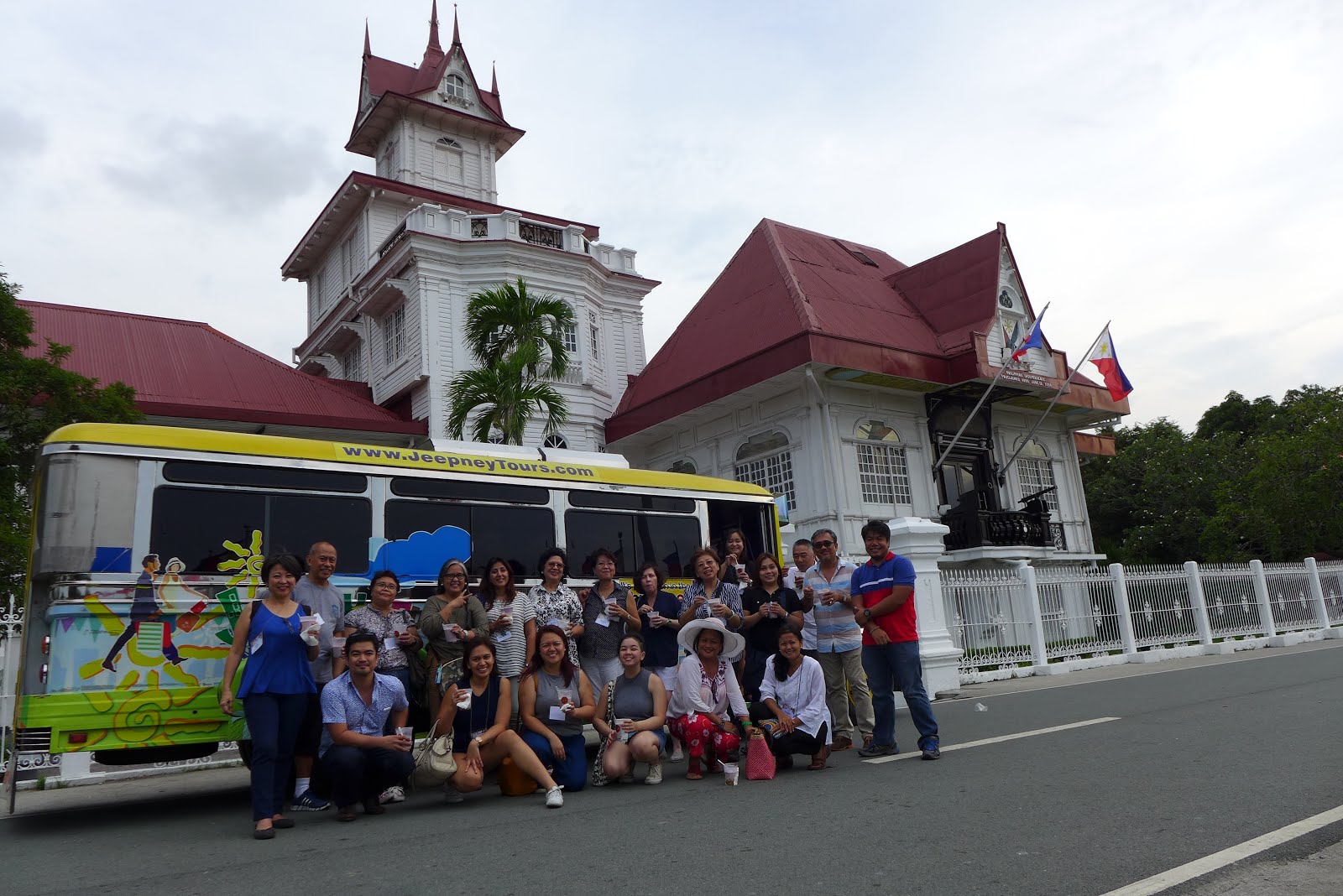
Before the light completely faded, we had time for a group photo in front of the Aguinaldo Shrine, beside Tour Holidays' vivid, varicoloured jeepney-on-steroids.  We each had a plastic cup of Asiong
Carinderia's special halo-halo -- a cold and reviving way to end this memorable culinary and historic tour of Cavite!


P.S.


Mabuhay ka, patriotic Caviteño Ige Ramos!  Thank you for a remarkable KKK (Kainan at Kasaysayan sa Kavite)  experience.  It was a memorable way to discover the historical treasures 
and culinary gems of Cavite.  


SaveSave