Tuesday, June 13, 2017

Kumano Kodo Day 2 Takahara to Chikatsuyu : Finding my inner "Yama Girl" in the mountain passes


First things first ... what is a "yama girl"?  Yama means mountain in Nihongo and yama girls are Japanese women who like the outdoors -- hiking and trekking are their week-end pursuits.
They wear matching hiking gear from head to toe, often in pretty pastels or stylish prints.  
But don't think of these fashionistas as lightweights --  they traipse up and down the mountainsides without even breaking a sweat.  These women have mad mountain skills. 
Now, I am not a "yama girl" -- far from it.  
On Day 2 of our Kumano Kodo hike, we would be walking through the mountains from Takahara to Chikatsuyu,  and I secretly wished I had a bit of "yama girl" in me, to help me through the trails.


We started the hike from the parking lot of  Takahara Lodge where a sign directed us back onto the Kumano Kodo.  It was a steep uphill climb for a few hundred meters over a paved footpath that passed through backyards and small terraced rice paddies.


Like the Camino de Santiago, the Kumano is well marked with directional signs.  It will be hard to get lost, even if you are walking by yourself.
This well meaning sign just at the edge of Takahara states that Chikatsuyu, 9.7 kilometres away and  our destination for  today is a 3 to 4 hour walk.  
Perhaps if I were a yama girl or a gazelle,  I would make it in 3 to 4 hours.  
I've learned that the Japanese compute distance and speed based on their own fast pace.  
This is very much different from my reality -- what they call a 10 minute walk takes me 20 minutes.
I correctly predicted it would take me 8 hours (including water/toilet/lunch breaks) to finish the walk. 


The steep footpath led us to this asphalt road.  The wooden marker states #8 which means we 
have travelled 4 kilometres since yesterday.  Our target for today is marker 26 -- quite a way to go. 
Today's walk at 9.7 kilometres would also be the longest leg on our Kumano Kodo.  
Our guides had said that unlike the Takijiri to Takahara stretch which was mostly a long steep
climb,  we  would be going through both ascents and descents as we passed through the mountains.  


At the exact boundary between village and mountain is this small altar .  They are not jizo as I originally thought but are two Buddhist deities, tasked to protect Takahara from any evil.


The dirt path changed to cobblestones ands this portion is a steep ascent deeper into the mountain. 
The moss makes the stones slippery so it's best to go slowly or step off onto the dirt track when possible.  Tall cedar and cypress trees line the way.  We hear the raucous caws of crows and the  distinct trill of the uguisu or the japanese warbler.
Birdsong helps lighten the way and makes the climb a little less difficult. 


There's a hut with a an official distance marker in front.  There's someone sleeping inside so we 
push on.


This carefully arranged pile of rocks catches my attention and our Mi Kumano  guide Yamamoto san told me that these are made by hikers as a way of saying "I was here".


Here's a horizontal version -- carefully placed on a piece of wood.  Someone took the time and the effort to choose the rocks and arrange them neatly, all in a row.


Our guide Yamamoto san pointed out this unusual plant growing by the mountain side.  At first glance it seems like someone left behind a wadded up bunch of white tissue.  This is the "silver dragon" plant, called ginryosou in Japanese.  It has absolutely no chlorophyll which explains the absence of any green colour.  Fascinating!


The ki-no ne or tree roots were pretty much absent for most parts of the walk.  Instead we faced loose gravel and dried leaves -- tricky in their own right since they made the path slippery.  At the end of this path the road turned right and we started to climb again.


The brief climb led us to Takahara-Ike, a small pond right in the centre of the mountain.  The water was so vividly green, reflecting the masses of leaves that surround it.  Can you see the  small fish swimming in the water?  


Signposts along the way point out the different Oji shrines.  Oji are minor deities and there are various shrines along the Kumano Kodo where pilgrims could stop to rest and pray for safety along the way.


Wooden posts mark the shaded entry to  Daimon-Oji.  The small red structure  houses the self stamping ink pad that pilgrims use to mark their booklets with.


Behind it are these two stones that mark the spot where the torii or gates of  Daimon-Oji used to be.  


The path turned narrow once again.  I'm glad I do not suffer from acrophobia (fear of heights) or stenophobia (fear of narrow trails).  Although I do have clumsi-mania  (a strong urge to trip and fall) so I made sure to tread carefully and slowly.


During the walk, we would move to the side to let faster hikers pass through.  
While there were not too many that day, we did meet this incredible 60+ year old man 
running along the trail!  He was getting ready for a trail running competition. 
I was so amazed  -- here I was, edging along snail-like on these narrow paths --  and here 
was this fit and fast person, much older than me -- racing along the paths. 
He was very friendly and stopped to chat with us and wish us well -- ganbatte!


After more rocky ascents and descents, it was a relief to reach Jujo-Oji  a grassy clearing with some log benches and toilets.  
Here are our Mi-Kumano guides -- Yamamoto san, third from left and at rightmost Michiko san, 
a former marathoner.   I don't  remember seeing either one of them show any strain or effort at all, 
as they navigated the hardest sections of the hike. 
They were very helpful and solicitous, telling us where to pass and how to walk safely through the mountains.  


There are jizos (statues of guardian deities) along the Kumano Kodo and as we stopped at this particular one called the Koban Jizo, Yamamoto san told us the sad story behind it.  
A poor traveller passed away on the path with a koban or gold coin in his mouth.  
The gold coin was meant for his expenses so he would not burden anyone who found him that he would be assured of a proper burial. 
Coins and even a cup of sake have been left behind by pilgrims to honour his memory.


We climbed up and up on these narrow and seemingly endless trails.  That is not a smile, that is a grimace of suffering that you can see on my face.  
Michiko san stays behind me probably to make sure I do not roll off the mountain -- can you see 
the steep slope right alongside?


From Takahara with an elevation of 317 meters, we reached the highest point on today's hike --  Uwadaya-Jaya Teahouse is 690 meters above sea level.  In the olden days, tea houses were popular fixtures along the Kumano Kodo as they were places where pilgrims could refresh themselves and meet up with the local people. 
We had walked almost 6 kilometres since we started and our guides assured us that after this highest peak on the mountain,  the paths would start to descend.


This shows you just how narrow the paths can get.  These paths must be impassable during the rainy season. 


My old friends, the ki-no ne made a few cameo appearances today -- although not as pervasive or invasive as yesterday's climb from Takijiri to Takahara.  Sometimes they did help, providing small footholds where you could securely plant your feet.


In steep descent,  the ki-no ne was my friend, as they formed a network of irregular steps that  
helped keep me from sliding straight down.


The sign marks the site of the Three Fold Moon Viewing Spot -- if you follow the trail going up on 
the right, you'll see the place where legend has it that a monk saw the moon rise in three places. 
I wonder what the scientific explanation of this phenomenon could be (perhaps too much sake or shochu, hmmm?)
From this marker, the Kumano Kodo continues on the left where the descent becomes difficult once more -- steep and perilous with a snarl of dried leaves, ki-no ne and small loose gravel on the narrow trails. 


It looks very much like a snake is hanging from this tree.  


I detest descents more than ascents -- they're extremely hard on the knees and ankles.  Since I'm so uncoordinated, descents are particularly dicey as I always imagine falling forward on my face.  
Full disclosure -- I did fall once on this day's hike but I landed on my butt.  Thankfully, the ground was well padded with soft leaves and my bottom is well padded as well.
Here is Jay before going down a really steep switchback -- I remember wondering if I could just sit and inch my way down.


All of us successfully made it, thanks to Jay who showed the way  and thanks to our expert guides who talked us through the descent.  Please note, the descent started way ahead that red circle on the top right of this photo. 


This is the marker for Oosakamoto-Oji -- time to stop for another stamp on our booklets.
Oosakamoto means "the bottom of the big slope" and I can heartily relate to that.  
I am sure the deities still guarding this place helped keep us safe on the way down.  
On the marker, it says that in 1109 a pilgrim mentions a snake like object hanging from a tree, 
which once used to be a woman.  I wonder if that is the same object that I just saw.


Our reward after traversing that challenging pass was this cooling and refreshing waterfall -- 
I longed to go down and wiggle my toes in the water. 


We  conquered the big slope of Oosako Pass!


We still had a few more trails to climb down from but once you have gotten through the "big slope" the rest comes easier.


Marker #23 --  just 3 more (or roughly 1.5 kilometres)  to go!  


At this point, the Kumano Kodo continues on towards Chikatsuyu but it also gives you the choice to make a detour at a rest stop on the highway across the trail.


This is the Kumano Kodo Nakahechi Michi-no-Eki which is right by Highway 311.  This delightful rest stop has clean toilets, vending machines for all kinds of hot and cold drinks and a small store selling snacks,  local specialties and shopping alert!!!  -- all sorts of kawaii Kumano Kodo souvenir items.  
The stone statue in front is of the young Emperor Kazan who lived in the 10th century and was one 
of the early Imperial pilgrims along the Kumano Kodo.  We would meet him later on during the walk. 


Thursday, June 8, 2017

Kumano Kodo Day 1 : A luxurious interlude at Kiri-no-Sato Takahara Lodge


Our first day's walk from Takijiri to Takahara was gruelling -- at least it was for me, an on-again-off-again hiker.  It would be more dramatic to say that I crawled in on my hands and knees into our lodgings for the night but tired as I was, I still managed to saunter in upright on my own two feet.


It was dusk when we got to  Takahara -- a tiny mountaintop village with an elevation of 317 
meters and the temperature had dropped a few degrees.  
Chilly as it was, a warm welcome awaited us as we walked into The  Kiri-no-Sato Takahara Lodge.  A government-built facility but now privately managed, this boutique hotel is rustic and pleasant.  
Local Japanese wood -- perhaps from the very same trees that I had walked through in the forest,  
is used extensively throughout -- reminding me of Alpine mountain lodges and Swiss chalets.  


A hospitable touch was this jug of cold water infused with herbs from the hotel's organic garden.  
Refreshing and instantly revitalising!


I was not prepared for this view that awaited me when I opened the door to our room for the night. 
I literally gasped -- what a glorious sight!  
The Hatenashi mountain range, framed by the masses of rhododendrons was a gift of grace that healed my spirit and nourished my soul.


All rooms in this small hotel have a small wooden deck, equipped with lounge chairs so you can step out and inhale the fresh mountain air.  And of course, fill your eyes with the incomparable scenery.


I'm sorry but you'll have to suffer through this self indulgent photo.  Jay and I were both absolutely overwhelmed with the view.


I could barely tear myself away from the room but dinner was to be served at 7 pm.  We were a big group of 10 and the staff did a good job of seating us all together. 
By the time I got to the dining room,  everything was meticulously laid out.


Dinner was a showcase of traditional Japanese dishes. It was a tasty and tasteful collection of small and delicious morsels, a study in contrasting textures and flavours.  
To start with, an assortment of  tsukemono or pickles, with the ingredients picked from the lodge's organic gardens.  The salty-tart flavours are meant to whet your appetite and open up the palate. 
Two kinds of sashimi and boiled shellfish reminded me that even if Takahara is in the mountains, 
it is part of the Kii Peninsula and the nearby towns are known for fresh fish and seafood.  
A delicate creamy tofu with an unmistakeable peanut flavour was a surprising touch.
The main course was sukiyaki -- with tender mouthfuls of umami rich wagyu that just melted in the mouth.   We each had individual cooking pots -- each one lit up by the attentive waitstaff at the precise moment before they brought out our bowls of steaming hot and fragrant rice. 
Everything was done to perfection!


As we were nearly done, these small plates came out from the kitchen.  Assorted bits of vegetables -- beans, radish, sprouts and ferns were coated with batter and lightly fried,  tempura style.  
The hotel proprietor came by to assure us that these were foraged from both the gardens and the mountainside right before they were cooked.   
Instead of the usual tempura sauce, he encouraged us to use the sea salt on the side -- it did bring out the natural sweetness and freshness of the vegetables.


At the end of the table, standing on the right is one of the most convivial and gracious hosts that 
I have ever met.  
Jian san owns and runs the Lodge , on a long term lease from the government.  He is Japanese and speaks English fluently although with a French accent.  This is  because he lived and studied in Paris for many years.   
Jian san brings a definite fusion of European and Japanese touches into the hotel. 
He made sure that everyone in the dining room was well attended to -- stopping to chat and give each guest his full and undivided attention.  


After dinner it was time for onsen!  While each room has an en suite toilet, baths are taken in the onsen  -- segregated between males and females.  Taking advantage of the fact that I was first in the bath and all alone, I sneaked this photo.
The onsen is spacious and very clean -- ideal for four or even five people to share. 
The water was deliciously hot -- Jian san said that the water comes from the natural springs at
Wataze Onsen near Hongu and it is brought all the way into Takahara.  
I enjoyed a long and much needed soak -- all the little knots and kinks just melted away. 


A common feature in Japanese inns, hotels, ryokans, minshukus, etc. is the vending machine. 
More convenient and certainly cheaper than room service,  it is indispensable for any late night drinking plans.  This particular one was stocked with among other things, cold Kirin Beer and 
was conveniently located right outside the bath area -- how could I resist its glowing blue lights?


Jay doesn't drink but our millennial Amigo Mayk does.  Kampai!


Our affable host Jian told us that Takahara is also known as the "Village in the Mist" (which is what Kiri no Sato means).
At certain times of the year, the entire valley is covered with mist and clouds. 
The next morning, I woke up at 5 to try and see if I would see this phenomenon but only a thin wisp was hovering above the Hatenashi mountains.  It was still amazing though to wake up to this view.


Jay and I wandered out to the open air terrace just outside the dining room.  Mismatched benches 
and this table was the ideal spot for a  pre-breakfast cup of coffee.  


Used cork from empty wine bottles are strewn on top of this log.   I was tempted to add the pull tabs from our cans of Kirin beer to this quirky but stylish arrangement. 


I met this charming Japanese lady whose husband had celebrated his birthday the night before 
(I know because the waiters brought out a cake and sung to him).  
From Yokohama, she and her husband were also doing the Kumano Kodo and I would see them again at various stages of our hike.


The normal Japanese breakfast is composed of fish, rice and some side dishes.  
We were served a fatty smoked mackerel,  sweet with woody notes.  It came with a tart dried plum or ume which is grown in the area, the ubiquitous crunchy tsukemono, a slice of tamagoyaki or rolled omelet and my favourite hijiki salad. 
This healthy meal would fortify us for the long walk ahead.


One group photo in front of the Takahara Organic Lodge before we set off.  Rejuvenated by a restful night in splendid surroundings, we were ready to move on.  
Ikimasho!

Lesson learned : This is such a lovely place that I would love to come back.  It would be a perfect place to relax for a night or two and spend the time exploring the small picturesque villages in the area.  It is reachable by public bus from Kii Tanabe station. 


Kumano Kodo Day 1 Takijiri to Takahara : Upwards (and some downwards) with the Ki no ne


The first day of our Kumano Kodo hike started well after lunch.  Perhaps because the route from Takijiri to Takahara would cover a scant distance of  3.7 kilometres and we were expected to finish the walk in good time.  Still, it took me four hours to cover that distance.
You'll have to read on to find out why ....


To get to Takijiri we took a local bus from Tanabe City. The bus stop is right in front of the Tanabe Tourist Center  where we also met up with our Mi-Kumano guides who would be walking with us for the next four days of our five day hike. 


Kumano Travel, the community based travel bureau who handled our reservations also made arrangements for our luggage transfers.  As in the Camino, we would not need to walk with everything in our backpacks as our suitcases would be ferried daily to our lodgings.
We would only need to carry what we needed for the day's walk.  
When we got off the bus at Takijiri,  Yama Shuttle Luggage Service was waiting by the stop.
This sweet little lady -- definitely smaller and lighter than me --  took my big suitcase and hefted it into her van ... without even batting an eyelash.  I was really impressed!


The Kumano Kodo Kan Pilgrimage Center is located right at the entrance of Takijiri.   Before we started the walk, our guides  brought us in for a quick briefing.


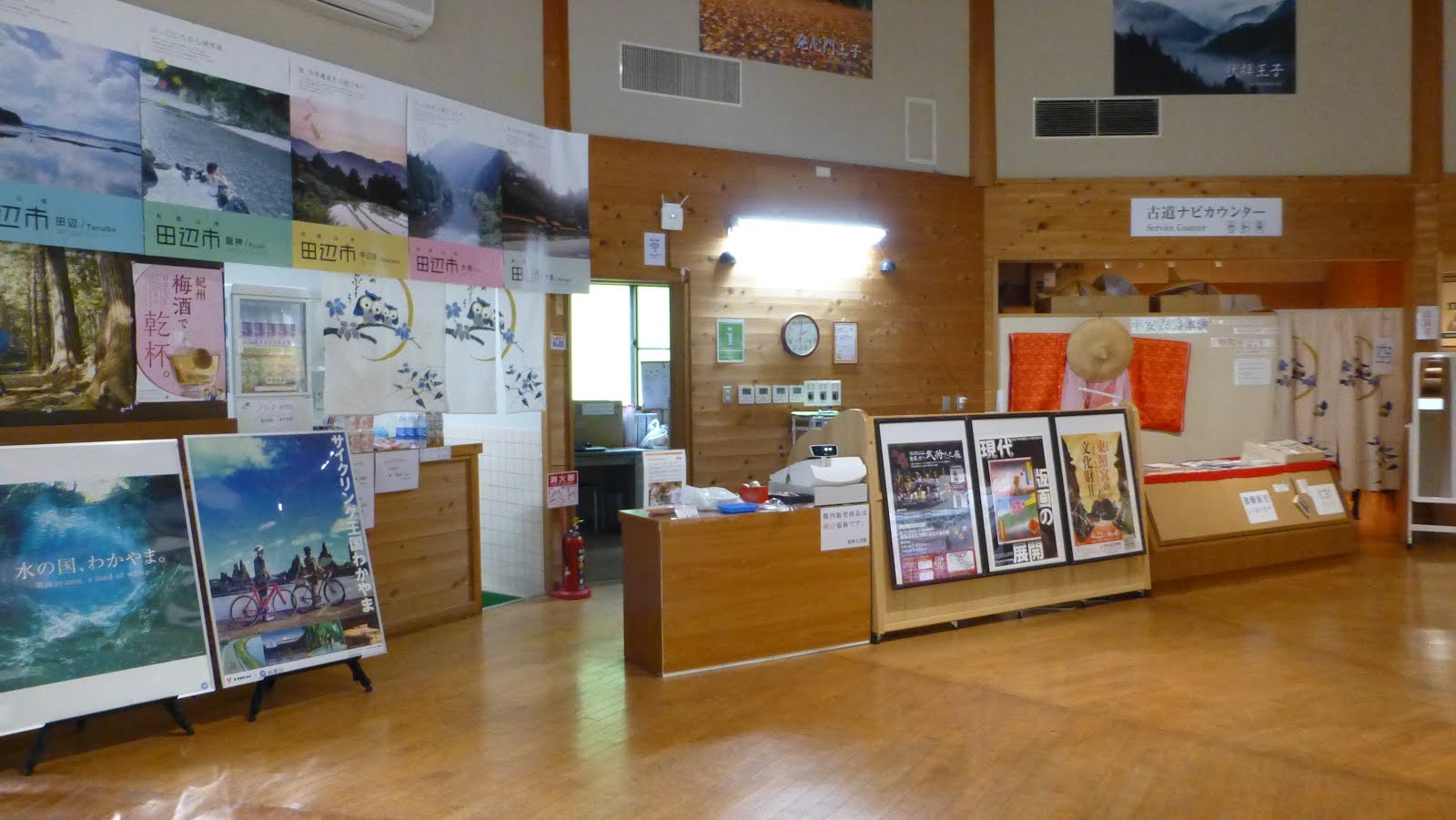
Inside, the Center is made up of gleaming cedar floors and walls.  There are tourism posters,  brochures, maps and even videos about the Kumano Kodo pilgrimage.


There's also a store with hiking gear, for those who need some last minute purchases.  I'm happy to see that the products are by my favourite, Mont-bell -- Japan's premier hiking and mountaineering brand.


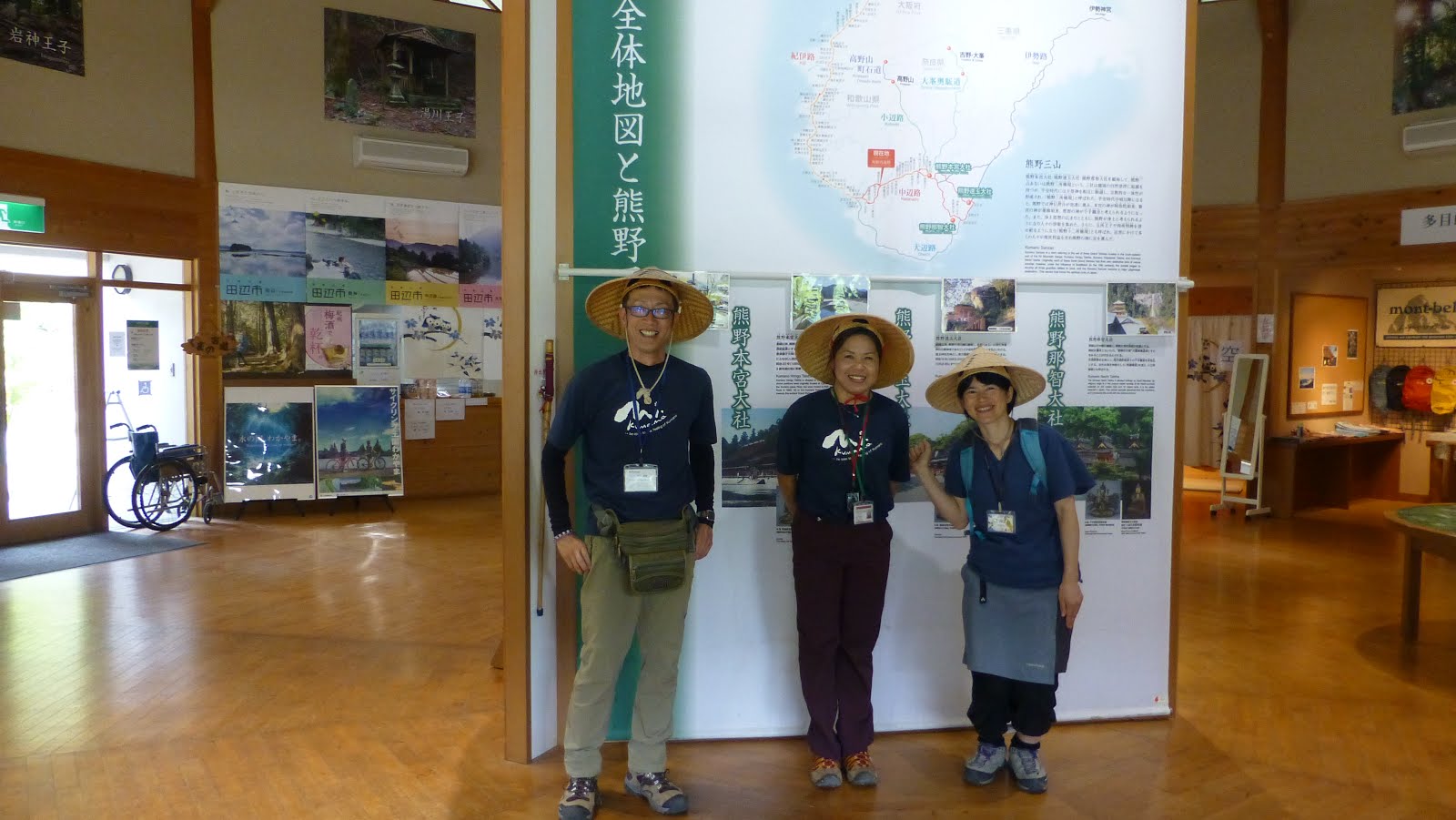
Meet the Mi-Kumano guides who would prove to be invaluable during our hike.  From left to right, they are Wada san, Jennifer san and Chika san.
Jennifer is an Ilongga married to a Japanese and who has lived in the area for over 20 years.  
We were all pleasantly surprised to hear someone welcoming us in Tagalog!  


After the briefing and the trips to the toilet (last one before we got to Takahara) we were finally
ready to head off.
Across the road from the Pilgrim Center is the Nakahechi route's official "gateway" to the sacred mountains of the Kumano Kodo.   It is marked by a small but significant shrine, the Takijiri-Oji.
Oji are "children of the deities" and all throughout the various routes, there are shrines dedicated to them where ancient pilgrims stopped to pray and rest.
Most of the very old shrines have been reduced to a mere pile of rocks or stones but are still marked with signs so you can read about their history and significance.


Like the mogotes along the Camino de Santiago,  you will find these wooden posts along the
Nakahechi and other Kumano Kodo routes.  These markers are set every 500 meters so hikers
have an idea of the distance they've travelled.
Phone numbers for the police and fire stations are on every marker -- a good reminder that
while these routes have been walked on by pilgrims through a thousand years,  today's hikers should still be careful along the trails. A false sense of security can lead to accidents on the rough and oftentimes uneven terrain.


Wada san and our guides lead us through the torii into the shrine where we  pay homage to the 
Oji and ask for a safe and accident free hike.


One last thing to do before we enter the mountain trails -- get our little booklet stamped at the shrine.   We had all been given these stamp booklets at the Tourist centre in Tanabe and instructed to collect stamps along the way.  
After we completed a certain number of stamps, we would need to show this to the Pilgrim Center at Hongu Taisha where we would be given a certificate for completing the Kumano Kodo.  
This is reminiscent of the sellos that pilgrims along the Camino de Santiago need to collect along the way so they can earn their compostela.


Right at the vey start of the path, a tree has grown over this massive boulder, its huge roots 
hugging the moss covered rock.  Looking back on this, it was a sign of what was to come -- 
we would see more ki-no ne or tree roots covering the forest trails. 


The initial way up is steep and through stone steps.  It would get progressively harder and steeper as we continued to climb.


Some minutes later, we came upon these gigantic rocks that formed a narrow opening.  
This was a test for those brave and yes,  slim enough to try and pass through.  
Our guides told us that to be able to clamber out on the other side of this stone "womb" meant 
that you had been "reborn".  Some of the Amigos successfully  experienced this "rebirth" but I 
decided that I enjoyed this life too much to want to be "reborn" into another.  


The trail is full of large and interesting rock formations, some of them with very interesting back stories.  
Our charming guide Chika san  told us the legend about this rock that hides a small cave.  
It is said that a baby was born to a powerful lord and his wife while they were on the Kumano pilgrimage. They left the baby near this rock and continued on to the shrine.
When they came back, they found the baby well and healthy -- nursed by the wolves in the forest.  
The rock is now called Chichi-iwa which  translates to "Milk Rock". 


We continued the unrelenting steep ascent towards Takahara.  Sometimes, we walked on uneven stone steps  --  I huffed and I puffed but those stones just kept climbing up and up and up.  


More difficult than the stone steps were the ki-no ne or tree roots that were even trickier, at least that's how I felt.  I had to look for secure footholds in between the roots.  One false step could mean a twisted ankle -- certainly the end of the hike for me.


The entire mountain is covered with these Japanese conifers.   They grow by the ridge along the narrow trails -- if you slip, you'll roll straight down the slope. I made a mental note to try and grab a tree trunk if that ever happened to me.


Normal seasoned hikers (these include the elderly Japanese who were trotting along and passing us on the trail) usually take the 3.7 km hike in 2 to 3 hours.  Navigating the twisting, snake like ki-no ne further slowed down my usual slug like pace.   


Thankfully at some points, we'd reach level ground -- where the roots were not as "invasive".
Time for a water break and a smile for the camera.


Halfway through the hike, the trails got a bit wider but were now covered in dried leaves making the path quite slippery.


Dirt covered paths amidst lush greenery reminded me of the Camino trails in the Galician mountains.  Instead of the smell of eucalyptus, there was a faint hint of pine leaves.


Smoother and wider walkways and a clearing at the end signified that we were nearer our goal.  It was almost  6 p.m. and we had been walking for more than 3 hours.


Three kilometres covered!  Just seven hundred meters to go.


At the outskirts of the village of Takahara, we saw this altar with two jizo. 
Jizo are traditionally deities who are guardians of children -- those who have died or were unborn, miscarried or aborted. 
This altar however houses a husband-and-wife jizo,  protectors of couples' relationships.
If you look closer, there is a sake cup in front of one of the stone figures,  I'm guessing it must be for the husband jizo. 


We are very near the centre of Takahara -- just 400 meters away.  We walked 3.3 kilometres to reach this point.  We had also climbed to 317 meters, the altitude of this mountain-top village. 


Marker number 7 is right by the roadway.   Takahara seems sleepy and quiet -- it's just after 6 pm  
but we did not pass a single person as we walked into the village.


The residents are used to pilgrims passing through -- as evinced by this handmade sign propped up against one of the houses. 


Before we got to our hotel, we stopped at Takahara-jinja which is one of the oldest shrines of  the  Kumano Kodo. 


Behind the shrine is the giant camphor tree that our guides tell me could be more than 800 years 
old.  It is enclosed by shimenawa, the rope seen in Shinto shrines  signifying that this is a sacred place. Shide or lightning shaped paper cut-outs are hung on the shimenawa -- a sign that kami or deities are present here.  
I bow my head in silent thanks to the kami of the tree for guiding my feet safely through the 
ki-no ne or tree roots along the trail.


It's almost dusk as I snap this last photo, taking advantage of the soft natural light.  
Takahara is surrounded by the beautiful Hatenashi Mountain range.  It is this panoramic vista that 
is my reward after a challenging but ultimately fulfilling first day's walk. 


Lessons learned : 
1. I do not know why  luggage transfer from Tanabe City to Takahara was not recommended to us.  Since we had suitcases, we took up all the aisle space in the bus and the local residents had to get around our  luggage to get on and 
off  - sumimasen! 
2. If you are inexperienced with tree roots and steep mountain trails, slow but sure is the best way to avoid accidents or spills. 
3. Sticks or poles are essential in navigating your way along the uneven terrain.
SaveSave
SaveSave
SaveSaveSaveSave