Friday, September 1, 2017

Koyasan, my soul's quiet place : Part 1 Revisiting Ekoin and the Okunoin Night tour


The winding highway from Katsuura to Mt Koya passes through mountain roads where the scenery becomes more and more spectacular with every twist and turn.  I ooh-ed and aah-ed from my window seat but had no one to share it with since everyone in the van was fast asleep. 


Katsuura to Mt Koya is a mere 165 kilometers but if one takes public transportation, it would be a
7 to 9 hour journey -- and one that is totally dependent on catching the right bus or train at very specific times.
Renting a car or in our case, a spacious and comfortable van from the Shirahanko Taxi company was the most convenient way ... it took us just 3 hours to get to Koyasan.


It had been 4 long years since my first visit to Koyasan.  Also known as the "Vatican" of Shingon 
or Esoteric Buddhism, it was founded 1,200 years ago by Kobo Daishi, a Buddhist monk.
Kobo Daishi is revered all over Japan as a great Buddhist saint and his practical and wise teachings transcend all religions.  
Kobo Daishi's "presence" and Koyasan's  inherently serene atmosphere are like a healing balm for
my soul.  


As in my first visit, we booked a one night stay at a shukubo or temple lodging.  We could have chosen from any of the 50 temples that have opened their doors to guests but I decided to go back to Eko-in  where Jay and I stayed the first time.
It is one of the oldest temples in Koyasan and one where the guest can experience the various practices of Shingon Buddhism like sutra writing, ajikan  meditation, the rishu-zanmai-hoyo or  morning sutra chanting,  and the goma fire ritual. 


As you pass through the gate of Eko-in, you are greeted by this smiling henro or pilgrim.  It is the sign that the temple is a shukubo and offers accommodations and meals to guests.


Eko-in's front yard has a small pond, surrounded by a riot of shrubbery.  


These giant white peonies are as big as plates.  Peony season has passed so these must be the late bloomers.


Two young monks lugged our large suitcases up to our second floor rooms.  Our room overlooked
the front yard.   A beautiful painting of mountain scenery graces the fusuma, the opaque paper
screen that separates our room from the next.
I just wanted to sit by the window and enjoy the tranquility  ... I did not realise how much I had missed being here.


But, the late afternoon sun was beckoning me outdoors.  I'm glad I decided to go for a walk or I may not have seen these pretty in pink tulips bobbing their heads in the breeze.  


This sacred mountain used to be home to hundreds of temples of the Shingon sect of Buddhism.  Today there are a little over a hundred left and half of these are shukubos, opening their ancient gates to visitors and guests. 


The setting sun peeps through the masses of cedar and pine trees. A clear stream gurgles by. 
I can feel my soul exhaling, I am content. 


This temple is hidden at the end of a long tree lined driveway.  
Come in and be refreshed, it seems to say.


We wander in and out of various temples.  Each has its own distinct character but all are oases of rest for tired and busy visitors seeking respite from life's daily troubles.


Most of the temples along the main road leading to Okunoin, the sacred cemetery of Koyasan are shukubos.  One is perfectly free to come in and look around the well maintained gardens. 


There are no conbini stores, no McDonalds and fast food restaurants in Mt. Koya.  
Instead there are small shops selling traditional sweets and delicacies.  I stop to buy some of my favourites.   On the left most is roppoyaki, which we know in the Philippines as "hopiang hapon".   
I particularly like the bean filled pastry, second from the left, which is encased in a sweet potato dough.   The kurumi-mochi rolled in a soy bean powder, reminds me very much of our own espasol, although it is a much lighter version.


Dinner at our shukubo Eko-in is set for 5:30 p.m. We hasten back to the temple so as not to be late 
for the meal.  Along the way, we pass by this multitude of red torii leading up to a Shinto shrine, again showing the synergistic relationship between Buddhism and the Shinto religion in Japan.


Another "hidden" shukubo, at the end of a tree lined path.  Guests are also on their way back perhaps to be on time for dinner.
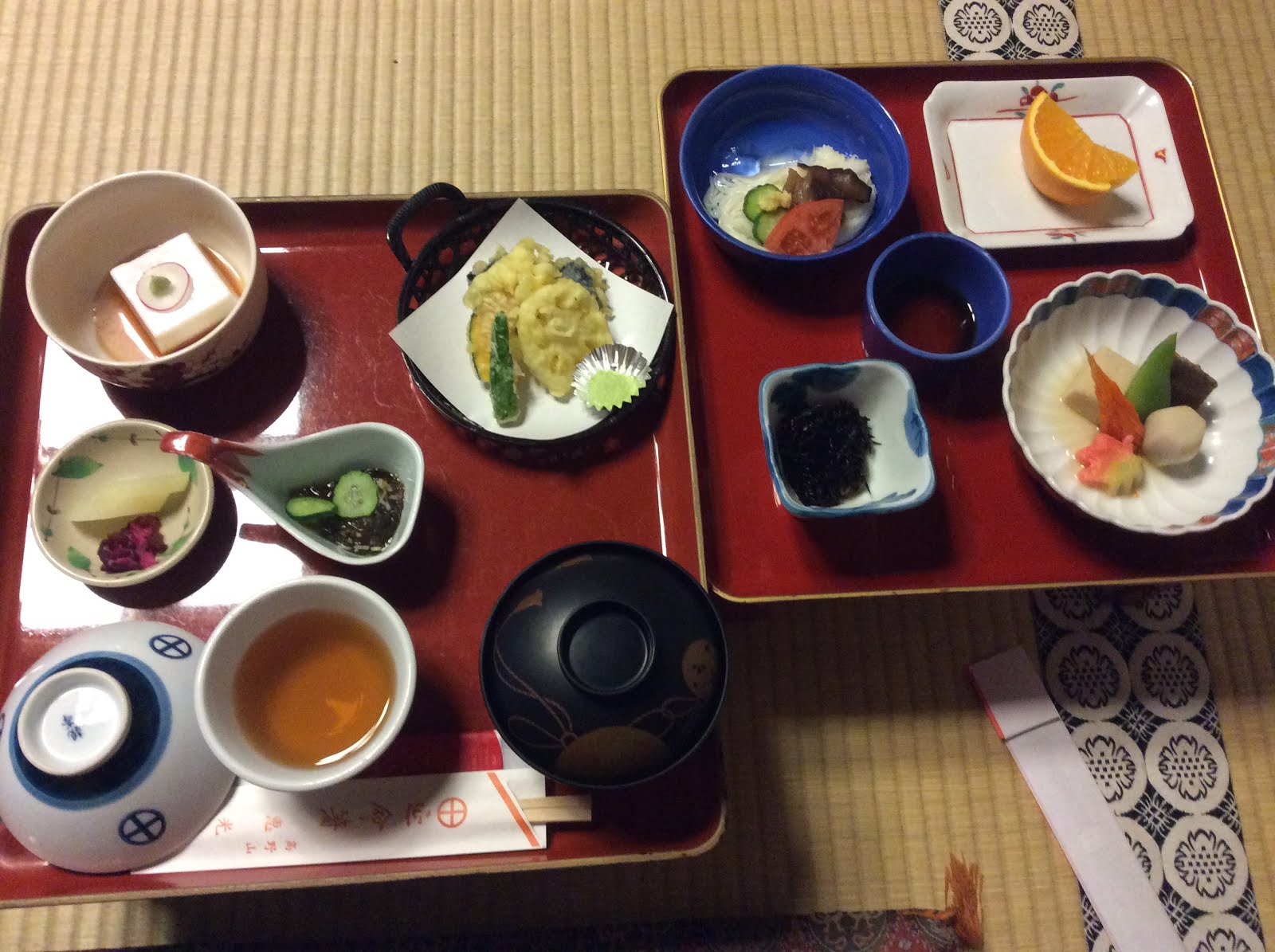

Dinner is shojin ryori or Buddhist traditional vegetarian cuisine.  It is usually brought to your room but since there were five of us and we wanted to eat together,  we were put in a private tatami room.
Cooked by the monks themselves,  shojin ryori is quite a  paradox -- simple flavours yet luxuriously delicious.  It is plain fare made from humble everyday ingredients, yet is served in an elegant manner.  
We are given two trays each -- dinner consists of sesame tofu, a specialty of Koyasan, vegetable tempura with a seasoned dipping salt, assorted tsukemono or pickles, various stewed root crops and a delicately flavoured miso soup.  
In keeping with this unpretentious meal, dessert is a single slice of a sweet orange. My not so secret stash of sweets that I had bought earlier would come in handy for any sugar cravings in the middle of the night.


When we get back to the room, the monks (who also cooked the shojin ryori meal we just enjoyed) have laid out the futons in our room.  The weather in Koyasan is always several degrees lower than anywhere else in the region so these quilted blankets will keep us nice and warm.


But it's not yet time to sleep -- we get our sweaters and head down to the courtyard to join the evening tour of Okunoin cemetery.  This is the largest cemetery in all of Japan.  
Many centuries old,  it is where Kobo Daishi sits in "eternal meditation".  Set in a forest of cedars and cypress trees, it is also where hundreds of thousands of tombstones can be found.  Eerie or scary? Not at all ... walking through the silent tombs is soothing,  the stillness is punctuated only by the "clicking" sounds made by the flying squirrels who inhabit the towering cedar trees.
While you can certainly visit the place anytime during the day, Eko-in conducts night tours, the only temple in Koyasan to do so.
Jay and I took this tour on our first visit a few years ago but we were happy to do it again.  
This time, we were joined by our friends from the US who were visiting Koyasan for the very first time.


By the time the tour started at 7:15, Okunoin was completely dark save for the stone lamps lighting the path.  The walk through the cemetery is a little over two kilometres from the gate to 
Kobo Daishi's mausoleum -- the most sacred spot not just in the cemetery but on the entire mountain.  
The tour, conducted by one of Eko-in's head monks takes about 45 minutes. 
Our monk-guide did not just walk with us through the cemetery but he gave a fascinating lecture about the history of Okunoin, who were some of the more important people buried there and most importantly, he shared highlights of the wisdom of Kobo Daishi.   It is a enlightening tour and one that you should not miss.


The stone lanterns along the path have cut-outs of the moon on the sides -- one shows the half moon and the other side, the full moon.  Candles were used before but now, thanks to the generosity of one of the many gigantic Japanese corporations supporting Koyasan, each lantern has been fitted with an electric light bulb that casts a soft glow on the stone paths.  


The bright lanterns of Eko-in guided our footsteps back to the temple.  There were no cars at all along the deserted roads.
 Peace and stillness enveloped the mountain.  This is what I had come here for ... to refresh my distracted soul in the restful realm that is Koyasan.  

Namu Daishi Henjo Kongo. 


Lessons learned

1. Renting a car or hiring a taxi is the best and fastest way to get to Koyasan from any point of the Kumano Kodo pilgrimage.  
2. The night tour of Okunoin conducted by Eko-in is available to guests staying in other shukubos.  Make reservations 
to ensure a spot on the tour.
3. All meals served in the shukubos are shojin ryori.  If this is not your idea of a filling meal, there are small restaurants in Koyasan serving non vegetarian fare.
4. If you are coming from Kyoto or Osaka,  the special limited express train to Koyasan is available from Namba station in Osaka. 


SaveSaveSaveSaveSaveSaveSaveSave

Monday, August 14, 2017

Postscript : Our Dual Pilgrim Certificate of the Kumano Kodo and the Camino de Santiago


The Kumano Kodo is one of only two pilgrimage routes  designated as a UNESCO
World Heritage site.  The other (and more popular) one is the Camino de Santiago in Spain.  
Both started  around the 10th century and both  have had millions of pilgrims walk through its
well trodden paths.
One is Shinto, dedicated to the kami or gods of nature and the other is in honour of St. James
or Santiago, one of Jesus' twelve apostles. 
The Kumano Kodo -- tucked away in a remote corner of hidden Japan is perhaps little known to
the pilgrims of the Camino.  However,  its popularity seems to be slowly growing, we met a number of Europeans and even some Americans along the trails.


The pilgrim who has completed the Camino de Santiago earns the Compostela, a small scroll written in Latin that attests to this fact.  The pilgrim who has walked the approved routes of the Kumano Kodo also receives a certificate.
And if you are fortunate to have walked both, you are recognised as a Dual Pilgrim and given a special credential. 
This is available from three  locations along the route ... from the Tanabe Tourist Center, the Hongu Heritage Centre (shown above) and the Kumano Kodo Kan Center in Takijiri.


When we dropped by on a late summer afternoon,  the Heritage Centre was quite devoid of visitors.  
There were no long queues waiting to get their credentials, as you would see in the Pilgrims' Office
in Santiago.  


Getting the certificate was quick and relatively easy.  The Hongu Heritage Center is staffed by volunteers from the community, many of whom are fluent in English.
To qualify for the Dual Pilgrim Certificate,  you should bring some proof that you have earned your Compostela from the Camino de Santiago.  A picture of your compostela is good enough.
You also have to show your passport as further proof of identification.


As in the Camino, stamps from places passed along the way are collected in a booklet.  The completed booklet is needed to show that you have really walked any of the following routes:  
a) the Nakahechi Route, from Takijiri to Hongu Taisha; 
b) the Nakahechi Route from Hongu Taisha to Nachi Taisha; 
c) the Nakahechi Route, from Hoshinmon Oji to Hongu Taisha plus stamps from Hayatama Taisha and Nachi Taisha and 
d) the Kohechi route, from Koyasan to Hongu Taisha.


Here are the Amigos holding up our newly minted Dual Pilgrim Certificates.  We also walked the Camino de Santiago together.
With us was the Heritage Center officer and our invaluably helpful Mi-Kumano guides  Wada san and Chika san.


This is the Certificate of Completion given to Dual Pilgrims.  You can get the same certificate in the Pilgrims' Office in Santiago de Compostela if you show proof of having completed the Kumano Kodo.  
Once you get your Certificate, you may be asked for permission to include your photo and pilgrimage details on the Dual Pilgrim website.   


In addition to the Certificate of Completion, Dual Pilgrims also get a commemorative pin showing 
the symbols of both pilgrimages .... the scallop shell of the Camino de Santiago and the Yatagarasu 
or 3 legged crow, a Shinto motif and symbol of the Kumano Kodo.  Both certificate and pin are given gratis and are lovely ways to remember your experiences on the trails. 

P.S


I feel doubly privileged to have walked both the Camino de Santiago and the Kumano Kodo. 
Walking through different and sometimes challenging trails, tracing the paths of many who have 
gone before, experiencing and giving thanks for the beauty of your surroundings ...  these are the 
life enhancing gifts that a pilgrimage gives to the pilgrim.   
Walking teaches you mindfulness.   As you walk, you find your way. 

Ultreia et suseia
Ganbatte


Lessons learned:
1. If you want the Dual Pilgrim Certificate, do not forget to fill up the booklet with the necessary stamps and bring a 
photo proof of your compostela from the Camino de Santiago.
2. You may get the booklet for stamps from Tanabe, Hongu or Takijiri.  It is given for free.
3. Unlike the Camino which requires you to walk a minimum of 100 kilometres to earn a Compostela, there are a number of options for the Kumano Kodo which require less walking.  The mandatory requirement is a visit to all 3 Grand Shrines. 


SaveSaveSaveSave
SaveSaveSaveSaveSaveSaveSaveSave

Friday, August 11, 2017

Kumano Kodo Day 5 Katsuura to Nachi Taisha : Climbing the stairs to the end of my pilgrimage


On the last day of our Kumano Kodo, I woke up with the thought that my hiking days were almost over.   There was one shrine left to visit -- Nachi Taisha.  Located at the top of Mt Nachi,  we would reach it by bus but with a bit of climbing left to do.


The bus terminal is right by the Kii Katsuura railway station.  This makes it convenient for those who come from Osaka or even Nagoya and who have time only for a day trip to the shrine.   


The round trip ticket will save you a few hundred yen.  We all needed to go our separate ways after lunch, so we took the 8:25 a.m. bus to give us enough time to get back to Katsuura.  There are buses that leave earlier, the first at 6:45 and again at 7:25. But those were a bit too early for us.


After a short 20 minute ride, we got off the bus at the stop for Daimonzaka -- which literally means "gate to the slope".  Nachi Taisha is located on Mt. Nachi,  just up ahead.


Near the bus stop is this familiar marker which we first saw at Takijiri Oji, 
at the start of  our hike.  The marker states that the Grand Shrines of the Kumano Kodo as well
as other landmarks and areas in the Kii Peninsula are UNESCO World Heritage Sites. 


Here is the map that shows the way to the shrine.  I've marked the various points -- the red circle shows the bus stop where we got off.  Next is Daimonzaka (orange circle) which are the stone steps that lead to the shrine.  
From Daimonzaka,  we would continue to walk up to Nachi Taisha (pink circle) and then walk down to the bus stop (yellow circle) that would take us back to Katsuura. This bus stop is also nearest Nachi no Taki or Nachi Falls.   
Some visitors opt to do a counterclockwise route --  by getting off the bus at the yellow circle and walking their way down to the red circle.  


A plain stone torii marks the start of the sacred grounds of Nachi.  Past the small red bridge are a few souvenir huts before you reach the stone staircase of Daimonzaka which will lead you up from the base to the mid point of Mt Nachi.  


At the very start of the stairs  are a pair of giant cedar trees that are said to be 800 years old.
These are known as the meoto-sugi or husband and wife trees so called because their roots are entwined at the base, underneath the stone steps.


We begin the steep and very crowded ascent of Daimonzaka.
As it is a Sunday, we are inundated with busloads of Japanese tourists who much to my chagrin,
bound up the uneven stone steps with such ease.
For those who need assistance, bamboo walking sticks are available, use them and leave them at the top when you finish your climb.


The air that surrounds Daimonzaka is suffused with a primordial energy -- these stone steps date
back hundreds and hundreds of years.  Trodden and well worn with the steps of countless pilgrims,
I can feel and understand the attraction and powerful pull of the Kumano Kodo.


We dawdle along the slope and soon it is completely quiet and there is no one around but us.  
The giant camphor, cedar and bamboo trees along the steps keep us cool on this warm summer day.  It is an incredible walk up this ancient stone staircase.   Surrounded by the forest, one can feel the strong chi or energy coming from this  natural environment.  


While picturesque and photogenic,  Daimonzaka is also quite a bit of a walk.
There are almost 270 steps, some of them steeply inclined,  that go on for over 600 meters, with a
rise in elevation of 100 meters.  
You  need to watch your step as it's easy to trip over the broken and unevenly placed stones. 
I see my dear old friends, the ki-no ne or tree roots and say a fond farewell to them.
Perhaps we will meet again someday?


Past the midway point, we came upon a group of Japanese ladies excitedly peering through the
trees. They quickly motion me over to point out a tiny but distinct glimpse of Nachi-no-Taki or
Nachi Waterfalls.


Along the way, we saw this hollowed out tree,  so massive that four or even five people would comfortably fit inside.  


The light at the top of the steps means we are nearing the end of the slope.  It has been an invigorating and unique  experience, climbing the Daimonzaka.


At the top of the steps, I take one last look back.  With a slight rustle, the trees seem to shroud the stone steps.  If it disappeared before my very eyes,  I don't think I would have been that surprised.


A signpost shows the way to the shrine complex.  We are headed for the direction of Nachi Taisha and Nachi no Taki. 


It's a bit of a let down to come upon this concrete car park that mars the natural beauty of the place.  While I realise a car or taxi could have brought me up here, I would not have exchanged going up the Daimonzaka for that convenience.  


There are more steps to climb on the way to the shrine.  As in most major temples and shrines there are shops selling souvenirs, amulets and crafts along the way.  The shops in Nachi are located along this stone staircase.   You can do some shopping as you stop to catch your breath.


These wooden masks and statues would make such great souvenirs but Jay calls them "dust gatherers" so all I can do is look and admire.


There are also figurines made of a type of jet black stone -- these come from the Kii Peninsula Mountain range. 


For thirsty pilgrims, there are bottles of water and tea set out by the side.  Naturally cooled by flowing mountain water, I can imagine how refreshing these must be.


At the top of the steps is a large torii that marks the entrance to Nachi Taisha. 


The view of the lush green mountains is a stunning backdrop for the vermillion torii and the
lanterns that line the steps.   The mountain breezes are no match for the hot sun -- it's an energy draining slog up this long staircase. 


And what do you think I found at the top of the steps?  Another tall and steep staircase to climb.  
Thankfully, it was the last one. 


At the top of the mountain is Nachi Taisha.   It is the smallest of the three Grand Shrines of the Kumano Kodo and like the Hayatama Taisha is painted in the traditional red orange of the
Shinto shrine.  We line up to pay our respects and thank kami sama for allowing us to finish our pilgrimage safely.


Another group photo is in order -- the Amigos just completed the Kumano Kodo!
Otsukare sama deshita!


Off to one side of the shrine is this giant camphor tree that is almost a thousand years old.  A  stone torii guards the entrance to the base of the tree where stone steps take you to the small shrine within.
Shinto venerates all  of nature and certain venerable elements such as rocks, water or  trees are seen as power spots where kami or gods are present.
The shimenawa or rope hung with shide that you can see on the torii signifies that this is a sacred place.


Just a few steps away from Nachi Taisha is Seiganto-ji,  an important Buddhist temple and the first stop in the Saigoku 33 Temple Pilgrimage devoted to Kannon, goddess of mercy.  This temple is 
also designated as an Important Cultural Property.
As you prepare to climb the wooden steps, pay homage to a statue of Kannon, located on the left.


Seiganto-ji's hondo or main hall is made totally of wood and is a marvellous piece of temple architecture that dates back to 1590.  Can you see the bright red pavilion of Nachi Taisha peeking from the left side of the photo? 
The proximity of Shinto shrine to Buddhist temple is a very common all over Japan.  
I particularly noticed it here along the Kumano Kodo where shrines to Oji or children of Shinto deities co-exist side by side with statues of jizos or Buddhist bodhisattvas. 
The Japanese observe and practice both Shinto and Buddhist rituals and traditions. 


I tried as best as I could to capture one of the more iconic scenes of the Kumano Kodo.  
As you walk down from the temple and the shrine, you will come to Sanjudo, the orange three-story pagoda of Seiganto-ji with Nachi-no-Taki, Japan's tallest waterfalls in the background.  
Even from this distance,  I could sense the power of the waters as it cascaded down from the mountain.
Rumor has it that the monks of Seiganto-ji know a secret spot to take the best photo from but since 
I did not run into any monk, I was not able to ask.  I can only hope my photo somehow captures this magnificent sight. 


From the pagoda, it was downhill all the way ... literally.  A 10- minute walk over paved roads 
took us down to the  stop for the bus back to Katsuura. This is right in front of the entrance 
to the stairs leading to Nachi no Taki.
On hindsight, it seems rather anticlimactic to end my Kumano Kodo pilgrimage at a bus stop.  
In a perfect scenario, I should be bowing to the gods on top of a windswept mountain or if I had 
the time, I could have been standing near the crashing waters of Nachi no Taki.

But perhaps is isn't so bad -- after all,  I was waiting for a bus  ...  to take me on to the next journey and on to the next pilgrimage.   

Ganbatte!


Lessons learned: 

1. The way down is harder than the way up.  Don't be daunted by the numerous stairs to climb, take the normal route of Daimonzaka to the Nachi Taisha.
2. The falls should be a gorgeous sight, leave enough time in your visit for the walk down to the falls.  I'm sorry we missed doing that.
3. Photos were not allowed inside the Seiganto-ji but don't miss a visit inside to see the beautiful treasures on display.


SaveSaveSaveSave