Friday, September 9, 2011

Park Hotel Shiodome ... great location and great view!

Tokyo is a terrific place to visit and thanks to my work at Dentsu, I get to go a couple of times a year. I stay at the same hotel every time -- The Park Hotel Shiodome. Aside from the fact that it's a hop and a skip away from the Dentsu office, I like the elegant, stylish, serene ambience of the hotel.

Park Hotel occupies floors 25 to 34 of the Shiodome Media Tower building which also houses the Kyodo News, a non profit news agency. Shiodome is a relatively new district of Tokyo, it's near the luxurious shops in the Ginza area and the very convenient Shimbashi subway and train station.

The lobby of the hotel is on the 25th floor and features an atrium which goes all the way up to the 34th floor. This makes for a very open and airy feel. The lobby also includes a lounge area with a baby grand piano where on some nights, live jazz music is performed.


The rooms are not very big, as is typical of hotel rooms in Tokyo, but they are comfortable and quietly stylish. Interiors are in warm beige with bold dashes of red. The bed comes with four pillows in varying options -- soft and squishy or with a bit more support.
There is a flat screen tv and free internet access.
The mini bar includes half a bottle of champagne, cans of Asahi beer and bottled water from Dean and Deluca. Not to mention, complimentary drip coffee and really good green tea.


This is one of the best things I like about the Park Hotel -- I always book a room that gives me a view of the city with the Tokyo Tower in the distance. On a clear day, I can even see Mt. Fuji!


The same view is what greets me when I come back from meetings at night. The best way to relax after a long day of meetings is to curl up on the window seat and stare at Tokyo's lights -- with a can of Asahi Super dry beer in hand!

Wednesday, September 7, 2011

Virgie's - the House that Mango Tarts Built!

The first time I visited Bacolod in the early 90s, I was told to forget the piaya but to make sure I tried the mango tarts from a lady named Virgie. I managed to find the house from which she sold her mango tarts and was instantly hooked!
Made with gooey mango jam encased and baked in pie pastry, each tart or mini empanada was an invitation to have another one.
I would order from Ilonggo friends and hoard my stash in the refrigerator.
Of course as the years wore on, Virgie would bring her products to Manila through the Negros Trade Fair and much later on, she even had carts and kiosks in some malls in the city.


The mango tarts now come in very attractive boxes, good for gifts and pasalubong when going abroad. The tarts keep for a few weeks, as long as you keep them refrigerated.
I like bringing them back to room temperature when I'm ready to eat them.
Or, you can put them in the toaster oven for a couple of minutes.


On this trip to Bacolod, I was really glad to see that all her success from mango tarts and a host of other baked goodies has taken Virgie's store out of her modest home to this spanking new building! You can find all her delicacies here, all branded Virgie's, in attractive and colorful packaging -- it is a showcase of what hard work and a great product can do!


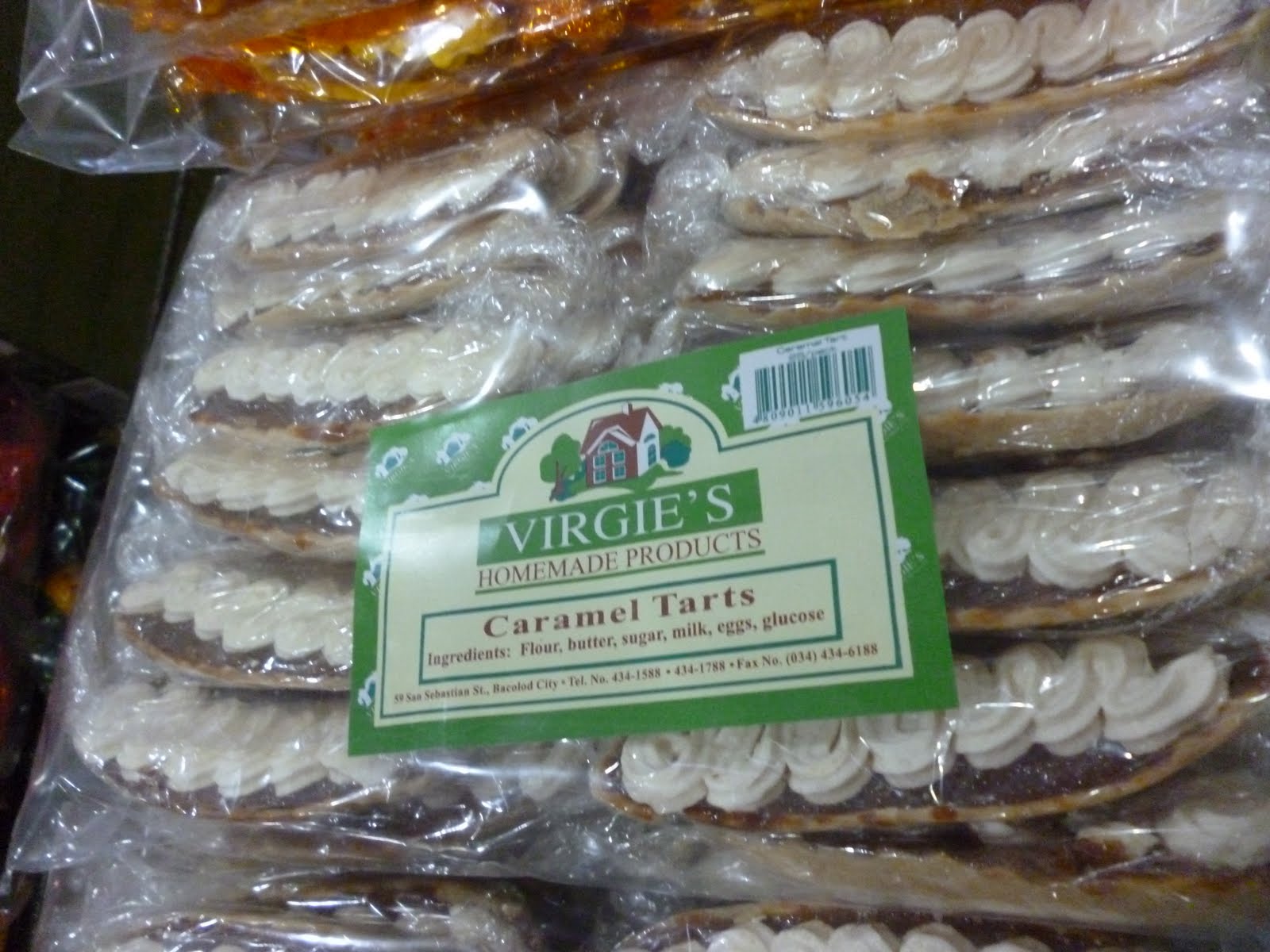
Here is my other favorite -- Virgie's Caramel tarts! These bring back memories of tarts that I used to eat when I was very young. Virgie's caramel tarts feature dark bittersweet caramel with that slight burnt sugar taste.
Each tart has a very retro looking squiggle of meringue piped on top.
A word of warning though -- if you have sugar issues, stay away.
While they are not too sweet, they are definitely habit forming!

Top ten favorite ... sisig at Kubo sa Lawn!

People think that sisig is best where it was first invented -- beside the tracks along Angeles City, Pampanga at Aling Lucing's. Be that as it may, but that was a long time ago and sisig has since been done and redone by nearly every restaurant, bar, carinderia in every part of the country.
On this trip to Bacolod, my friends and I discovered that sisig has been perfected in a casual and breezy outdoor drinking place called Kubo sa Lawn. KSL, as the locals call it, has received rave reviews from various newspapers and food magazines -- ranking its sisig as one of the top ten in the Philippines!


Just because I've stopped eating meat doesn't mean the rest of the party have to suffer. We ordered KSL's famous pork sisig which came sizzling on a hot plate -- naturally we let it cook a bit more until we could see the edges turn a toasty, crusty brown.
As it cooked further, I found myself slowly being enveloped in sisig-y fumes. The wonderful onion and pork aroma brought back memories of sisigs past. Everyone who tried it said it was indeed delicious -- and possibly one of the best they had ever tasted.


Thankfully, KSL had squid sisig on the menu so of course I ordered that. Done with lots more chopped white onions, the squid was tender and tasted fresh. It was perfectly done and went well with my ice cold beer.

Kubo sa Lawn is right along well traveled Libertad Ext. Hard to miss, specially at night when the brightly lit sign beckons.


You'll find a cluster of open air native huts -- perfect for wafting away those food smells from all the sizzling plates of sisig! You can choose to dine semi indoors where most families and office workers sit.


Drinking and eating buddies prefer the more outdoorsy feel and stay in the tented gazebo that is softly lit with hanging lamps and framed by a lot of shrubbery and trees.
The mild Bacolod night breeze perks up the appetite and enhances one's enjoyment of the evening!

Saturday, September 3, 2011

Enrica Alunan Lizares and her Balay ni Tana Dicang


Our visit to another one of Silay's many Heritage Houses stands out in my mind for so many reasons -- Balay ni Tana Dicang or House of Capitana Dicang is the oldest among the heritage houses, built in the late 1800s by Enrica Alunan Lizares. She was a lady way ahead of her time in terms of her foresight and character -- unusually strong for a woman raised during those times.


The house stands along the aptly named Lizares Street and while it is imposing from the outside, you only begin to appreciate its significance once you enter the massive doors.


A huge wooden angel, rescued from the Lizares Mausoleum stands guard at the door.


On this visit, we were greeted by the sight of a table laid out with merienda - Tana Dicang's hospitality extends up to today.


I had never seen peach gumamelas with a dark red center! Grown in the garden, they made a colorful centerpiece for the merienda table. The plate of fried bicho bicho, sweet and crunchy with a buko filling was very yummy and is a traditional snack from Silay.


Portraits of the Grande Dame of the house, done by different Silaynon artists in varying styles lined the walls of the receiving room.


This to my mind is the photo that says it all about Tana Dicang. With President Manuel Quezon to her left and President Sergio Osmena to her right, this shows just how politically powerful and important she was -- truly a trailblazer for her time!


All the furniture in the house has been kept in its original condition. You can really see the grandeur of that era and how people of Tana Dicang's class lived. The level of gentility, sophistication and elegance is truly amazing.
What is even more inspiring is that during World War II, Tana Dicang had the foresight and presence of mind to carefully wrap and put away all her furniture and furnishings from beds to tables and chairs down to the smallest silver teaspoon and porcelain plate -- everything was kept and thus survived, intact and in one piece -- something truly mind boggling considering how much was lost during the war.

Since President Manuel Quezon came and stayed over a few times, he had his own bedroom and bed -- which are kept just as how he must have seen it then.


Even if Tana Dicang was one of the wealthiest and most powerful women of that time, her bedroom was very simple, even austere. Note the sewing machine at one corner -- I was told she sewed clothes for her own daughters. Considering all that she had to do -- I cannot imagine how she had time to do that!

Friday, September 2, 2011

An Art Gourmet -- The Hofilena Heritage House in Silay

The last time I was in Bacolod, we just did a drive by of some of the heritage houses in Silay since we didn't have enough time. This trip, our guide Bambi Borromeo said that we had to go to the one of the most important houses in town and the only heritage house in Negros that was still occupied by its owner.
The son of the original owners still lives here -- he is a true raconteur, a bon vivant, an art collector non pareil, rightfully called the "Prince of Heritage Conservation" -- we were very fortunate to have Ramon Hofilena take us on a personal guided tour of the treasures inside the Hofilena Heritage House.


The house was built in the 1920s, in the grand and genteel style of that time. While a sign does proclaim its heritage status, the familiar images of the twin hearts of Jesus and Mary, show that it is not just a museum, somebody does live here.


Ramon Hofilena has a biting wit and peppered his tour with lots of interesting and lively anecdotes from decades past. After showing us the living room and the dining room still filled with original furniture his family has owned since the house was built, his library filled with books in shelves from floor to ceiling (my kind of guy!), he took us upstairs to see his huge collection of artwork from the most noted and famous Philippine masters and artists.


There was an Amorsolo, many Manansalas (and personally inscribed by the artist to "Mon"), a Hernando Ocampo, a De la Rosa, Hidalgo, a Juan Luna and so many more by artists I had only read about in books but the one that completely floored me was the pencil drawing signed "Jose Rizal". There it is in the photo above, on the second row, second from the left. Mr. Hofilena said that in Ateneo de Municipal during Rizal's time, the students were required to draw something everyday in their high school art class and this drawing was from that time. It was a simple drawing of different ordinary objects but you could see Rizal's firm and artistic hand.


Both walls of the second story are filled with framed paintings, drawings from Philippine artists.
Ramon Hofilena's collection would rival that of any local museum!


The other wall is dedicated to Conrado Judit, a local painter, unlearned and unschooled in any form of art education, who passed away many years ago, impoverished and unknown until Mr. Hofilena found all his paintings and gave them and the artist their proper due.
These paintings are filled with pathos and pain -- they show the hardship of life of the poor in Negros and are peopled by hacienda workers, laborers, common folk -- much like Mr. Judit who sadly did not see anything come from his art during his lifetime.
I could have stayed at this wall for hours, more than a gallery of his paintings, it is a tribute to Mr. Judit's greatness and native talent.
Thanks to the "Prince of Heritage Conservation" of Silay -- everyone can now see what immense talent sprung from the roots of this town.

Namit ang Luto ni "Sir"! A food find in Silay.

The plane from Manila landed in Bacolod just before 10 am -- too early for lunch but just right for a quick bite before embarking on our "C" Bacolod tour. The last time I was there, I saw this restaurant called "Sir" in Silay -- I had asked Bambi Borromeo, our indefatigable and excellent tour guide if it would be a good place for a late breakfast so that became our first stop of the day.


The signboard "Sir" apparently also includes "Maam", a fact I missed the first time, since the font was decidedly smaller. We presumed that "Maam" must have taken umbrage at being left out of the billing since she probably also calls the shots in the kitchen.


"Sir" Restaurant is right along the highway from Bacolod to Silay and is across the very popular Sta. Teresita school. It looks like a converted family home and has a wide and welcoming expanse of lawn, a tiled walkway and lots of greenery.


It isn't air conditioned but it's fan cooled and because there are wide windows that open up to the outdoors, where there are lots of large shady trees, it's cool and comfortable inside.
There are simple monobloc chairs and tables for 6 and 8 -- which further attests that this is a place where large groups usually dine.


Dishes are laid out, turo turo style. You lift up the caldero covers and choose from what's available for that day.


Since we were in Negros after all, we had to have lumpiang ubod. Their version came unwrapped or hubad. It was very good, the ubod or heart of the coconut tree, was fresh and sweet. Lightly sauteed with small shrimps, it was one of the best I had ever had -- and I didn't miss the lumpia wrapper at all!


Bambi recommended that we try the pata with beans or a home cooked version of what has made Hunts quite famous -- pork and beans. Since I no longer eat meat, I was not able to enjoy the pata but my friends said it was delicious -- falling off the bone tender! The beans were soft but not mushy and the sauce had the right balance of sweet and sour tomato goodness.


They were selling packs of Manapla puto by the counter. This version was called puto margarine and it was margarine'y indeed! It was the perfect thing to sop up the sauce of the pata with beans with -- savory salty meets sourish sweet!
"Sir" in Silay was definitely a good opening salvo to the rest of what would be a very culinary week-end in Negros!

"C" you in Bacolod!


After my working week-end in Bacolod last July, I had such a great albeit short visit that I quickly roped in a few girlfriends to come with me and do a more extensive and experiential tour.
Off we went last week-end and from the time we landed in the airport to the time we left, it was a non stop blitzkrieg of all the Cs that Bacolod had to offer.
Culture, chapels and churches, cuisine, chismis (we found out about skeletons in a lot of Ilonggo closets -- that's another C), comfort (we so enjoyed the nightly massages at the aptly named Cocoon Spa at the hotel, again another C!).
Best of all, we reveled in the companionship.
Travel with friends can be a dream or a nightmare -- not all good friends translate to perfect travel companions.
When you find the right fit and match -- then the trip, no matter how short or long it is, becomes really memorable.
"A journey is best measured in friends, than in miles" -- from the travel writer Tim Cahill.
And that's the last C!