Sunday, July 1, 2018

Banaue Bound Part 3 - Hiking along the Hapao Rice Terraces


Whether it is a month long once-in-a-lifetime vacation, a trip of just a week or two, a week-end road trip or even just a day trip to a nearby destination, it always helps to do your research before you go.
Since it was my first trip to Banaue, I made sure to read up on how to best enjoy the short two days that we would spend there. 


Research led me to this valuable travelers' tip -- if you're short on time, it's best to hire a local guide and private transportation.  
Public transport between the towns (and terraces) of Banaue are few and far in between so save yourself  the long wait for a ride that may never come and just simply hire your own.  
The local guide we contacted (thank you internet,  for the topnotch recommendation!) took care of hiring a jeep for our two day excursions into the delights of Banaue.  
We could have opted for a van but who wants to sit in an air conditioned cocoon when you can inhale the fresh mountain breeze (and a few diesel fumes) from a jeep's open windows.


My research also led me to making up my own itinerary for the two whole days that we would be there.  I decided that on our very first day, we would head to Hapao Rice Terraces in Hungduan town.  I had learned that exploring the terraces would take about 3 to 4 hours, certainly doable in one afternoon.  
Hapao is less than an hour's drive from Banaue, and when we reached a certain vantage point in the snaky mountain roads, the driver stopped so we could enjoy this view of the roads down below.  


The local governments have an efficient system for assisting tourists and visitors.
Everyone is asked to register at the Information Center of each municipality upon arrival.
The town of Hungduan,  frequented by local and foreign tourists alike has a very good program involving local residents.  If you are heading for the terraces and the hot springs at its end (as we were), you are asked to hire a local guide to take you on the trek.  
I think it's a beneficial program for the residents and more importantly,  helps them realise that
they are important stakeholders in maintaining and preserving the integrity of the rice terraces.


A few hundred meters from the Information Center is a look out point where you have a sweeping panoramic view of Hapao.  The young man in lavender is our excellent local guide from Banaue, John Bodah and the lady in yellow is Elisa, our local Hapao guide.  


The view of Hapao Terraces just about took my breath away.  
Silly me, before I came to Banaue, I did not realise that the terraces are in different towns scattered all throughout the province.  Five of the terraces are UNESCO World Heritage sites.  
While Hapao is not one of them, it is magnificent and was easily my favourite among those that I would see on this trip.
Hapao's terraces are not tall -- they cannot be called "stairways to the sky" but they are wide and expansive, stretching as far as the eye can see.  


Today's adventure would be an up close and personal exploration of Hapao.  We would trek through about 2.5 kilometers of rice terraces to get to Bogyah Hot Springs, approximately located in the area  I have encircled in red on the photo above.
Our guide John assured me it would be a leisurely stroll.
Hmm,  let me be the judge of that!


A steep ascent over paved roads is the first sign that this may not be such a leisurely stroll after all.  Our guide had brought wooden poles but Jay and I had our trusty Mont Bell hiking sticks which we try to use on every hike we've taken. 


The trail started just past the cement road.   The path winds gently through the hillsides surrounding the terraces.  Trees and foliage sometimes completely block the view.


The dirt trail ends and and it's time to walk along Hapao's rice terraces.  
To make the experience tourist friendly (and I suppose a little easier too for the locals who live here) portions of the pilapil (walkways)  have been paved. It would have been much harder to walk on uneven stones and earth which is what the terraces are really made of.  
If you suffer from a fear of heights or from vertigo, you may find walking the pilapil a bit scary as 
there is a 3 meter drop on one side.  Our guides half-jokingly told us that if we felt like falling, we should fall on the side of the rice field and not over the other side  -- better to ruin some rice plants than to break a lot of bones.  


On the paved portions, the pilapil was just about 18-inches wide.  The unpaved portions were even narrower.  At first I stepped gingerly and slowly, one careful step at a time,  but as I got the hang of it,  I got into my natural stride. 
The scenery was awe inspiring -- I felt so small and humbled walking in the midst of these majestic mountains and the seemingly unending fields of terraced greenery. 


The clear, clean and bubbling Hapao River passes through the rice terraces, an important source of irrigation for the rice fields.  


The bridge that crosses Hapao River leads to a series of steep stone steps carved along the side of the terraces.  There is a small village at the very top - the residents climb up and down these steps everyday,  most of the time carrying provisions.  We met a lady balancing two small sacks of potatoes on her head and carrying a shopping bag at the same time. 


At the top of the steps, we were rewarded with an exhilarating view, albeit marred by this man's laundry.  After a friendly nod,  he turned back to gazing at his fields, unbothered by the excited tourists taking selfies.
As a point of reference, we had walked from the spot circled in red above, just under the purple shorts. 


It would be another ten minute walk from the village to Bogyah Hot Springs. While some of the native houses still use the traditional thatched roof,  I find it sad  that more have started to use yero 
or galvanised iron sheets.  


Our first glimpse of our destination!  Bogyah Hot Springs marks the end of the trail and promises both a hot soak and a cooling dip.  


Tickets to the springs are included in the registration fee  paid at the Tourist Information Center in Hungduan.  Tourists can use the springs from 9 a.m. to 4 p.m. after which it is reserved for the local residents' use.


While it is called Bogyah HOT Springs, this is a bit misleading as there is a pool with cold and clear water from Hapao River.  The cold and hot waters sit side by side with each other, separated just a stone wall.  There are cairns or piles of small rocks placed on the boulders.  The lady in purple on the right side was making one just as I snapped this photo.


I did not feel like changing so I merely dipped my legs in the warm water.  It was therapeutic after that walk through the rice terraces -- I could feel my toes unclench!


Jay decided to go all in and take a refreshing soak.  While you would not say this hot spring is "onsen hot" (40C)  it was warm enough to relax tired and aching muscles. 


Rain was in the forecast for the afternoon but the travel gods were kind to us.  We enjoyed the dry and cool walk back.  Going back was much faster as we had all gotten the hang of walking through the terraces -- even on the narrower ones made of packed earth and stones such as this stretch that you see above.


We made it safely back and in one piece!  No slips and falls, thanks to the expert guidance of our local guide Elisa.  If you ever decide to visit Hapao Terraces,  ask for her at the local tourist information center.  She was kind and patient and a fount of knowledge about the terraces, the people who live there and how they go about their daily lives.  Certainly the best person to walk you through this amazing experience!  

P.S.


Jay and I discovered the singular joys of hiking and trekking late in our lives.  We try to enjoy as much of it as we can, while we can ... as I don't think we have many years of hiking ahead of us. 
Walking through the centuries old rice terraces of Hapao was one of the best walks we have enjoyed. We're both grateful to have done this short but very fulfilling trek. 

Sunday, June 24, 2018

Banaue Bound Part 2 - Imbayah 2018 Opening Ceremonies


I learned the hard way -- two things that won't work together:  a first time visit to Banaue and the Imabayah Festival.  One has to give way to the other ... unless you have more than a weekend to spare.


Imbayah -- Ifugao Province's biggest and grandest festival is held annually and this year, it happened from April 26 to 29.  Imbayah was ostensibly our main reason for visiting Banaue but it did not
quite work out as planned.
However, we made it just in time to catch the starting ceremonies held at the town plaza. 


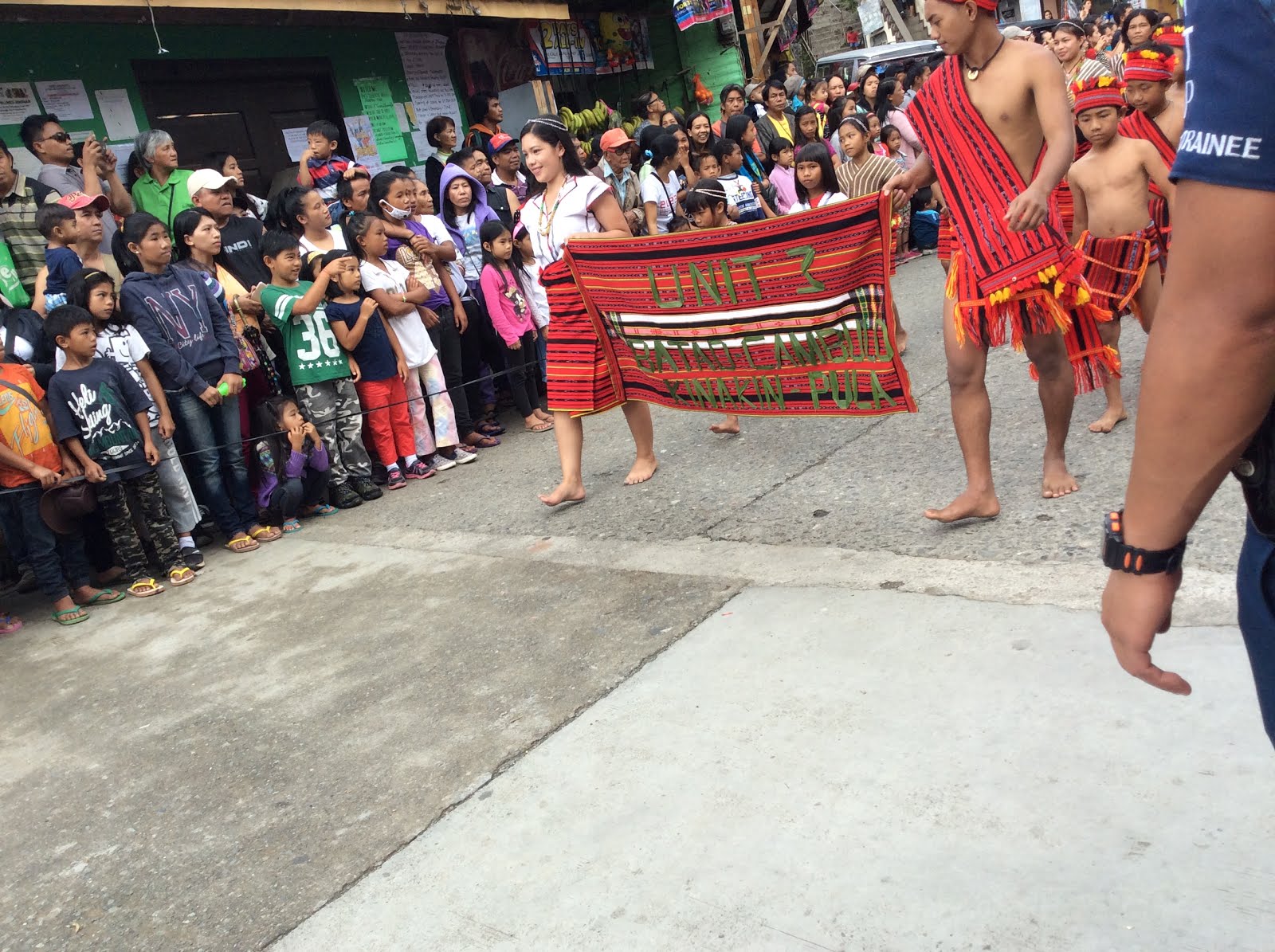
I  squeezed myself to the front of the crowd, massed three deep on each side and thus had a good view of the parade as it passed by. 


Participants came from the different barangays  in Ifugao province.  Grouped into clusters, they each showed off the richness of the Ifugao culture and heritage.


These ladies showed off the traditional produce from their farms -- aside from the rice stalks that one is holding, I saw onions or leeks in the basket perched atop the lady's head.  She carried the basket with such grace and panache -- and would have put any beauty pageant contestant to shame.


I did not know it before but the handwoven cloth that the Ifugao wear show their status in the tribe.
The red cloth with black stripes that you see on the left is  worn by ordinary folk while the cloth with the white stripes on the right signifies that the wearer belongs to a higher, wealthier class.


It was heartening to see young people participate in the festival, a sign that their culture is alive and well and will continue on to the next generations.


Imbayah is a happy occasion,  where everyone comes together and puts aside differences to celebrate and show off their kinship and solidarity.


It was entertaining to watch the different tribal dances, the staged "fights" and battles.  People whooped and hollered with every imaginary thrust and feint.  What great fun!


This last group carried a poor hog, slung on bamboo poles.  I knew it was about to be slaughtered right there,  for the traditional canao where animals are killed and roasted as a sacrificial offering. Canaos are typically held during festivals, weddings and funerals.
I did not want to witness this gruesome (to my mind) tradition so I quickly walked through the crowds -- however, I was not able to escape the piercing albeit short dying squeals of that poor pig.


I made my way through the crowd to the other end of the plaza where there were booths showing off the traditional art and crafts.   These young ladies were busy hard at work weaving materials needed for basket making.


The gorgeous vibrant woven cloth traditionally worn by everyone is worked on this simple loom.  
I could not resist and ended up buying a native blouse, you can see it hanging on the rack above.


The lady at the booth said that there are now efforts to continue to cultivate and plant the heirloom rice of the terraces.  These come in several varieties -- red or brown rice,  black rice and the tinawon rice with round, small grains.  


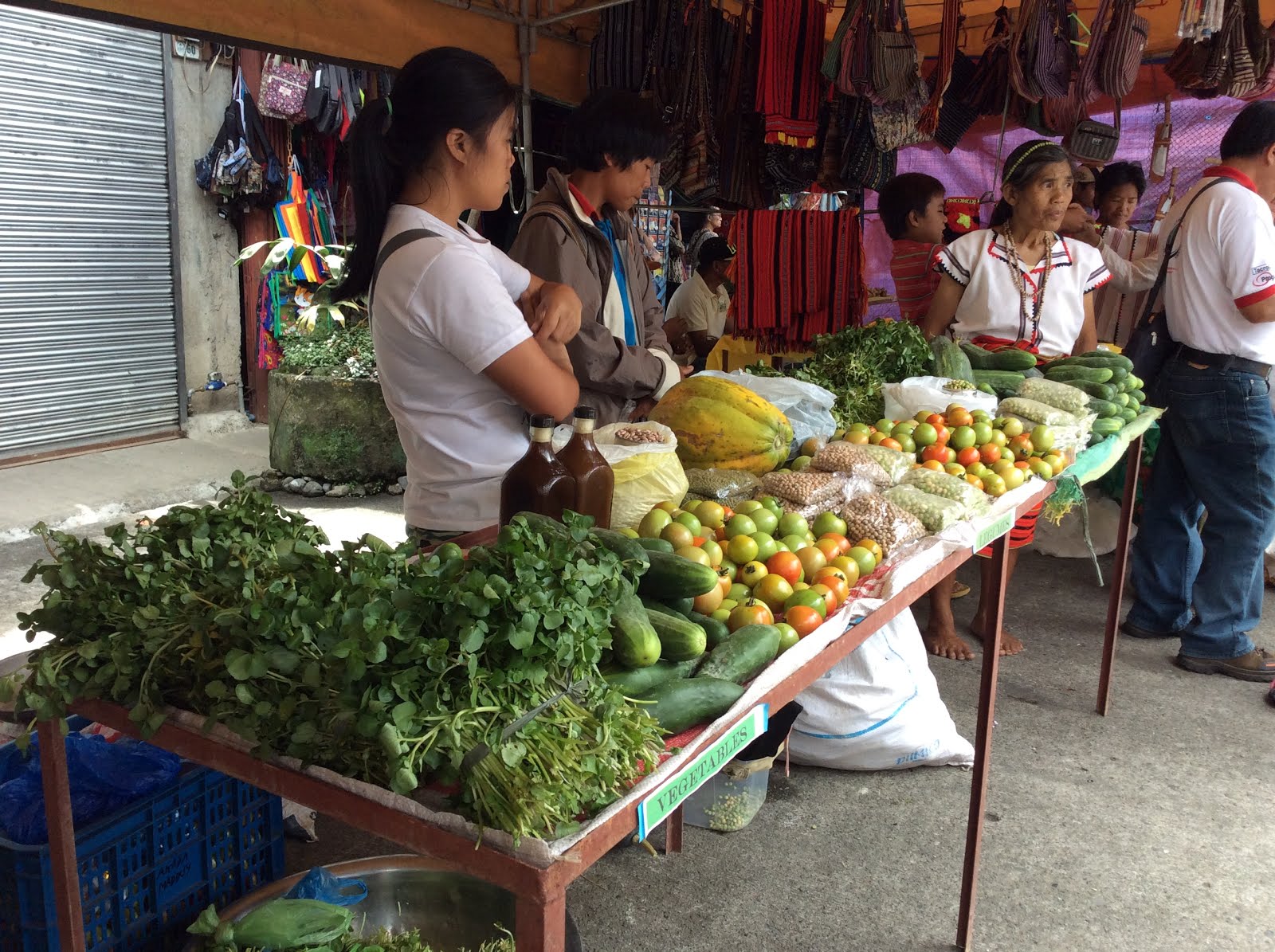
Rice is not the only crop grown in the mountains.  The farmers also brought their locally grown fruits and vegetables and even bottles of wild honey. 


These small fish are found in the terraces and I was told they are considered as a tasty, local delicacy.
These are called "japanese fish" because they were introduced to the terraces by a Japanese scientist.  They reminded me of "talimusak", a particular favorite of my father.  I suppose these would also be delicious cooked in vinegar as "paksiw".


The sounds of the canao had died down so it was time to walk back to the center and catch what was left of the opening ceremonies.  
I quietly followed behind this young Igorot father and his son -- I have high hopes that in a few years, the little boy too would be alongside his father, dressed in Ifugao finery, revelling in the proud legacy and heritage of these mountain provinces.
SaveSave

Friday, May 18, 2018

Banaue Bound Part 1 - Of Carinderia Hits and a ride on the Coda Bus


A journey of a thousand miles starts with a single step.  In our case, a journey of 350 kilometres started with a casual invitation ... "I'm going to the Imbayah Festival in Banaue next month, why don't you come?" I don't remember hesitating for even a split second before I said yes.
I had never been to Banaue and all of a sudden,  now seemed like the perfect time to go. 
So, thank you Harvey for popping the question!


We took the night bus to Banaue, a 9 hour long ride.  A trip that long needed sustenance.  
Good thing the area around the bus terminal in Cubao had lots of carinderias -- we were attracted 
to the bright red ceiling and wall of this nameless one.


Since it was nearly 10 p.m there was not much food left on the eskaparate (display case).  
Just a few pieces of fish, the local sausage longganiza and vegetables.  It would have to do.


Our  "light" dinner consisted of chopped string beans cooked in a spicy gata or coconut cream and 
paksiw na galunggong wrapped in banana leaf.  The fish was fresh and the vegetables were tasty.  
A perfect meal combination -- this plain carinderia with its honest, homespun cooking could give more expensive Filipino restaurants a run for their money!


While there are a number of bus lines plying the Manila - Banaue - Sagada route, we decided to take Coda Bus which advertised "super deluxe" buses that came with its own toilet.  The buses were new although I wasn't so keen on the lavender and dark purple colour scheme. 


You can buy bus tickets online and choose your seats as well.  Time for a quick selfie before the bus pulled out of the terminal -- just a few minutes past the designated departure time.


Coda keeps its buses clean and well maintained, I was quite impressed.  I wondered if the toilet would be a bit smelly as it would be in use throughout the trip but I need not have worried at all. 


I slept fitfully,  waking up every so often.  The bus drove straight for about 6 hours until it pulled in to a rest stop in Aritao, Nueva Vizcaya.  This is the Pink Pantry -- with a convenience store, a cafeteria and the most important thing for travellers (at least those who did not ride a Coda Bus),  relatively clean pay toilets. 


The buses stop for about 20 minutes -- giving the drivers a quick rest and a chance to sit and eat.  
We spent our time checking out the convenience store where we were tempted by an array of regional delicacies like silvanas from Nueva Ecija, pastillas de leche from Bulacan even otap from Cebu!  Now that travelled quite a long way.  


I had planned to stay awake till the bus pulled into Banaue but I must have fallen asleep again.  
When I woke up, it was way past sunrise and we were navigating the twists and turns of the mountain road.   In a few minutes, I would finally see Banaue!  The adventure was about to begin. 


Tuesday, May 8, 2018

Tokyo Tales Part 3 - A Haiku in the Park (Hotel)


According to an industry survey, Tokyo has about 100,000 hotel rooms. Thirty of the most interesting and unique ones are at The Park Hotel Tokyo, located in the quiet yet accessible business district of Shiodome.  It is also my favourite hotel -- a refuge in this huge, hectic mega-city.


What makes these rooms at the Park Hotel so special? They are called Artist Rooms,
each one designed and done by noted contemporary Japanese artists.  
The Artists Rooms used to be spread out in different floors but they are now all clustered on the
31st floor.
The project is not new and has been ongoing for several years now. It is a way for the hotel to bring art and hospitality together, creating unique and lovely spaces for its guests. 
On this last visit to Tokyo, I stayed at the Haiku Room by Rieko Fujinami. 


Each room is done in the featured artist's distinctive style and each artist chooses a theme to "play" with.  The theme of my room was "Haiku" with a poem by noted Japanese poet Basho written on a scroll on the wall.  In english, the haiku goes "The moon a sign / this way sir,  to enter / a traveller's inn".  Such an appropriate and elegant way to welcome the guest into the hotel. 


I had stayed in an Artist Room before (see previous post https://porkintheroad.blogspot.com/2015/04/sleeping-under-sakura-tree-park-hotels.html)  but on 
this trip had opted for my regular room with a view of Tokyo Tower.  Perhaps because I am a 
member of the hotel's loyalty programme and perhaps because I have stayed so many times in the past,  I was upgraded to this single room.  
While it was a bit on the smallish side and I hardly had a view but I could sleep surrounded by art --  on the walls and the even on the ceiling.  


To add texture to her work, the artist Fujinami san had attached irregular shaped discs which symbolised the Milky Way.  It shimmered throughout the length of the black painted ceiling.  
I lay in bed and let my thoughts meander among the stars. 


Lotus pads and the occasional blossom encircled the room, painted on the walls around the bed and cascading down to the floor.   On the large blank wall koi in different colours floated lazily in the lotus pond, not in still life but swimming serenely, brought to life via the wonders of a video shown on an LCD projector.    I did not have to hie myself off to a Japanese garden,  the lotus pond had been brought right into my room.  


The koi swam languidly.  Subtle sounds of water and soft music followed their gentle movements. 


I tried to capture the experience of almost being immersed in the lotus pond via this video.  A part of me wished that I could just stay in my room enjoying the solitude but I had places to go and people to see.  At some point, I had to turn off the projector and step out of the room.  But I knew this tranquility would be waiting for me ... later tonight.   
I would make sure that I would hurry back. 


P.S

I hope you indulge me (and a thousand apologies to the great Basho san for even daring to try)  
but I was encouraged to create my own haiku inspired by Fujinami san's lovely Artist Room at the 
Park Hotel. . . 

My mind drifts, wanders
Through koi noiselessly gliding
Weaving through my dreams. 


SaveSave

Tuesday, April 17, 2018

Tokyo Tales Part 2 - Lining up for Luke's Lobster in Shibuya


Unless it's for my favourite ramen or tonkatsu place, I hardly ever line up for food in Japan.
If the restaurant/izakaya/yatai/coffee shop or even the convenience store is full,  the food in
the next less crowded spot will assuredly be just as good.
It's almost impossible to eat badly in Japan.
However, on this last trip to Tokyo I was herded to a popular sandwich shop by my
friend's young daughters.  And so that's how I found myself standing in line at New York based
Luke's Lobster in Shibuya.


Luke's Lobster is a popular US franchise.   You can find one of its Tokyo branches in a side street 
off youth-crowded Omotesando.  The little shop is very popular among young Japanese who enjoy 
the authentic Maine lobster rolls.  


While the lobsters used in the sandwiches are flown in from Maine, Luke's Lobster also offers 
locally sourced crustaceans which cost much less than their US cousins.  The lobster roll is 
the star of the show but if you are lobster-averse (as one of my friends was)  you can order shrimp 
or crab rolls or even a combination of both. 


It's hot and sunny but the crowds continue to line up.  See the guy in the blue t-shirt -- he's Luke's Lobster's maitre d and keeps the line from spilling into the street.  Having someone run over by a passing car would certainly be bad for business.


That day there was a special --  three rolls of your choice for a lower price.  Left to right is the shrimp roll, the lobster roll and the crab roll.


I thought the lobster rolls were the best of Luke's offerings -- the store isn't called Luke's Lobster  
for nothing.  
The  lobster meat was soft and piled generously on a toasted warm well- buttered bun.  
It was mixed with a light tangy, citrusy mayonnaise dressing. 
One six inch roll was just perfect for a quick lunch before heading back into the Shibuya shopping swarm.  


Tokyo Tales Part 1 -- Ginza Lion reunion with my BFBDs (best friends beyond D....)


The best perks of my career were the work friends that I made.
Work friends usually start off as casual relationships among people thrown together by time
(at least 8 hours a day) and tension (budgets, requirements, client demands etc etc) but over time,
(or yes, on overtime usually) these relationships deepen and true and lasting friendships are forged. 
Aside from all the friends I made in the office, those that I  "struggled" with and laughed hysterically
with every day, I also made very good friends  within our regional network.
I saw these people regularly but not that frequently  yet we managed to form close alliances that
soon turned into strong bonds of friendship. We were confidantes, "co-conspirators", comrades in arms.
Our merry little band of four had not seen each other since I retired a couple of years ago so I was happy when our plans for a reunion  finally fell through.


We all converged in Tokyo some months ago.  Booked in different hotels, we agreed to meet up in our old happy hunting grounds, Ginza.  
Tokyo's premier shopping, eating and entertainment district is a short stroll away from our head office -- the bright lights were always an irresistible lure particularly after a long and tiring day of meetings and presentations.
For tonight's reunion, we headed to one of Tokyo's landmarks, the 100+ year old Ginza Lion Beer Hall.  
Sumimasen, in my excitement to meet my old friends I completely forgot to take a photo of the restaurant facade ... take my word for it, it's that lit yellow sign on the left side of the street. 


Ginza Lion opened in 1899 and is the grand daddy of beer halls in Japan.  You can see from this 
glass encased figure how its waiters used to look like -- spiffied up in western attire and carrying 
huge german style beer steins.  
As you enter the ground floor, you feel transported to a European beer garden.  Even the menu 
is western in orientation and would not look out of place at the Oktoberfest. 


Kanpai!  Thankfully the beer now comes in regular mugs and not in gigantic steins.


Don't look for typical izakaya fare in Ginza Lion.  We passed on the wide selection of charcuterie since two of my friends do not eat pork.  The beef stew was a good alternative.  The thick, slightly sweet sauce reminded me of japanese style curry.


We also ordered a  tender veal schnitzel, grilled tuna and tenderloin, medium rare.  
And yes, I'll have a  large fries with that please!


The food was incidental -- the company was the main thing.  Here is our little group of four.  
I call them my BFBDs ... best friends beyond Dentsu (where all of us met). 
We are the Asean bunch ... left to right, Malaysia, Singapore and Indonesia and the distaff side, 
the crazy Pinay from Manila.
Long may our fellowship continue to thrive!

P.S.


Through more than fifteen years, our friendship has extended to include  wives, husband (although Jay was not able to join this trip) and children.  
There is a worn out saying that says you can't choose your relatives but you can choose your friends. 
My  BFBDs are people I have chosen to think of as family.